/file/attachments/orphans/ED_543155_209242.jpg)












Erdogan is the real winner of Iran war
Turkish president cracks down on opposition while the world’s gaze is averted

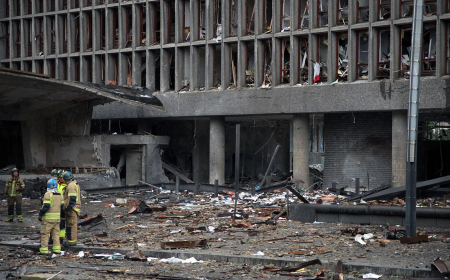
Rows of riot police forced their way through the gate at the headquarters of Turkey’s main opposition political party.
After knocking down the barrier, they marched, shields in hand, toward the party’s office, stopping at the entrance to shoot tear gas to clear supportersstacking barricades against the glass doors.
Inside was Özgür Özel, the leader of the Republican People’s Party – Cumhuriyet Halk Partisi in Turkish, also known as CHP – holed up in protest after being ousted by a Turkish court three days earlier.
Explosions rang through the air as the police trampled on opposition politics, snuffing out what many fear are the country’s last vestiges of civic and political freedoms.
Turkey is emerging as a long-term winner from the US-Israeli war against Iran, which has provided Recep Tayyip Erdoğan, the Turkish president, room to accelerate an anti-democratic backslide with no global repercussions.
Not only has he seized the moment to stage a crackdown on his opposition while the world’s gaze was averted, but he has also managed to boost Turkey’s standing on the global stage.
Gönül Tol, the founding director of the Washington-based Middle East Institute’s Turkey programme, said: “It’s the perfect international environment for Erdoğan to be doing all these things at home.
“All those geopolitical shocks are allowing and emboldening Erdoğan to do whatever he wants with whatever is left of the democratic space at home.”
At the same time, Mr Erdoğan is capitalising on a fractured global order – first, with Russia’s ongoing invasion of Ukraine since 2022; and now, with the emerging security and diplomatic vacuum as confidence wanes in the US under Donald Trump.
Ms Tol said: “This provides Erdoğan favourable circumstances where the world – European countries, Nato allies, regional neighbours, even African countries – feel they have [no choice but] to work with Erdoğan.”
Mr Erdoğan has led Turkey for nearly a quarter of a century, consolidating power at home, particularly in the periods immediately following political challenges – mass protests in 2013, and a military coup in 2016, both of which were halted by the authorities with deadly force.
More recently, major demonstrations erupted in March 2025 after Mr Erdoğan’s main political challenger, Ekrem İmamoğlu, the mayor of Istanbul, was arrested.
Nine days after the Iran war broke out, Mr İmamoğlu went on trial for what many criticise as spurious charges aimed at taking out the opposition, and not a peep of criticism has emerged from the West. Even Britain’s Labour Party, the sister party of Turkey’s CHP, has been muted.
Detailed in 4,000 pages of documents, those charges range from corruption to leading a criminal organisation, and could result in a combined sentence of more than 2,000 years. Mr İmamoğlu strongly denies the charges.
Still, despite periodic bursts of public discontent spilling over into the streets, Mr Erdoğan has generally enjoyed widespread popularity, riding the wave of a personality cult he built that rivals that of Mustafa Kemal Atatürk, the revered founder of modern Turkey.
However, economic woes in recent years – inflation has averaged roughly 50 per cent since the last presidential election in 2023, when Mr Erdoğan won by a hair’s breadth in a run-off – have begun to chip away at his base, thus prompting tighter controls.
He is also seeking to crack down on the opposition before the next presidential elections, expected in 2028, though he could call an early round of voting, but few believe their ballots will count for much.
Yusuf Can, an associate at Amena Strategies, a US-based consulting firm that specialises in the Middle East and North Africa, said: “Erdoğan’s government understands that they don’t have the popular support they used to have 10, 15 years ago.
“That’s why they are resorting to all these oppressive and authoritarian methods to basically destroy the CHP. If Erdoğan would win elections as he used to, with his economic policies or actual democratic, lawful policies, it’s unlikely they would resort to such dramatic measures as they’ve done in the last few years.”
The police are retroactively arresting people for alleged crimes from a decade or more ago.
On top of that, Mr Erdoğan is taking advantage of a security transformation in the Middle East, where many nations – after watching Iranian missiles rain down on their territory – are quietly pivoting away from Washington.
In May, Iraq inked a deal to buy 20 Turkish air defence systems, marking a big change for the country, which has long relied on the US to protect its skies – a promise that failed in the current war.
Iraq has been uniquely exposed, targeted by both sides of the war for hosting Western military staff and Iran-backed regional militias on its soil.
In Indonesia, concerns over an aggressive China have mounted after the US diverted military resources from the Indo-Pacific region to the Middle East. That has pushed the south-east Asian nation to sign a deal, also this month, to become the inaugural foreign buyer of up to 60 unmanned combat aircraft – the Bayraktar Kızılelma – from Turkey, with delivery starting in 2028.
This is in addition to an existing deal to furnish Portugal with two military support ships, the first such Turkish export to a Nato and EU member state.
Under Mr Erdoğan, Turkey – which boasts Nato’s second-largest military after the US – has become the world’s 11th largest arms exporter, particularly of drones, which have been shipped to numerous countries, from Ukraine to Libya.
Turkey’s military kit has been battle-tested, and allows Mr Erdoğan to say “you can rely on me”, noted Ms Tol. “That resonates well amongst Middle Eastern countries; that’s why he’s signing all these defence partnerships left and right.”
It comes full circle in that these defence tie-ups boost Mr Erdoğan’s “domestic standing and generate legitimacy at a time when his legitimacy is questioned by more and more people”, according to Ms Tol. “It also generates financial resources, and that’s significant, given the state of the Turkish economy.”
Mr Erdoğan is also keen to turn Turkey into a major energy trade hub – the global connector mining critical minerals, laying new pipelines, and linking up maritime ports, all routed through Turkish territory.
The president said last week following the removal of Mr Özel: “Turkey’s aim is not to remain a spectator, but to be a game changer in this competition.”
Experts say that achieving this means neutralising political opposition, but also anyone who might oppose his policies.
Ankara is going so far as to appeal to the public, especially the expatriate crowd looking to relocate out of the Gulf, offering a 20-year tax holiday for foreigners moving to Turkey. And it may be a good sell, as Turkey remains protected by the Nato umbrella.
Growing global reach for Turkey has allowed Mr Erdoğan to burnish his credentials at home, providing cover for his autocratic turn.
In January, Turkey was Nato’s most exposed nation as a neighbour of Iran, desperately trying to stay out of the war, even as Iranian missiles buzzed through its airspace, thought to be targeting the joint US-Turkish base on the Mediterranean coast.
But come early July, when Mr Erdoğan hosts a major summit of the security alliance, he will be speaking from a position of strength, and with leverage over many nations that he did not enjoy before the Iran war broke out.
Ms Tol added: “There was a time when Nato was framed as a defence organisation for the democratic world; one cannot really say that any more.
“These countries – Western countries, Nato allies – will be paying less and less attention to democratic erosion and autocratic consolidation in countries like Turkey and focus on the technical stuff – can they produce drones, do they have a good manufacturing base?”
But experts say that would be a mistake.
She said: “When you work with autocrats, on the top of their mind is always regime survival. If the regime is at risk, then they’re not bound by international treaties; they won’t be loyal to you. That’s what makes them unstable allies.”
[Source: Daily Telegraph]