








/file/attachments/orphans/iStock-802203090_325419.jpg)












The greasy pole: politics and democracy
Michael EJ Phillips

It has been a busy week in British politics. Various by-elections have taken place, and news has broken that Nigel Farage is to contest the very seat he held until yesterday – his only main opponent being ‘Count Binface’.
This article will cover the essence of how Benjamin Disraeli’s assertion ‘I have climbed to the top of the greasy pole’ on becoming Prime Minister relates to such events.
A greasy pole is essentially just that, a tall pole that has been made slippery through being coated with grease or other lubricants. In various countries around the world, competitions are held for those who can climb to the top with prizes awarded for those who are successful. Disraeli - the first and only Jewish prime minister of the UK – had the odds stacked against him due to his background. Reaching the top was something he never expected, hence his use of the metaphor.
It is also very true that once having attained [high] office, one may quite easily suffer a fall from grace or loss of that position either as a consequence of one’s own actions or at the simple whim of the electorate. Examples below are now given to illustrate how true that adage holds.
Dr Mahathir bin Mohamad, born in Alor Setar 101 years ago tomorrow and still very much active, was the 4th and 7thPrime Minister of Malaysia. He held office from 1981 to 2003 and again from 2020 to 2022, though had also held ministerial roles, some concurrent, from 1974 onwards. He was the first prime minister not born into the aristocracy or a prominent religious or political family. He studied hard and qualified as a doctor; his entry into politics was during the wave of Malay nationalism following World War II and the defeat of the barbaric Japanese occupiers. He is widely recognised as the architect of modern Malaysia.
He typically never received below 60% of the vote since he was first elected in 1964 for Kota Setar Selatan. Leaving UMNO (he had been a member since 1946), he founded BERSATU; in 2018 he stood in Langkawi and was elected again as prime minister thus pretty much putting his old party UMNO out to pasture: they had been in power for 60 years. Quite a remarkable achievement! And yet, standing for PEJUANG (formed following the exit of BERSATU from the Pakatan Harapan coalition) in 2022, he crashed and burned, receiving only 9.62% of the vote to BERSATU. His defenestration complete, he slid back down the pole again.
Two far less distinguished examples are given in the cases of Mark Oaten, the Liberal Democrat member for Winchester (1997-2010). He first won with a majority of 2, the result then being declared invalid. He thus stood again, gaining a thumping majority with 68% of the vote. What may have been a reasonably successful political career followed, with a position on the front bench, yet ended after a 2006 scandal in his personal life which led to him not seeking re-election in 2010. In 2023, he attempted to stand as a councillor on South Gloucestershire, but was soundly defeated.
The second is of Ross Thomson, the former Scottish Conservative MP. Having initially – like Mark Oaten – shown such early promise, he was elected to Aberdeen City Council aged 25 in 2012, followed by which he was an MSP for North East Scotland (2016-17) and MP for Aberdeen South (2017-19), when he too had to step down due to a scandal – not the first and not the last. One of which was when young Ross was accused of trivialising the dictatorship of Saddam Hussein by posing for photos at Hussein's military parade ground. He defected to Reform UK in June 2025, but having been blocked from standing for that party in the Peterhead South and Cruden Bay by-election last Thursday, he stood as an independent. Failing miserably, he received only 6.46% of the first preference votes. There are thus many parallels between him and Mr Oaten.
The final example, in the headlines as we speak, is that of Nigel Farage. Undeniably a very successful politician, not least for having taken the UK out of the European Union and whose life work from the age of 28 has been to destroy the Conservative Party. He left them in 1992 in protest at Prime Minister John Major's government's signing of the Treaty on European Union at Maastricht. Some may say that Reform has become the second party across the UK, pushing the Tories into third, though given the way the electoral system is set up mainly as first-past-the post, Labour gained 411 seats on only a 33.7% share of the vote (the lowest ever for a governing party on record, which makes it the least proportional election in British history), while Reform gained only 5 seats on a 14.3% share of the vote.
Large question marks over his personal and party funding have followed him around for years, including most recently an undeclared £5 million donation from a cryptocurrency magnate which he claims was an ‘unconditional gift’. He thus resigned his Clacton seat yesterday to pre-empt parliamentary investigations into his finances. This means that the investigation is on hold. Should he be successfully re-elected, the train will be set in motion again, and should it result in a suspension of more than 10 days, it could trigger a recall petition and thus a further by-election at which the other main parties would field candidates.
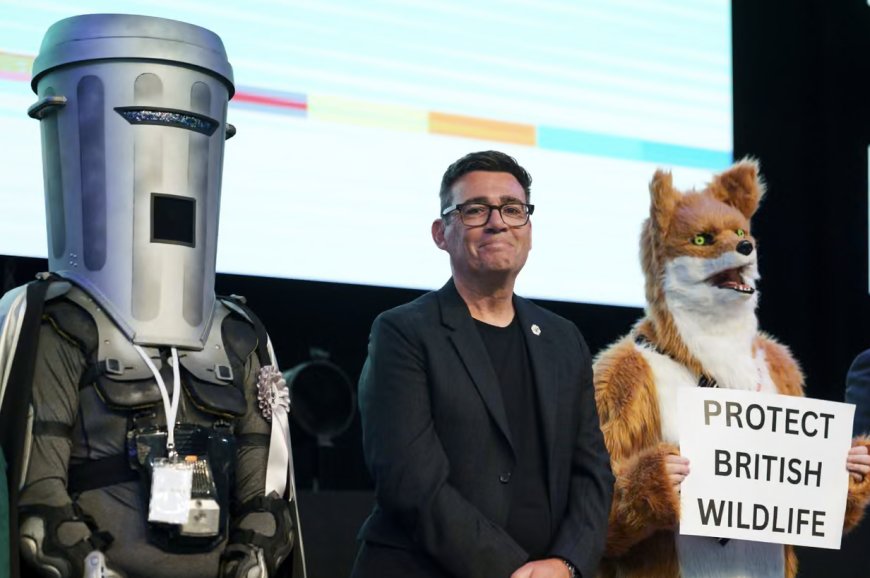
While clearly unfair on the good people of Clacton [the exact same may be said of Mayor Burnham, ostensibly the next UK prime minister, who having never held a job in the real world before politics, cynically used the people of Makerfield to parachute himself in – and put Manchester through a new mayoral election] what makes it amusing in a way is that it illustrates a very British characteristic: the ability not to take things too seriously. Mr Farage’s main opponent is Count Binface (real name Jonathan David Harvey), a joke candidate who has stood in various elections since 2017 against Mrs May (as Lord Buckethead), Boris Johnson, in the London mayoral elections and others, latterly against Andy Burnham last month.
In no other country would such a thing happen, and how refreshing it is. Could, therefore, Mr Farage lose to a man dressed as a rubbish-bin, and thus slide back down the greasy pole of his own making? We indeed live in interesting times.
Binface next to Labour’s Andy Burnham and a Protect British Wildlife candidate at the count for last month’s Makerfield byelection. Photograph: Jon Super/AP
Views expressed are the writer's own.