






















Larry the cat (c. 2007- )
Michael EJ Phillips

Only in England!
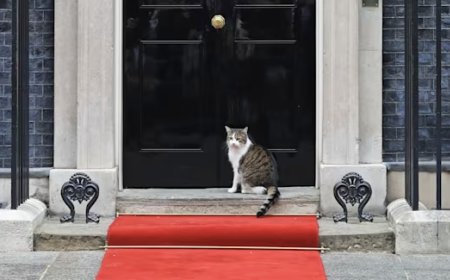
Larry awaiting the arrival of President Donald Trump and Melania, during the 2019 State Visit - PA.
Larry, born c. 2007, is the current Chief Mouser to the Cabinet Office, in post since 2011. He has lived at 10 Downing Street through six prime ministers: David Cameron, Mrs May, Boris Johnson, Liz Truss, Rishi Sunak and Sir Keir Starmer. He is the first cat to be given the official title of "Chief Mouser".
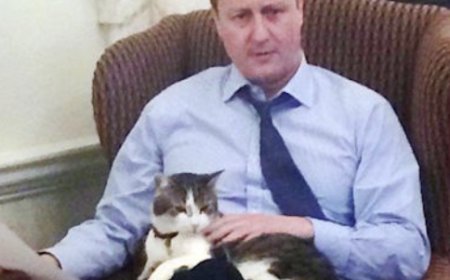
David Cameron enjoying Larry's company - ITVX
In 2013, reports claimed that David Cameron objected to having cat hair on his suit, and that the smell of cat food had to be masked with air-freshener whenever visitors came to Downing Street. There were suggestions that he did not like Larry, so Cameron posted on Twitter (now X) that he and Larry got on “purr-fectly well”.
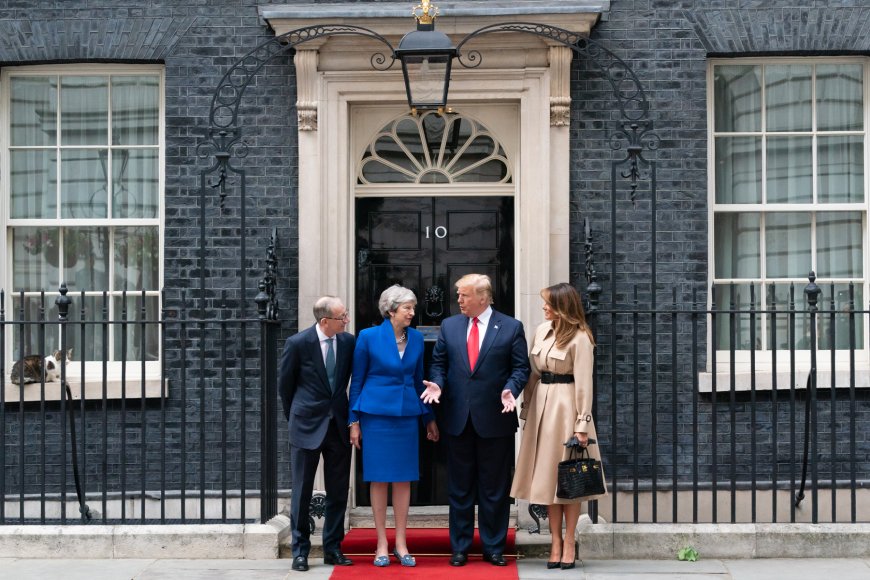
Larry with President Trump, Mrs May and their spouses at the State Visit in 2019.
What follows is a potted history on the cats of Number 10 in modern times. There is evidence of a cat in residence in the English government dating back to the reign of Henry VIII. Official records however only date back to 3 June 1929, when A.E. Banham at the Treasury authorised the Office Keeper "to spend 1d a day from petty cash towards the maintenance of an efficient cat". Such cats have over time patrolled offices, comforted prime ministers, and captured the public imagination, blurring the line between “office cats” and “official cats.”
In 1907, Tatler drew an important distinction in the feline life of Whitehall. It described the ordinary “office cat” as living by charity, unofficial and unfunded, while the “official cat” was a recognised part of the institution, with a fixed allowance for food and care. This informal arrangement evolved over time into the more defined post of “chief mouser”, a title dating to at least 1924, when a marmalade cat called Rufus (after the king) took on the role. Even then, the distinction between official and unofficial cats persisted, with some felines funded by departmental budgets and others relying on the generosity of civil servants.
As the Second World War approached, cats also took on symbolic weight. Bob, a black cat who roamed Downing Street, was seen as a harbinger of good fortune in anxious times. He appeared during the signing of the Munich Agreement in 1938 and again days before war was declared in 1939. Newspapers celebrated him as a comforting presence amid diplomatic crises, describing him strolling up Downing Street and cheered by onlookers, before darting away from photographers. By the time he died in 1943, Bob had become one of the most photographed cats in the world.
The effort to formalise feline duties is well illustrated by Peter, a cat who lived in the Home Office from 1929 to 1946. He was initially supported by voluntary contributions from staff, as was normal for Whitehall cats. Peter proved so indulged by treats that his mouse-catching skills suffered. To restore his work ethic, the Home Office applied to the Treasury for a regular food allowance to curb his overfeeding, as mentioned in the introduction.
Peter’s popularity was such that when part of the Home Office relocated to Bournemouth during the war, staff there requested an allowance to maintain two cats of their own. Peter himself lived to the venerable age of seventeen before being put to sleep in 1946. His designated replacement, Peter II, a two‑month‑old kitten, met a tragic end when he was run over on Whitehall in 1947.
No British leader is more closely linked with cats than Winston Churchill. As Prime Minister during the Second World War, he saw cats not only as practical mousers but as emotional anchors in a time of crisis.
One such companion was Tango, a cat who shared lunches with Churchill and his private secretary John “Jock” Colville in 1941, when the war in Europe was at a low ebb. Colville later recalled Churchill chatting to Tango, wiping his eyes with a napkin and apologising that there could be no cream in wartime, all while offering him mutton. Tango died roughly a year later, around the time of the fall of Tobruk. Aware of Churchill’s attachment to the cat, Colville and others delayed breaking the news until military fortunes improved.
Churchill’s most famous feline ally, however, was a large grey cat named Nelson. Churchill admired Nelson’s courage, recalling how he once saw the cat chase a huge dog out of the Admiralty. Impressed, he adopted him and gave him the name of Britain’s most celebrated naval hero. Nelson quickly asserted himself at Downing Street, driving out Neville Chamberlain’s cat, nicknamed the “Munich Mouser” after Chamberlain’s ill‑fated promise of “peace in our time”.
Nelson became an almost constant presence at Churchill’s side, even serving as his “hot water bottle” in bed. Despite wartime rationing, he enjoyed luxury foods such as pheasant, cream, and smoked salmon. He was included in evacuation plans should Downing Street be bombed, though Churchill himself refused to leave London during the Blitz. On one occasion, Nelson hid in a drawer during an air raid, prompting Churchill to scold him for cowardice unbecoming of a cat with such a martial name. As the bombing intensified, Nelson was eventually sent for safety to Chequers, the Prime Minister’s country residence.
Nelson’s successor at Downing Street, a dark Persian named Smoky, was a calmer presence amid the chaos of the Blitz. Smoky had lived in the Cabinet Office before being allowed into Churchill’s private quarters, where he, like Nelson, slept on the bed. During a tense conversation with the head of MI6, Sir Stewart Menzies, about a major Cabinet leak, Smoky strolled onto the windowsill. Churchill, never missing a chance for humour, quipped that the cat was signalling with his tail to the pelicans in the park.
By the late 20th century, Downing Street cats remained both working mousers and minor celebrities. Humphrey, who served through the Thatcher and Major governments, became particularly famous. By 1997 he was elderly and unwell, suffering from kidney problems and a waning appetite.
Humphrey left Downing Street on 13 November 1997 to live in retirement with an older couple in the suburbs. Rumours and speculation about his fate quickly swirled, prompting a media frenzy. Eleven days later, journalists were taken to a secret location, apparently his new home, to see that he was alive, thriving, and putting on weight. Photographs of a relaxed Humphrey appeared in the press the next day. He lived to 18.
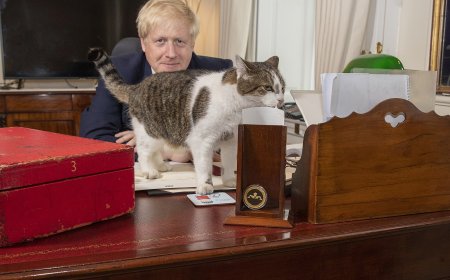
Larry the cat with Boris Johnson, at his desk - Wikipedia.
With the recent resignation of Sir Keir Starmer, will Larry outlast his successor (in all likelihood Andy Burnham)? One very much hopes so.