













/file/attachments/orphans/iStock-802203090_325419.jpg)













'Plus ça change' - the 14 July Revolution
Michael EJ Phillips / Lecturer in the Department of French, Salahaddin University
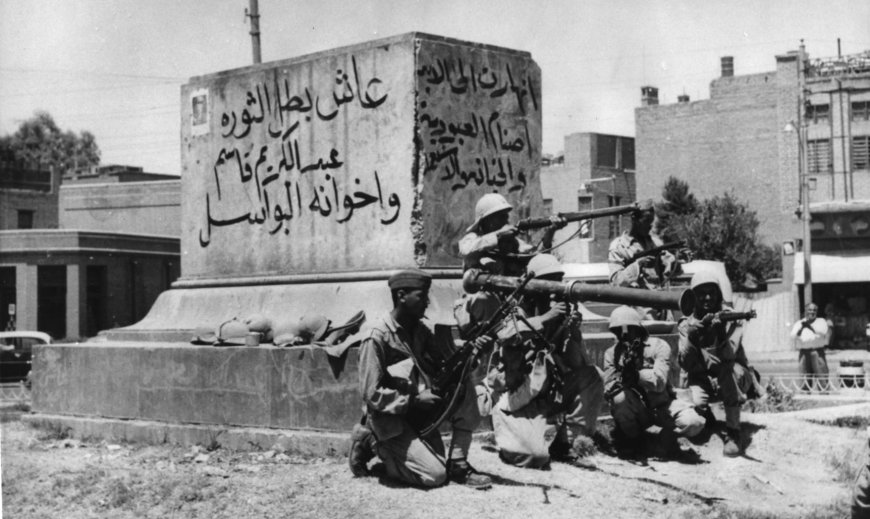
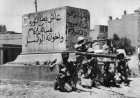
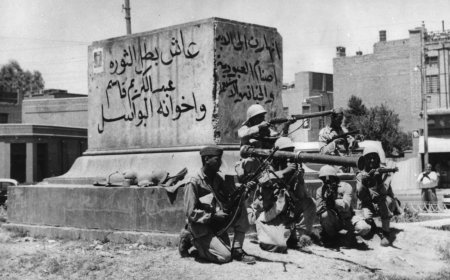
Today marks the 68th anniversary of the 14 July Revolution (also known as the 1958 Iraqi military coup). A group of young officers overthrew the British-supported Faisal II thus ending the nascent Hashemite Arab Federation of Iraq and Jordan. The two leading figures in the coup were Abdul Karim Qasim and Abdul Salam Arif, activists in an underground network of 'Free Officers'.
In the early hours of that day, men under Abdul Salam Arif’s command set off to seize the royal palace with only two or three rounds of ammunition each. Even the army had been kept deliberately short of ammunition in order to paralyse would-be mutineers.
A few hours later, millions of Iraqis awoke to a special radio broadcast, with Abdul Salam Arif announcing the overthrow of Iraq’s Hashemite dynasty and the birth of a new 'people’s republic'. They knew they were taking a desperate gamble. Iraq’s rulers had honed their skills in repressing popular protest over many decades. Their well‑trained police force had crushed waves of demonstrations in 1948, 1952 and 1956.
Opposition parties, even those led by social democrats and moderate nationalists, had been forced underground, while many Communist Party members had been imprisoned.
Although formal British control of Iraq had ended with its independence in 1932, the interests of the ruling Hashemites were tightly aligned with those of the United Kingdom. British managers ran Iraq’s oilfields, and British aircraft were stationed at the country’s airbases. The young King Faisal was himself a product of the British public school system, having attended Sandroyd and then Harrow.
Iraq was also the centrepiece of the Baghdad Pact, an anti-Soviet alliance of Middle Eastern states designed both to defend Western interests and to curb the rising influence of Gamal Abdel Nasser, Egypt’s radical nationalist leader.
Following the assault on the palace, the king, his regent and other members of the royal family were shot. Nuri al-Said, the pro-British prime minister and architect of the Baghdad Pact, was executed the following day.
From the British perspective, the Iraqi revolution marked the end of an era. Iraq, formerly a British mandate, had effectively become part of Britain’s informal empire in the Middle East after its formal independence in 1932. The Hashemite monarchy, installed by Britain in 1921, underpinned a very close Anglo-Iraqi alliance. On 24 February 1955, both countries had joined the Baghdad Pact (formally, the Central Treaty Organisation formed on 24 February 1955 comprising Iran, Iraq, Pakistan, Turkey, and the United Kingdom). This was a regional defence organisation that formed the cornerstone of Britain’s military strategy in the Middle East. A special agreement between Iraq and the UK granted the Royal Air Force overflying and staging rights in Iraq. However, in March 1959 Iraq withdrew from the Baghdad Pact and terminated this special agreement with Britain.
The 1958 revolution was not only a turning point in relations between Britain and Iraq but also a major shift in British policy towards the Middle East as a whole. This was largely due to the impact that events in Iraq had on British perceptions of Arab nationalism. The idea of solidarity among all Arabic-speaking states, with the ultimate goal of their unification, had steadily gained traction since the early 20th century, increasing in momentum by the end of the Second World War. Because of the Arab nationalist movement’s anti-imperialist ethos, its growing popularity posed a serious threat to the survival of Britain’s informal empire in the region. Throughout the 1950s and 1960s, the confrontation with Arab nationalism represented the single most important element of continuity in British policy in the Middle East. This Iraqi revolution was a watershed in such a concept, as it prompted the United Kingdom to adopt a more nuanced understanding of, and a new policy towards, the Arab nationalist movement.
The British government had until 1958 regarded Gamal Abdel Nasser, president of Egypt since 1952, not only as the leader but as the very embodiment of Arab nationalist thought. The terms ‘Nasserism’ and ‘Arab nationalism’ were frequently used interchangeably in British government papers to describe a policy aimed at driving Britain out of the Middle East. Prime Minister Harold Macmillan was convinced that Nasser’s ultimate objective was to create an anti-British ‘Arab Empire’ in the region. In the months preceding the Iraqi revolution, several developments in the Middle East appeared to confirm Macmillan’s suspicions. On 1 February 1958, Egypt and Syria united to form the United Arab Republic, while in Lebanon strikes and demonstrations began to destabilise the government of the pro-Western president.
One wonders therefore if the Arab Spring movement, ostensibly still continuing with the recent fall of Bashar al-Assad in Syria, the end of the Libyan civil war, ongoing conflict in Yemen, the rise and fall of ISIS, and so on (and definitely rumbling on, particularly in Tunisia under President Kais Saied where the pressure is rising on opposition figures, journalists and civil society) could have been foretold by these words written on 8 January 1959 in the wake of those events described above: Although Arab unity as an effective political concept, denoting the constitutional amalgamation of the Arab world, is a myth, Arab solidarity as a political force is a powerful reality - perhaps the dominating force in the Middle East today.1
« Plus ça change ? »2
[1] ‘Middle East Policy’. Memorandum by the Middle East Official Committee, O.M.E. (59),
[2] att. Jean-Baptiste Alphonse Karr, 1849