























38th anniversary of the Piper Alpha disaster
Michael EJ Phillips
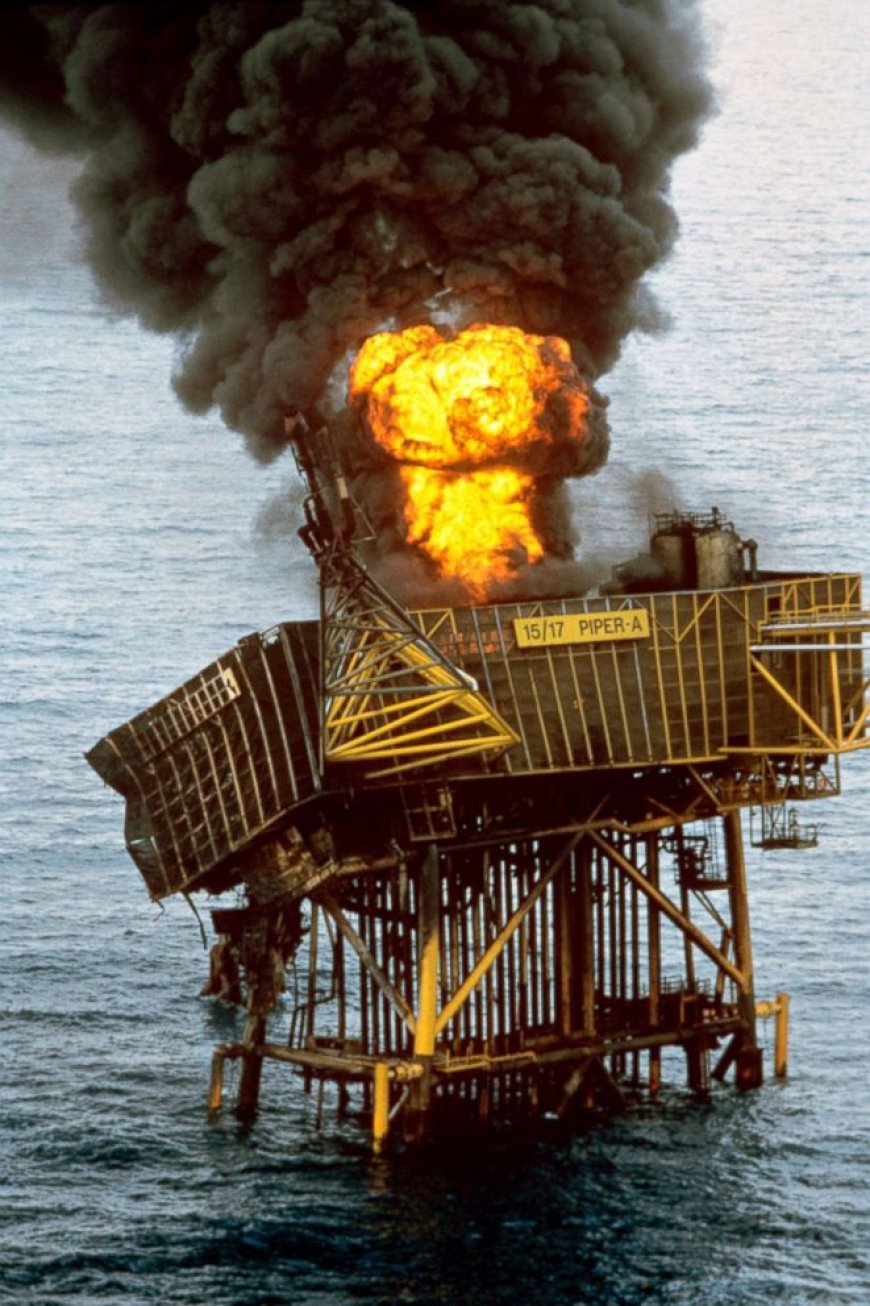
The Piper Alpha incident was the world’s worst offshore oil industry disaster, taking place in the North Sea off Aberdeen. 165 men (out of 226) died on board the platform, alongside two men on a rescue vessel. Dozens of others were badly injured. Thirty bodies were never recovered. It took more than three weeks to extinguish the fire, and the remains of Piper Alpha were scuttled on 28 March 1989.
Originally an oil-only platform which came online in 1976, Piper Alpha was modified in 1978 to produce gas and had four safety modules separated by firewalls. It received gas from two platforms (Tartan and Claymore) via two risers that led into the processing area. It processed the imported gas, as well as the oil products it drilled itself, then piping these final products to shore. It was therefore handling large amounts of high-pressure gas. In July 1988 the platform was producing 10% of the North Sea’s annual production.
For safety reasons, the modules were organised so that the most dangerous platform operations took place far from staff areas. However, the conversion from oil to gas violated this safety concept, resulting in the bringing together of sensitive areas. The gas compression module was now next to the control room. The close position of these two areas played a significant role in the accident.
Two pumps on Piper Alpha compressed gas for onward transmission, but on 6 July Pump A’s safety valve was removed for maintenance and the open pipe sealed with a metal plug. At 21:45, Pump B, a condensate injection pump, failed. Supply had to be maintained, and control room staff failed to find the written notification that Pump A was out of commission. They started Pump A at 21:55, immediately initiating a major leak through the temporary plug.
The gas ignited at about 22:00 causing an explosion that demolished safety walls built to withstand fire only. The control room was abandoned, with things spiralling out of control. The Tharos rescue and firefighting vessel came close by, but a second explosion rocked the platform at 22:20, intensifying the blaze and driving her away. Another rescue craft was destroyed by the second explosion, killing two crew and the six men they had just pulled from the sea.
The remaining men on the platform were either sheltering in the accommodation block or jumping into the sea.
The accommodation module was not smoke-proofed, and the lack of training that caused people to repeatedly open and shut doors only worsened the problem. Conditions got so bad in the accommodation module that some people realised the only way to survive would be to escape the station. They, however, found that all routes to lifeboats were blocked by smoke and flames, and in the absence of any other instructions, they made the jump into the sea hoping to be rescued by boat. Sixty-two men were saved in this fashion; most of those who died suffocated on carbon monoxide and fumes in the accommodation module.
At 23:50 most of the platform collapsed into the sea, with rest soon following. 00:45, all that remained were the skeletal remains of one module, its top still burning.
According to the 1990 Cullen Inquiry, several shortcomings allowed the disaster to develop, each contributing to the escalation and adding to the losses.
Safety and related administrative procedures were not followed properly. The requirement for a safety management system to be in place was introduced by legislation in the wake of Piper Alpha. Elements of process safety management that failed on Piper Alpha included the Permit-to-work system, particularly the permit handover mechanism. The whole accident chain of events commenced when an attempt was made to start up a pump that was actually under maintenance.
While there were firewalls, these were not built to withstand an explosion. The initial blast blew these down, and the subsequent fire spread unimpeded.
The fire suppression system was designed to automatically activate in the event of a fire and spray water on it to suppress it. The platform manager had ordered that the automatic start feature be turned off to protect divers in the water near the intake for the system (a fairly common practice among similarly designed platforms). Since divers were in the water up to half the time during the summer months, this meant that the automatic deluge was off for all that time also, including when the disaster happened. Since there was no control for just that purpose, it was probably done at the circuit breaker.
The workers on the platform were not adequately trained in emergency procedures, and management was not trained to make up the gap and provide good leadership during a crisis situation. Evacuation drills were not done as frequently as the official schedule of once a week, and a full drill had not happened in over three years.
There was also inadequate training in inter-platform communication. When the other platforms realized that there was a problem on Piper Alpha, they did not shut off the flow of gas that they were pumping onto it for over an hour, effectively tripling the available fuel supply. While training guidelines existed, they were not properly followed. Safety audits often did not identify the problems that existed. When a major problem was found, it was sometimes ignored.
The events of 6 July 1988 and their aftermath are a reminder that health and safety are important concepts that should not simply be dismissed out of hand, even in shops or offices. Britain, which led the Industrial Revolution, also led the way in developing health and safety legislation, yet there is still a long way to go in much of the world in terms of such a culture. Life is precious.