





















Jacaranda by Gaël Faye review – the limits of forgiveness after Rwanda
This bold family saga explores a search for healing and truth in the aftermath of the Rwanda genocide

ow to forgive the unforgivable? How to live in the aftermath of atrocity? Following 2016’s Small Country, French-Rwandan rapper and writer Gaël Faye takes on huge questions in his second novel, Jacaranda, which explores the seismic events of the Rwanda genocide and the aftershocks that continue to ripple through the generations.
Structurally bold, the story opens in summer 1994 with Milan, Faye’s then 12-year-old protagonist, enjoying an extended break from school. Milan’s father is white French and the family’s life in Versailles is the embodiment of first world ease – their holiday that year, as usual, spent sailing at the Île de Ré. Milan’s mother, though, is Rwandan. Venancia arrived in the 1970s, establishing a life for herself, a successful clothing boutique, a family. However, she cannot share the French ease, much less her thoughts on the disturbing reports from Rwanda now making the evening news.
Indeed, taciturn Venancia has never shared the reasons she left for Europe, and Milan only learns he has extended Rwandan family when his “cousin” Claude arrives at the end of the holidays, out of the blue, and terribly injured by a machete. Small and so traumatised he can barely speak, Claude has been brought to France for treatment. While Venancia takes him in under obligation, young Milan quickly takes him to heart, and the boys’ developing bond over the autumn is tenderly described. But once his wounds are improving, Claude returns as abruptly as he arrived, and with just as little explanation, and the hole he leaves in Milan’s life refuses to heal.
In part two we jump to 1998. Milan is 16, his parents’ marriage is faltering, and so are his studies, and he travels to Rwanda for the first time. In Kigali, Milan finds an alternative mother figure in Eusébie, a childhood friend of Venancia’s. A fellow Tutsi, and a survivor of the 1994 genocide, she is now a campaigner for justice and healing. The jacaranda of the title grows in her garden, providing shade for her elderly mother Rosalie and her newborn daughter Stella, the sibling Milan has been craving. When he holds the child, she smiles her first smile.
Much to his joy, Milan also finds Claude again, and through him meets the pivotal character Sartre, who lives in Le Palais, a ramshackle compound far from Eusébie’s leafy neighbourhood. Here, at the height of the violence, he gave shelter to dozens of Tutsi children, orphans of the genocide, becoming a Fagin of sorts. A scavenger of considerable discernment, Sartre has established an extensive library of books and music; Milan learns much about Rwanda under his tutelage, and from the many now almost-adult orphans – not least that, here, he is considered white. He finds a home from home among them regardless. Having stared death in the face, the young residents of Le Palais spend their days grafting and their nights partying, and Milan is inspired by their defiance.
His grandmother is less welcoming. Milan finds Mamie much like Venancia: withheld and withholding. But he does begin to see that the 1994 violence had long and tangled roots, as does the Hutu-Tutsi divide; Claude was not the first in their family to suffer, but exactly why and how they fled remains shrouded.
Milan will return to Rwanda many more times, and for longer and longer periods. Adrift, he will seek out Sartre, and the oblivion of partying in Le Palais; in search of shelter, he will turn to Eusébie and the now grown Stella; under the shade of the jacaranda, he will discover that she seeks answers too.
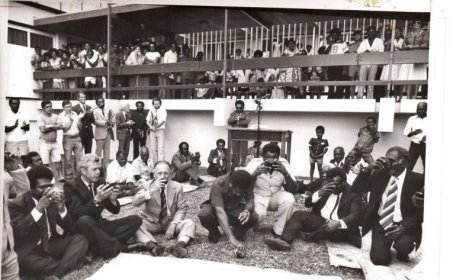
The book’s most painful chapters describe the gacaca courts, which ran until 2012: mass open-air hearings, gathering testimonies from across the victim-perpetrator divide; public confessions and accusations that campaigners like Eusébie hoped would provide truth and reconciliation.
But some truths are hard to take – perhaps impossible – and in some revelations, Milan sees forgiveness reach its limits. Venancia will not be the only one to have withheld her story, and neither will Claude have been alone in masquerading as someone he’s not. Who can Milan trust after all that he’s heard? Where can he find peace when even the shade of the jacaranda will not provide refuge?
In Milan and his family, in Claude, Stella, Sartre and Eusébie, Faye gives face and voice to the human capacity for endurance. Perhaps above all, he sees the harm in the divides we make between victim and perpetrator, Tutsi and Hutu, parent and child, black and white, Europe and Africa. Jacaranda is a bold and uncompromising book.









/file/attachments/orphans/ED_543155_209242.jpg)