





/file/attachments/orphans/ED_543155_209242.jpg)



























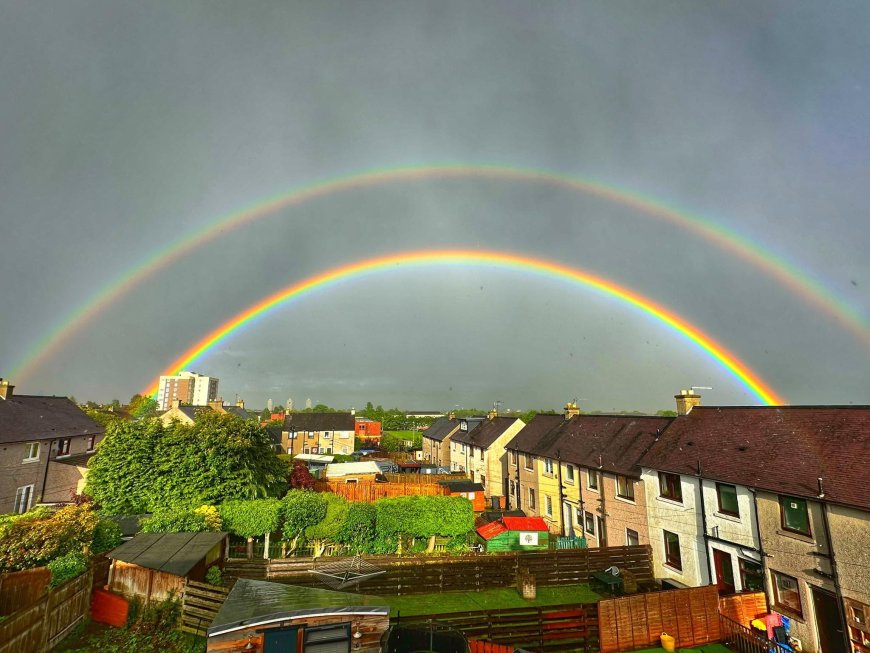
Double rainbow
This was taken on 8 June 2026 in Aberdeen. An explanation of the phenomenon is below.
A rainbow is an optical phenomenon caused by refraction, internal reflection and dispersion of light in water droplets resulting in a continuous spectrum of light appearing in the sky. The rainbow takes the form of a multicoloured circular arc. Rainbows caused by sunlight always appear in the section of sky directly opposite the sun. Rainbows can be caused by many forms of airborne water. These include not only rain, but also mist, spray, and airborne dew.
Rainbows can be full circles. However, the observer typically sees only an arc formed by illuminated droplets above the ground, and centred on a line from the Sun to the observer's eye.
In a primary rainbow, the arc shows red on the outer part and violet on the inner side. This rainbow is caused by light being refracted when entering a droplet of water, then reflected inside on the back of the droplet and refracted again when leaving it.
In a double rainbow, a second arc is seen about 10° outside the primary arc. Its colours are perceived to be in reverse order, with red on the lower side of the arc. The term double rainbow is used when both the primary and secondary rainbows are visible. In theory, all rainbows are double rainbows, but since the secondary bow is always fainter than the primary, it may be too weak to spot in practice.
Secondary rainbows are caused by a double reflection of sunlight inside the water droplets. Technically, the secondary bow is centred on the sun itself, but since its angular size is more than 90° (about 127° for violet to 130° for red), it is seen on the same side of the sky as the primary rainbow, about 10° outside it at an apparent angle of 50–53°. As a result of the "inside" of the secondary bow being "up" to the observer, the colours appear reversed compared to those of the primary bow.
The secondary rainbow is fainter than the primary because more light escapes from two reflections compared to one and because the rainbow itself is spread over a greater area of the sky. Each rainbow reflects white light inside its coloured bands, but that is "down" for the primary and "up" for the secondary. The dark area of unlit sky lying between the primary and secondary bows is called Alexander's band, after Alexander of Aphrodisias, who first described it.
[Source: Wikipedia]