

/file/attachments/orphans/ED_543155_209242.jpg)














US plots Cuba regime change ‘by end of year’
Trump wants Cuban turncoats to strike a deal as Communist president pledges ‘no surrender’

Donald Trump is seeking regime change in Cuba by the end of the year.
Emboldened by the capture of Nicolas Maduro, Venezuela’s leader, the Trump administration is now looking for Cuban government insiders who would cut a deal to change leadership, the Wall Street Journal has reported.
The White House hopes that by finding an ally inside the Cuban government a deal can be made that pushes the regime out quickly, according to the publication.
The Caribbean country has been ruled by Miguel Díaz-Canel since 2019.
White House officials have been meeting with Cuban exiles and civic groups in Miami – an area with a large Cuban diaspora – and Washington, where they are focusing on identifying a willing turncoat.
Administration officials said that the invasion of Venezuela on Jan 3 was helped by an asset within Maduro’s inner circle, and that the raid should serve as a threat to Cuba.
Mr Trump has expressed a desire to re-establish US hegemony over Latin America. It something his allies have described as the “Donroe Doctrine”, a pun on the 1823 Monroe Doctrine which ensconced Latin America as America’s sphere of influence.
In the aftermath of seizing Maduro, the US president began threatening Cuba. He wrote on social media on Jan 11: “I strongly suggest they make a deal. Before it is too late”, adding that “no more oil or money” would be going to Cuba.
But the US has not publicly threatened to use military force in Cuba, with Mr Trump assuring it would fall on its own.
The loss of Caracas’ support came as a big blow for Havana, which had relied on oil and money from its close ally since Hugo Chavez took power in 1999.
Some 32 Cubans protecting Maduro were also killed by US forces during the raid, highlighting the close relationship between the two countries.
The island is blighted by supply shortages, economic mismanagement, a large population exodus and fuel shortages that prompt frequent and long blackouts.
Economists have predicted that Cuba, which now only receives oil from Mexico and Russia, could run out of oil within weeks.
America increases financial pressure
Since taking office, Mr Trump – who is widely supported by Cuban Americans – has imposed blockades designed to strangle Cuba’s ailing economy.
He has again added Cuba to the list of state sponsors of terrorism, enacted a travel ban on the country and ended a family reunification programme.
Last month, the Trump administration paused all Cuban immigration cases, including pending naturalisation, residency and asylum applications.
In 2025 alone, he deported more than 1,600 Cubans, more than his three predecessors.
The administration is also targeting Cuba’s overseas medical missions, in which Havana has sent its doctors abroad to countries such as Haiti, through visa bans targeting Cuban and foreign officials accused of facilitating the programme.
The anti-Cuba rhetoric is predominantly espoused by Marco Rubio, the US secretary of state whose parents left Cuba under the Fulgencio Batista regime and who is a fierce critic of the Communist government.
Reshaping the hemisphere
Officials said Mr Trump and his inner circle see toppling Cuba’s government as the defining test of his strategy to reshape the hemisphere and cement his legacy, citing the cooperation of Venezuelan acting president Delcy Rodriguez as an example.
The Cuban regime is unpopular but the obstinacy of the government and the Armed Forces could make it difficult for the US to find a replacement deemed suitable.
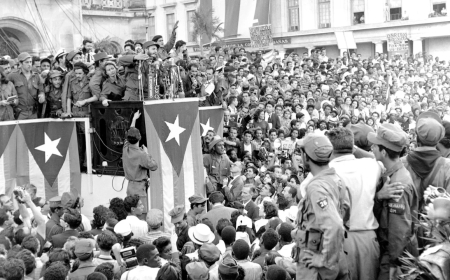
Havana has long withstood US invasions, since the late leader Fidel Castro toppled the US-backed dictator Batista and started a Communist revolution in 1959.
The country is also a single-party state that bans political opposition and strongly represses dissent. Human rights groups estimate there are more than 1,000 political prisoners.
Amnesty International yesterday demanded the release of political captives and called for the end of repression in Cuba, a year after the government released around 500 people as part of a negotiation between Joe Biden, as the outgoing US president, and Havana.
In response to US threats, Mr Díaz-Canel has imposed a “state of war” and upped Cuba’s defence and patriotic rhetoric. He told crowds: “There is no surrender” and held a national day of defence last Sunday.
But as the economy grinds to a halt and the US increases its pressure, many in Washington are feeling hopeful Cuba will follow in Venezuela’s footsteps.
[Source: Daily Telegraph]