





/file/attachments/orphans/ED_543155_209242.jpg)
























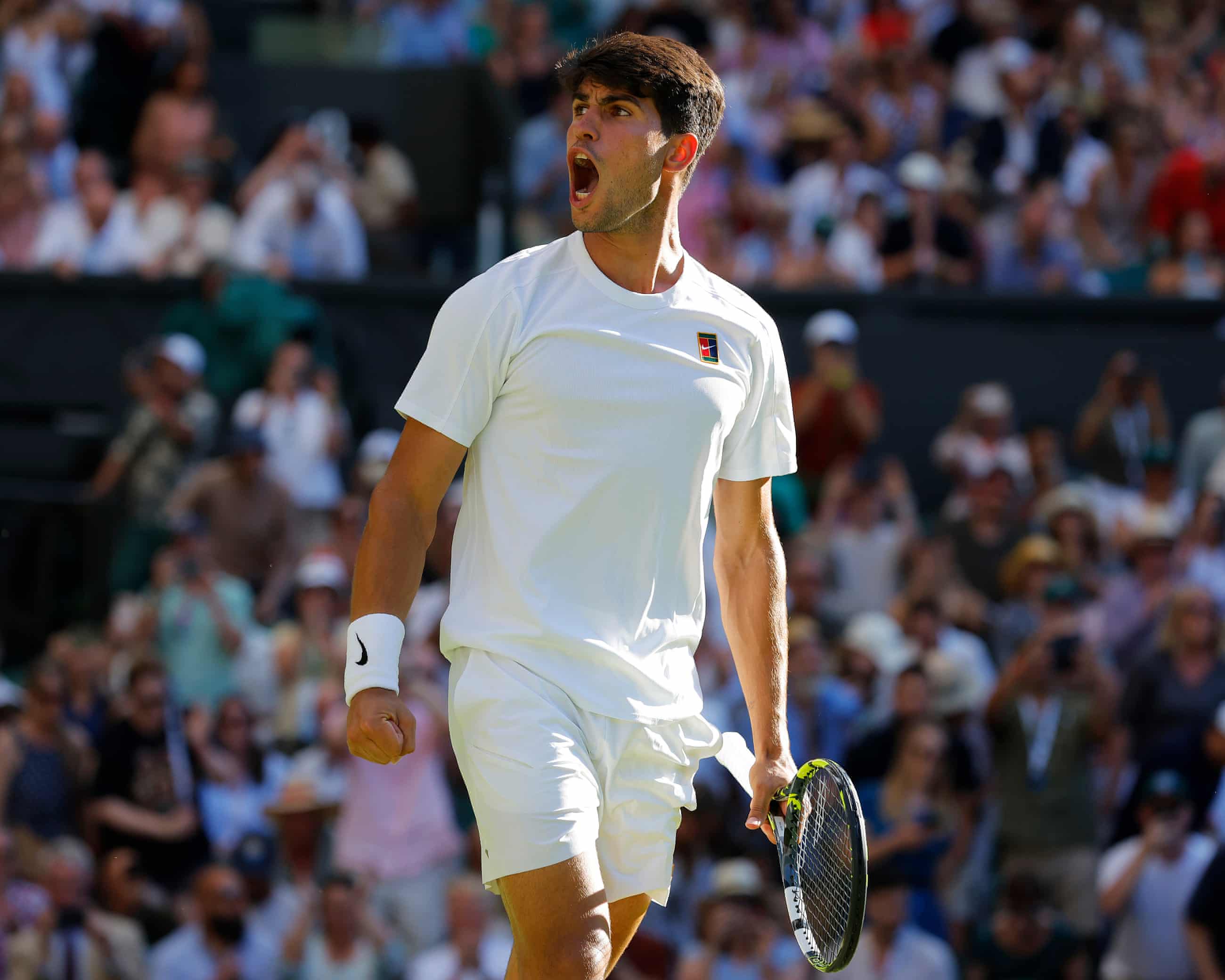
Carlos Alcaraz serves up lesson with Australian Open dismissal of Paul
World No 1 claims 7-6 (6), 6-4, 7-5 victory over 19th seed Player been making significant changes to service motion

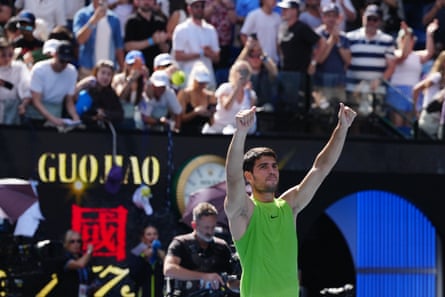
Carlos Alcaraz spent the final 52 minutes of his fourth-round match at the Australian Open chasing down his prey, determined to convert his two-set lead into a straightforward win against Tommy Paul.
As he worked hard to secure the decisive break in set three, Alcaraz put together a flawless serving performance. He won 86% of his first serve points in the set, landing 76% of his first serves. He did not even come close to facing a break point, losing just five service points in total. Alcaraz, the world No 1, closed out his 7-6 (6), 6-4, 7-5 win over the 19th seed Paul with an unreturned serve. He will play Australian Alex de Minaur in the quarter-finals.
These were good signs for the world No 1 in the aftermath of another off-season that, beyond the seismic news of his decision to part ways with his longtime coach Juan Carlos Ferrero, saw him make another significant change to his service motion.
Alcaraz’s serve has understandably been a significant point of interest since his emergence on the professional circuit. The 22-year-old has commanded such a complete game since his youth, but his serve, the point-starter and the most important shot in men’s tennis, always lagged behind the rest of his shots.
Although he could generate pace behind his first serve and he has always possessed an excellent topspin kick serve, Alcaraz’s first serve badly lacked the precision and consistency that distinguishes the best servers in the world. He would not always hit his intended spots close to the line or find quality first serves under pressure in important moments. Alcaraz has therefore repeatedly tinkered with his service motion over the past few years, trying to morph the shot into a smoother, more reliable motion.
The 2025 season saw its most significant changes to date. Alcaraz changed his starting stance, he lengthened his swing and, most importantly, he eliminated the hitch in the motion after his ball toss, creating a more rhythmic, fluid stroke. These changes culminated in the greatest serving performance of his career during the 2025 US Open, with the Spaniard losing his serve just three times en route to winning his sixth grand slam title. At times in New York, his serve looked indestructible.
It was reasonable to assume that Alcaraz would simply look to fortify those changes in the off season. Instead, he modified his service motion yet again. Alcaraz significantly altered the start of his motion, which now begins in a higher, more upright position. He also keeps his racket closer to his body at the beginning of his motion.
This new edition of Alcaraz’s serve has particularly generated interest due to how closely the first half of his service motion now closely resembles Novak Djokovic’s service motion. This was not lost on Djokovic, who came across the first videos on social media that depicted the change.
The pair have a great relationship, so Djokovic’s first reaction was to send Alcaraz a playful text: “I said, ‘We have to speak about the copyrights,’” said Djokovic, smiling. “Then when I saw him here, I told him we have to talk about the percentage of his winnings. Every ace I expect, a tribute to me. Every ace that he makes here. Let’s see if he’s going to stick to the agreement.”
Djokovic’s serve is one of the most underrated shots in the game, its excellent precision and consistency playing a large role in his continued longevity. Using his easy motion as a reference point is a smart decision. However, while Alcaraz has played along with the many jokes that have followed, he insists that he did not specifically copy Djokovic. “I wasn’t thinking about making the same serve as Djokovic,” he said. “But at the end, I can even see the similarities.”
A few details make this a fascinating decision. Rather than these changes occurring as a result of Samuel López taking full control as Alcaraz’s head coach, Alcaraz says he autonomously changed his service motion. He then later showed those changes to the rest of his team.
This is unusual. When tennis players usually make technical changes, they are either initiated by a coach or executed in conjunction with a coach. Alcaraz’s method reflects how much he works on instinct, and how his feel for the game is one of his greatest strengths. It also shows the confidence Alcaraz has in his own decision making as he continues to grow and mature.
There are some tennis players who believe technique is solidified in their formative years and they believe it is inadvisable to make significant changes once they are established professionals. Alcaraz is not one of those players. He believes in making constant changes and tinkering his game to ensure that he is always improving. “Let’s see how it’s going to be this year,” he said. “Probably you’re going to see another change, I don’t know if in the next months or at the end of the year. I just make constant changes in every shot. It’s just about really small details.”
The motivation behind this latest change is clear. As Alcaraz continues to inch closer to his goal of becoming the youngest man in tennis history to complete the career grand slam, he hopes his smoother, more fluid service motion will allow him to further establish himself as an all-time great.
[Source: The Guardian]