



/file/attachments/orphans/Nonku-Nombasa-Mapisa3_550805.jpg)
























Gelatinous horde of red stinging jellyfish washes onto Australian beach
A ‘massive smack’ of lion’s mane jellyfish has appeared across Port Phillip Bay, but experts say fears of a ‘jellygeddon’ are overblown

Swimmers have been advised to steer clear if they see red jellies in the water after a gelatinous horde descended on Melbourne beaches.
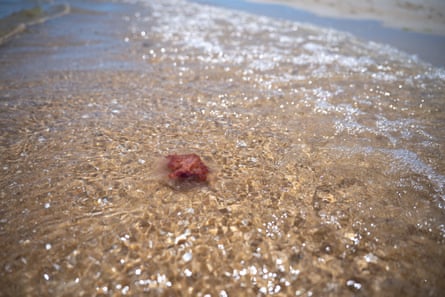
Thousands of lion’s mane jellyfish have washed into the shallows and on to the sand across Port Phillip Bay, from Altona in the west to Blairgowrie on the Mornington Peninsula.
The Port Phillip Baykeeper, Neil Blake, said a bloom of that size was a rare event, last seen about four years ago. The influx followed a bloom of bluebottles that washed up on Victorian beaches in December.
Their presence ebbed and flowed with the wind and waves, although numbers appeared to have declined from a week ago when the arrival of a “massive smack” of jellies caused the closure of one Melbourne beach.
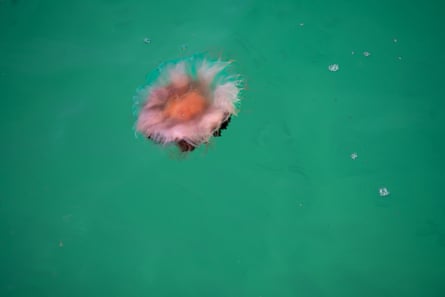
Most of the current lot were about the size of a peach, he said, with “quite long tentacles” stretching up to about a metre, sometimes more. Some could reportedly grow up to a metre across, however.
“The joys of an Australian summer!” said Bayside city council on social media, noting jellyfish sightings and strandings were a natural and seasonal occurrence.
The council, with coastline stretching from Brighton to Beaumaris, advised beachgoers to take care when swimming, walking barefoot on the sand, or with dogs.
Their sting could be painful, and potentially dangerous for young children, older people and those with allergies.
“If you can see jellyfish in the shallows, don’t swim,” a Life Saving Victoria spokesperson advised. “Stick to patrolled beaches and always swim between the red and yellow flags. Don’t touch jellyfish on the sand as they can still sting.”
“If you’re stung, get out of the water and seek help from a lifesaver or lifeguard if present,” the spokesperson said. “Rinse with seawater, remove any tentacles carefully, use hot water for pain relief, and call 000 if there are any serious symptoms.”
The species, Cyanea annaskala, is native to south-eastern Australia, but their recent unusual numbers close to shore is thought to be linked to warm water, nutrients and onshore winds.
Jellyfish expert Dr Jonathan Lawley said lion’s mane jellies were “not very good swimmers”, and tended to drift with the current and the wind.
“We often only observe them when the tide and currents bring them to shore – that’s when we see these huge numbers.”
The jellyfish stage was only a temporary part of their life cycle, he said. Larvae, called polyps, lay at the bottom of the sea until the right conditions triggered them to “strobilate” – dividing into dozens of tiny baby jellyfish.
The trigger might be a change in temperature, Lawley said, or other factors like rainfall or food availability could play a role.
There was little evidence to support sensationalist fears of a looming “jellygeddon” due to climate change, he said. Some species may be increasing in response to global heating, while others were thought to be in decline.
Jellies were often viewed negatively due to their risk to the public, he said, but they performed an important role in the food web and the environment. Some fish appeared to use jellyfish swarms as protection against predators.
Blooms could persist for days or weeks, he said, until the adults spawned and died, or were eaten by other marine animals.
[Source: The Guardian]








/file/attachments/orphans/ED_543155_209242.jpg)
