

/file/attachments/orphans/ED_543155_209242.jpg)





















Saudi defense deals could change Middle East security
Riyadh is in talks with Somalia, Egypt and Turkey about two new defense pacts. What impact will they have if they go ahead?
The political wheels across the Middle East keep turning.
Earlier this week, Saudi Foreign Minister Prince Faisal bin Farhan met his Egyptian counterpart Badr Abdelatty on the sidelines of the World Economic Forum in Davos, Switzerland, to discuss a "range of issues of mutual interest," a statement by the Saudi Foreign Ministry confirmed.
It is highly likely the two foreign ministers not only addressed US President Donald Trump's invitations to his Board of Peace — which both have already accepted — but also details of a new defense pact between their countries.
In addition, Somali President Hassan Sheikh Mohamud is reportedly traveling to Saudi Arabia in the coming days to sign a defense deal with Riyadh.
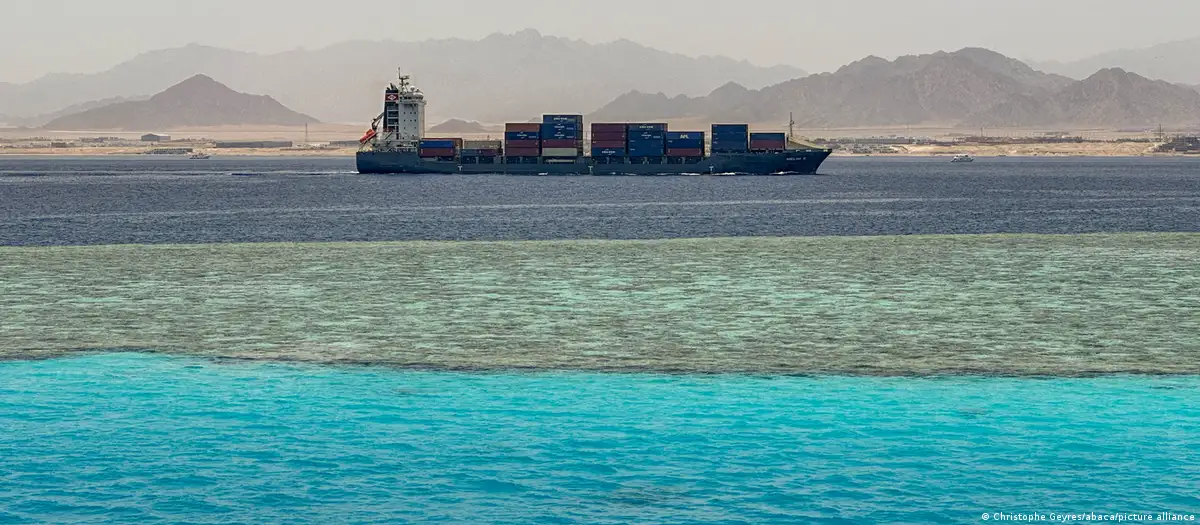
If Somalia is included in the deal between Riyadh and Cairo, the trilateral pact would boost Saudi and Egyptian influence on the African side of the key shipping route, the Bab el-Mandeb Strait, that links the Red Sea with the Gulf of Aden and the Indian Ocean.
'Islamic NATO'?
Media outlet Bloomberg also reported that Turkey is increasingly interested in joining the existing "Strategic Mutual Defense Agreement" between Saudi Arabia and Pakistan from last September.
Once signed, this trilateral deal, dubbed by some as an "Islamic NATO" — which refers to the North Atlantic Treaty Organization, or NATO — would combine Pakistani nuclear power with Saudi money and Turkish military strength.
"This would not be a symbolic bloc," Sergio Restelli, an Italian political adviser, author and geopolitical expert, wrote in an op-ed for media outlet The Times of Israel in January. "It would unite ... nuclear capability, control of strategic waterways, expeditionary forces and ideological influence," he said, pointing out that, "combined, these capabilities would create a trans-regional security axis stretching from the eastern Mediterranean through the Red Sea to the Indian Ocean. Such geographic continuity is unprecedented among Muslim-majority powers and would inevitably challenge the current balance maintained through US alliances and informal regional deterrence."
However, for Sami Hamdi, managing director of London-based risk and intelligence company, The International Interest, the underlying dynamics of Saudi Arabia's latest push for defense deals have more to do with the retreating US security umbrella.
"There is a growing view in the region that the US can no longer be depended upon to defend the security of those Gulf states," Hamdi told DW, pointing to 2019 when the US did not respond after an attack by the Yemen-based Houthis on Saudi oil facilities, or to September 2025, when Israel, the closest US ally in the region, attacked the political Hamas leadership in Qatar's capital, Doha.
Geopolitical rifts
Tensions between the Gulf states Saudi Arabia and the United Arab Emirates, or UAE, have been on the rise over their support of opposing factions in Sudan and Yemen.
In December, Saudi Arabia launched airstrikes on a military camp held by the UAE-backed Southern Transitional Council in Yemen's Hadramout province.
Earlier this month, Riyadh reportedly offered a $1.5 billion (€1.23 billion) Pakistan-Sudan arms deal to Sudan's army in its war against the Rapid Support Forces paramilitary, who are reportedly equipped by the UAE even though this has been denied by Abu Dhabi.
Meanwhile, the striving for new deals is not limited to Saudi Arabia alone. Most recently, the UAE also signed a comprehensive deal with Pakistan's adversary India, which turns India not only into Abu Dhabi's largest customer for liquefied natural gas but also into its closest partner for nuclear cooperation.
"I think that the UAE-India deal is not just about military technology but it is a political statement," said Hamdi.
"Given the fallout between Saudi Arabia and the UAE, the UAE is trying to show muscle against Saudi Arabia, in that, yes, Saudi Arabia may be a bigger power geographically but the UAE still has international standing," he added.
'No real rupture'
Despite these different alignments and conflicting interests, Cinzia Bianco, a Gulf research rellow at the European Council on Foreign Relations, said it's hard to imagine severe fault lines between Riyadh and Abu Dhabi at this stage.
"Both the United Arab Emirates and Saudi Arabia are sitting on Donald Trump's Board of Peace," she pointed out.
Saudi Arabia's potential new security partner,Turkey, also remains closely aligned with the UAE. Therefore, Bianco doesn't see that these new security deals could cause a real rupture beyond Saudi Arabia and the UAE. "And if we think of coalition geopolitics, you also can't really go anywhere if you don't have the US on your side," she said.
While the UAE are close US allies and host several US military bases, US-Saudi ties have also further increased with several mega deals announced during mutual state visits by Trump and Saudi Arabia's de facto leader, Crown Prince Mohammed bin Salman.
Given all this, the potential influence of new defense deals will be somewhat limited.
"The idea of an Islamic NATO is slightly exaggerated," said Hamdi. In his view, it remains true that the individual powers have a lot of ideological differences and different interests. "But the deals really have more to do with the technology transfer and trying to pursue some sort of autonomy," he said.
[Source: DW English]