
















UN presses for Erbil-Baghdad dialogue, Kurdistan cabinet breakthrough
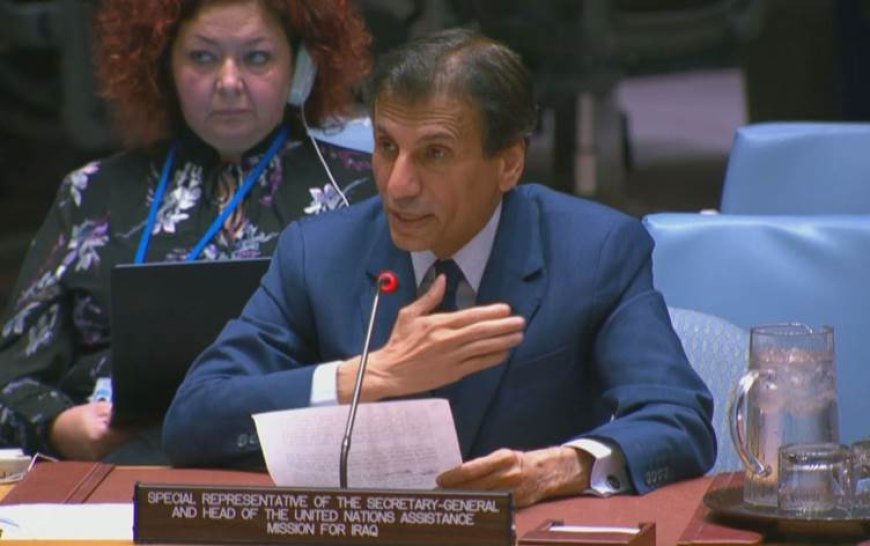
Special representative of the United Nations secretary-general for Iraq, Mohamed Al Hassan, on Tuesday called for dialogue between Baghdad and Erbil to resolve escalating disputes and urged Kurdish political parties to compromise in forming the Kurdistan Region’s next government.
Addressing representatives at the UN Security Council, Al Hassan stressed that the “Baghdad-Erbil relationship is a partnership that necessitates ongoing dialogue and collaboration, grounded in the constitution of Iraq to effectively address and resolve any outstanding issues between the two sides.”
His remarks come as tensions flared over the past two weeks after Baghdad suspensed budget transfers to the Kurdistan Regional Government (KRG).
Iraqi Oil Minister Taif Sami claimed Erbil had exceeded its 12.67 percent budget allocation for 2025 by more than 13.5 trillion Iraqi dinars (approximately $10.34 billion), citing rulings from Iraq’s Federal Supreme Court that prohibit further disbursements under such circumstances.
The decision has halted salaries for over 1.2 million public sector workers in the Kurdistan Region, sparking strong backlash from Kurdish parties, who denounced it as politically motivated and unconstitutional. They warned they would pursue “all options” to defend the Kurdistan Region’s interests, while reaffirming a commitment to resolving the issue through dialogue.
Importantly, Kurdistan Region Prime Minister Masrour Barzani sharply criticized the federal government’s move on Tuesday, calling its decision to “suspend the salaries of the people of the Kurdistan Region” as “unlawful, illegal and unconstitutional.”
He further accused Baghdad of using financial pressure to derail the Region’s development and stressed that “Iraq is a federal country, and the Kurdistan Region is a constitutional and legal entity.”
"We will not give up our constitutional rights,” PM Barzani asserted.
Speaking at the UNSC on Tuesday as well, Iraq’s representative to the UN Abbas Kadhim Obaid said that the relationship between the federal government and the KRG “is rooted in dialogue and common understanding,” and that the two sides “are working to resolve differences through negotiations based on commitment to the constitution.”
KRG deadlock
Al Hassan, who also serves as the head of the UN’s Assistance Mission to Iraq (UNAMI), also touched on the “protracted impasse” plaguing the push to form the Kurdistan Region’s tenth cabinet.
After a two year delay, the Region held its parliamentary elections in October, which saw the Kurdistan Democratic Party (KDP) emerge on top securing 39 seats in the Region’s 100-member legislature. The PUK came in second with 23 seats.
As no party won a majority, a coalition government will need to be formed, as has traditionally been the case. The KDP and PUK have been in talks since the October ballot to agree on the shape of the KRG’s tenth cabinet.
Al Hassan urged Kurdish parties to adopt a “spirit of compromise focusing on shared objectives rather than partisan divisions” to “overcome this protracted impasse.”
“There is no doubt in my mind that the concerned parties… will be able to form a competent government that will serve the interest of the people of the Kurdistan Region of Iraq and Iraq at large,” the top UN official said.
Lingering crises
The UNAMI chief also spoke on key humanitarian and security challenges, including the repatriation of Iraqi citizens from Syria’s al-Hol camp, which continues to house families with links to the Islamic State (ISIS). As of April, the camp held 34,927 people, including 15,681 Iraqis.
Al Hassan confirmed that “more than 800 Iraqis returned ten days ago from al-Hol camp” to Iraq, reflecting Baghdad’s “commitment to accelerating the return process of its citizens with the support of the United Nations.”
However, he stressed the importance of exerting efforts to ensure “the dignified reintegration” of returning families and “ensuring a fair judicial process for the detainees who are being repatriated.”
For his part, the Iraqi representative to the UN, Obaid, described the situation in the al-Hol camp as “a major source of concern [to Iraq] due to the existence of extremist elements and families connected to ISIS, which may aggravate the security situation” in the region.
He stressed the need to “address these issue through effective regional and international cooperation and finding sustainable solutions for the al-Hol camp so that it does not continue to pose a dangerous hotspot.”
Obaid additionally pointed to the presence of ISIS elements on Syrian territory, describing them as a “joint security threat” for the countries of the region.
Moreover, Al Hassan shed light on the situation of internally displaced persons across Iraq and the Kurdistan Region which “continues to demand urgent attention.”
He noted that there are “hundreds of thousands of individuals remain displaced,” including “100,000 primarily Yazidis from [Shingal] Sinjar” who live under “precarious conditions.”
He urged Baghdad to create “sustainable conditions for the returns require more coherent political, administrative and security measures” and adopt “a comprehensive national plan for durable solutions” to “protect this sect” that “has been harmed in ways that cannot be described by ISIS.”
In June 2014, ISIS took control of large areas in northern and western Iraq. Two months later, in August, the group launched a brutal assault on the Yazidi community in the district of Shingal, resulting in the abduction of 6,417 Yazidi women and children. Many were subjected to sexual slavery and forced labor. The UN officially recognized the campaign against the Yazidis as a genocide.
As of now, 2,590 Yazidis remain missing, according to the Office of Rescuing Abducted Yazidis, affiliated with the Kurdistan Region Presidency.
An estimated 200,000 Yazidis were also displaced from Shingal during the onslaught, many of whom continue to live in displacement camps across the Kurdistan Region, particularly in the northern Duhok province.
Though more than 10 years have passed since the ISIS attack on Shingal, much of the Yazidi community remains displaced. Their return has been hindered by a combination of security concerns, political disputes, and infrastructure and reconstruction challenges. The presence of various armed groups has also created an unstable environment, further deterring many Yazidis from returning.
The Iraqi representative at the UN, Obaid, said on Tuesday that Baghdad has made the return of IDPs to their hometowns and the closure of displacement camps, including the Yazidis, a “national priority.”
End of UNAMI mandate
Established in 2003 at the request of Iraqi authorities, UNAMI has played a key role in coordinating between the Iraqi government and over 20 UN agencies. While it does not directly implement aid projects, its mandate has focused on political support, human rights, and elections.
In May 2024, Iraqi Prime Minister Mohammed Shia’ al-Sudani formally requested an end to UNAMI’s mandate, citing improved political and security conditions. The UN Security Council has since scheduled the mission’s conclusion for December 31, 2025.
Al Hassan noted that as UNAMI’s mandate ends, it “continues to pursue a structured transition” per schedule and in close cooperation with the Iraqi government.” He added that the mission has shut down its offices in the capital of Iraq’s northern Nineveh province, Mosul, as well as in Kirkuk.
Despite this, he stressed that “UNAMI will spare no effort in providing the most professional technical support” in the ongoing preparations for Iraq’s upcoming legislative elections, slated for November 11, “including efforts to promote the widest participation of women, youth and minorities.”