




















The Iranian Kurds, potentially part of an internal front that would weaken the regime in Tehran
As American-Israeli strikes continue, attention turns to the Kurdish factions in Iran. United in an unprecedented coalition, they could attempt to take advantage of the regime's weakening position. But the history of the Kurds, marked by fragile alliances and abandonment, inspires both hope and caution.
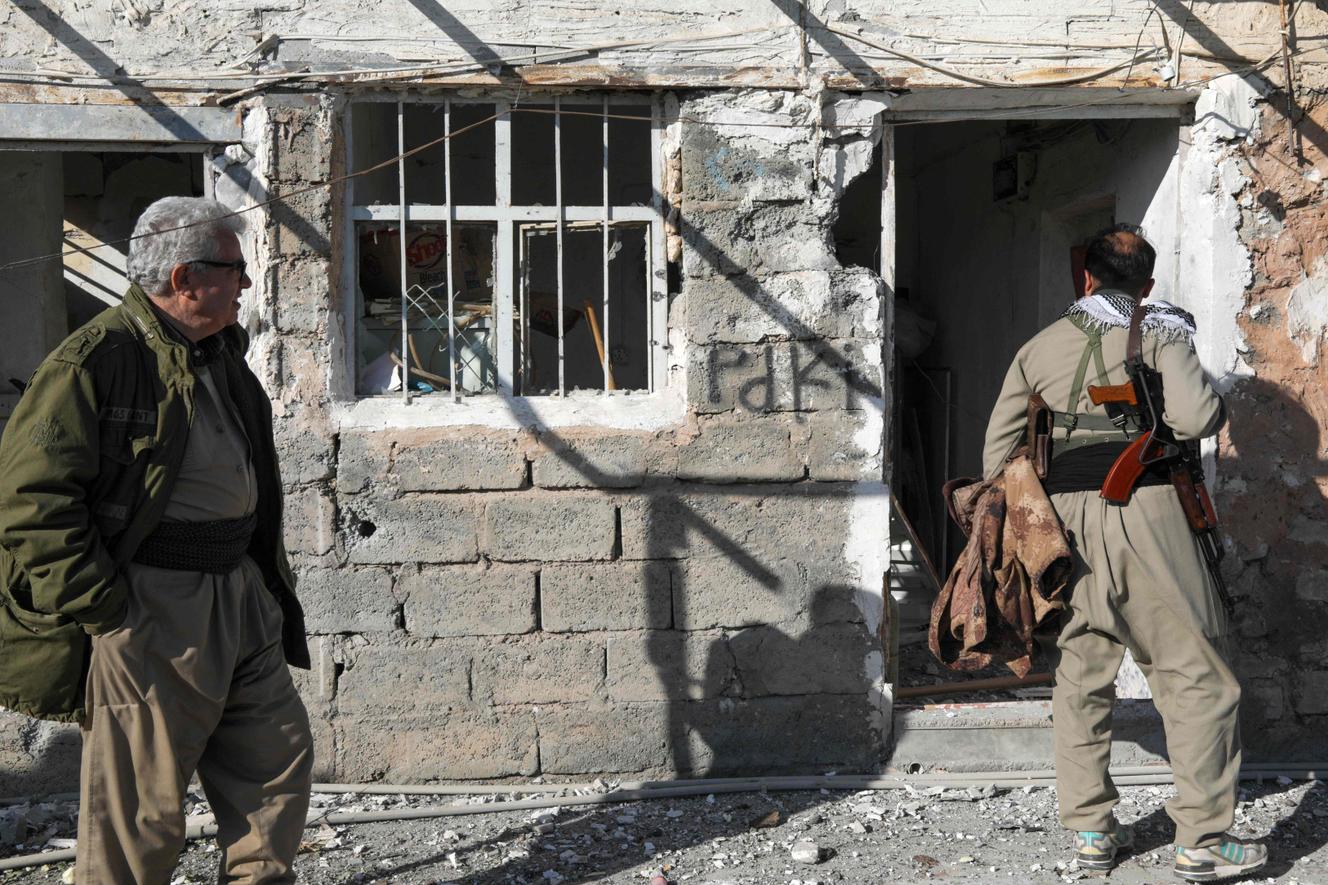
Rumours, opacity, errors and denials. The situation on Iran's western borders remains the subject of speculation on the morning of Thursday 5 March, as Kurdish armed groups have denied their involvement in operations reported the previous day by Israeli and American media. These organisations, based in neighbouring Iraqi Kurdistan and claiming to represent a minority accounting for 10% of the Iranian population, are seen as the only actors capable of forming a structured armed opposition to the Islamic Republic.
On Wednesday evening, amid a context of considerable confusion over the information available, a series of rumours began to circulate that their fighters had crossed the Iranian border from their positions in Iraqi Kurdistan. However, there has been no independent or official confirmation to support these allegations at this stage. Earlier, the Axios website, known for its links to the Israeli security apparatus, reported that the CIA was financing and arming the Kurdish national movement with a view to taking control of Iranian Kurdistan.
Reports to this effect were relayed by CNN, Fox News and Israeli media, accompanied by confusing statements of support for the Kurdish forces from Republican figures. These statements seem to have caused embarrassment among the Kurdish forces. Doubt was therefore setting in when, according to the NGO Human Rights Activists News Agency (HRANA), at least 1,114 civilians, including 181 children, were killed in US-Israeli strikes across Iran. A further 926 deaths, currently being verified and classified, could be added to this toll.
Fratricidal conflicts
In the west of the country, the distribution of the bombings that began in the previous days resembled a map of a future area of operation in the Kurdish regions of Iran, from southern Urmia, a city near the Turkish border, to Kermanshah, near Iraq. But the fog of war remained thick over the mountains of Kurdistan on Thursday morning. The only certainty is that six Kurdish factions, marked by a long history of fratricidal conflicts and divisions, officially formed a coalition on 22 February.
Their positions on the Iraqi side of the border have already been hit by drones and missiles, including on Wednesday night and Thursday morning. ‘We cannot tolerate these attacks indefinitely,’ said Kerim Pervizi, a member of the leadership of the Iranian Kurdistan Democratic Party. However, contrary to rumours circulating on Wednesday, the Iranian Kurdish military is not yet on a war footing. ‘The formation of a joint operations room is still underway, but it can only be finalised if we have assurance that the regime has lost its capacity for repression,’ said Ali Ranjbari, a member of the central committee of the Komala Party of Kurdistan, one of the groups involved, as the first rumours, which were soon denied, were already circulating. However, we have reached a point of no return and some regions could change hands." At this stage, no Kurdish organisation has confirmed the start of military operations.
Ahwan Chiako, a member of the executive council of the Party for a Free Life in Kurdistan (PJAK), confirmed that the alliance did not have a single representative at this stage, going so far as to deny any external support. ‘Without control of the skies, a Kurdish operation would be a massacre,’ he added. PJAK is the Iranian offshoot of the Kurdistan Workers' Party (PKK), which was driven out of Syria this year and is engaged in a rocky negotiation process with Turkey, which it has been fighting since 1984.
Stories of abandonment
Despite hopes for a historic opportunity, concern remains for the Kurds: will they be able to rally the interests of Tehran's enemies and find their place, even if the American-Israeli war has not yet led to the fall of the regime? Or do they risk once again feeding into the narrative of a Kurdish history made up of recurring episodes of exploitation followed by fatal abandonment? The takeover in January of areas under Kurdish control in Syria by Damascus and the forces of Ahmad Al-Charaa, with the blessing of the West, is still fresh in everyone's minds.
According to Shamal Bishir, an Iranian Kurdish analyst based in Stockholm and former head of external relations for the PJAK, who maintains a network of contacts on the ground, ‘the latest reports indicate that Kurdish towns have been abandoned by regime forces, with the populations waiting hopefully for further developments’. In a statement on Wednesday, the PJAK leadership called on the Kurds to set up a local political and military self-organisation.
The question of the role of the Iraqi Kurdistan authorities, historically linked to Tehran despite their proximity to Washington and whose territory would serve as a launching pad for such an operation, remains unresolved. ‘The stability of autonomous Iraqi Kurdistan has always depended on its good relations with regional powers. This balance is now under threat,’ warns Maria Luisa Fantappie of the Istituto affari internazionali in Rome, who has been following Kurdish political and security issues since 2010. ‘Regional crises always serve as catalysts for Kurdish history. For now, time is on their side, as the United States and Israel need them, but they need real guarantees or a catastrophe is to be feared,’ says the expert.
Nationalism
Condemned as separatists by some Iranians, particularly the monarchist movement led by Reza Pahlavi, son of the former Shah of Iran, the Kurdish factions fighting against the Islamic Republic could also face the wrath of the rest of the Iranian opposition. ‘A Kurdish offensive could cloud the prospects for regime change, strengthening nationalism within the country in its favour, while the war would turn into an ethnic conflict, mobilising Iranian ground forces without changing the military balance in the face of strikes,’ explains Arman Mahmoudian, a researcher at the Global and National Security Institute at the University of South Florida.
From within Iran, the Kurdish movement is viewed with ambivalence. The mountains of Kurdistan, with their guerrillas and smugglers, have often been the only route for opponents of the Islamic Republic to reach Turkey, Iraq and then the West. The Kurds were at the forefront of the 1979 revolution, before Ayatollah Khomeini's supporters, eliminating their allies against the monarchy, orchestrated a deadly crackdown against this minority that continues to this day.
However, what is happening in western Iran has implications beyond the country's borders. ‘Iranian Kurdistan is the cradle of pan-Kurdish nationalism. The Kurds of Iran, Iraq, Turkey and Syria still celebrate the memory of the 1946 Republic of Mahabad, considered the only Kurdish state in modern history,’ recalls Boris James, a leading historian of the Kurdish world and lecturer at Paul-Valéry University in Montpellier. Following the recognition of Iraqi Kurdistan's autonomy in the wake of the American intervention in Iraq in 2003, the rise and then political and military repression of the Kurdish movement in Turkey from 2015 onwards, and the expansion from 2011 and then collapse in 2026 of the Kurdish experiment in Syria, developments in Iran could mark a new chapter in this long history.
[Source: Le Monde - translated by EDGE news]