


/file/attachments/orphans/ED_543155_209242.jpg)

























Dame Averil Cameron, historian who transformed perceptions of the Byzantine empire
The Byzantines were, she argued, far more dynamic, disputatious and intellectually sparky than historians had hitherto believed them to be

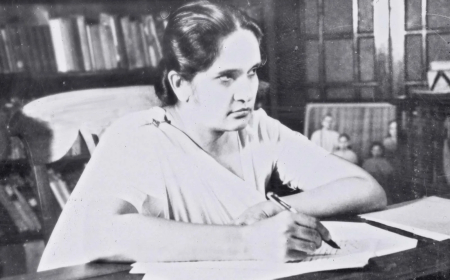
Dame Averil Cameron, who has died aged 86, was Professor of Byzantine History at Oxford, and a leading voice in a generation of scholars who finally salvaged the study of the Eastern Roman empire from the prejudices of the Enlightenment; as Warden of Keble (1994-2010), she was also one of the first women to serve as head of a former men’s college at Oxford.
For centuries historians saw the Byzantine empire – beginning with Constantine’s dedication of Constantinople in AD 330 and ending with its fall to the Ottoman Turks in 1453 – as an awkward impediment to a neat view of European civilisation, in which the fall of the Roman empire led to the intellectual deep-freeze of the Dark Ages and finally the birth of the modern world.
As Averil Cameron put it in Byzantine Matters (2014), “Byzantium lies outside the standard western narrative of the formation of Europe. It is consigned to the twin spheres of exoticism and the East, and above all to the realms of ossification and pointless bureaucracy. One looks in vain for civil society in Byzantium, let alone democracy or the hallmarks of western liberalism.”
English historians also sniffily considered the Byzantines as inferior in every way to their classical predecessors; Edward Gibbon dismissed them as derivative, stagnant and corrupt, and compressed eight centuries of post-Justinian decline into a rapid canter, on the grounds that the “patient reader” would find a more detailed history intolerable.
And yet the Byzantines are worthy of attention not just because they held sway over a large chunk of the earth’s surface, including swathes of Europe, for more than a millennium, but also because they were, as Averil Cameron convincingly argued, far more dynamic, disputatious and intellectually sparky than Gibbon’s caricature: “We see… a mass of experimentation.”
She made the case that Christianity captured the hearts of Romans not just because it delivered a message that so many wanted to hear, but because it redeployed language that already felt familiar – the ancient tricks of rhetoric, and the literary forms of the panegyric and the philosophical dialogue. In other words, Christianity did not shut down ancient thought – as had been claimed – but rather spun it imaginatively into something it could use.
So deft was her handling in Christianity and the Rhetoric of Empire (1991) of the cross-currents between a pagan worldview and a Christian one that, as one critic put it, “one almost feels that she alone could have successfully invited both Procopius [the Christian-but-pragmatic late antique historian] and Dionysius the Areopagite [the impassioned mystic] to lunch on the same day.”
Moving from late antiquity to the even less fashionable field of medieval Byzantium, she attacked the idea that the Byzantines were slavishly hierarchical. In her contribution to David Cannadine and Simon Price’s Rituals of Royalty, she threw out the challenge: “Was there a Byzantine Princess Diana?” Instead, she argued that there was nothing to suggest that the Byzantine population could match the warmth and fervour that accompanies British royal occasions.
She also defended her period from the charge of dogmatic religiosity: “Orthodoxy in Byzantium was always vaunted but also always contested.” Religion was in fact so decentralised that nobody was sure who had the last word on a heresy: the patriarch, the emperor, or a cabal of puritanical monks?
Her other writings included biographies of Agathias and Procopius, editions of previously unpublished Byzantine texts, and several books for the general reader, including The Byzantines, The Mediterranean World in Late Antiquity, Byzantine Christianity and Byzantine Matters.
Over the 1990s and early 2000s, Averil Cameron also co-edited three volumes of the overhauled second edition of the monumental Cambridge Ancient History: Vol 12, The Crisis of Empire, AD 193-337; Vol 13, The Late Empire, AD 337-425; and Vol 14, Late Antiquity: Empire and Successors, AD 425-600. That the 13th and 14th volumes had not existed in the original CAH, a 1920s and 1930s project which took AD 324 as its cut-off, was a sign of new-found regard for late antiquity, for which Averil Cameron could take some credit.
“She has enriched us by leading us away, firmly and with alert intelligence, from the debased images of Byzantium that have, for many centuries, locked Western Europeans into a pitiably narrow and superficial view of their own past,” wrote the late antique historian Peter Brown, while the Oxford ancient historian Peter Thonemann held that “no one has written about the history and culture of Byzantium with such luminous intelligence as Averil Cameron.”
She was born Averil Millicent Sutton on February 8 1940 in a small terraced house in Leek in Staffordshire. Her father was proud to work in a mill that made paper for the Oxford University Press. Among the family’s few books was a one-volume encyclopaedia and Charles Dickens’s A Child’s History of England.
At Westwood Hall Girls’ High School, she came under the spell of a “Miss Brodie-like” music mistress, but was steered by the headmistress to read Classics as an exhibitioner at Somerville College, Oxford, where she was taught ancient history by Isobel Henderson (a mentor of Iris Murdoch), philosophy by Elizabeth Anscombe and Philippa Foot, and Greek drama by the intimidating Eduard Fraenkel.
In 1962, after her final exams, she married Alan Cameron, a fellow student who became a scholar of late antiquity, but by the 1970s she was a working single parent to their son and daughter; in 1980 the marriage was dissolved.
She was nudged into the study of late antiquity by chance when a Byzantinist suggested the sixth-century Greek historian Agathias for her PhD subject at Glasgow University. Averil Cameron then became a lecturer at King’s College London, where she was a disciple of the great historian Arnaldo Momigliano, who was “always solicitous as to whether I was eating enough oranges or yoghurt”.
A visiting year teaching at Columbia in New York in 1967-68 opened her eyes to second-wave feminism, student strikes and anti-Vietnam protests. Rising to be the head of KCL’s Classics department (1984-89), and then director of its new Centre for Hellenic Studies, Averil Cameron stayed at KCL until her 1994 appointment as Warden of Keble. In 2010 she retired from Keble to chair the new Oxford Centre for Byzantine Research.
She was at various times editor of the Journal of Roman Studies; president of the Roman Society; chairman of the Cathedrals Fabric Commission for England and the British National Byzantine Committee; pro-vice-chancellor of the University of Oxford; and a fellow of the Society of Antiquaries. In 2020 she received a medal from the British Academy for her lifetime contribution to Byzantine studies.
She was appointed CBE in 1999, advanced to DBE in 2006.
Looking back on her 16 years as Warden of Keble, her 2025 memoir Transitions brought out, as the TLS reviewer put it, the “relative powerlessness of a head of house, effective stewardship being dependent on one’s capacity to sweet-talk, reason or bully the body of Fellows… it is hard not to feel that this towering intellect was wasted in parochial wars over rowing prowess, pudding provision or lawn maintenance.”
[Source: Daily Telegraph]