
















Mrs Thatcher elected prime minister: 4 May 1979
Michael EJ Phillips
She was born Margaret Hilda Roberts in 1925 in Grantham, a market town 100 miles to the north of London, to a greengrocer. The family lived above the shop, with her parents bringing her and her sister up to take personal responsibility, work hard and uphold traditional moral values, a background that shaped both her future life and politics.
After reading Chemistry at Oxford, she went on to work in research and later study law. Both these were unusual for a woman even at that time. She married Denis Thatcher in 1951, gave birth to twins in 1953 and was admitted to the Bar that same year. After contesting Dartford in 1951 and choosing not to stand in 1955 because of her children, she won Finchley in 1959. By 1970 she had become Education Secretary under Edward Heath, and the party leader in 1975, defeating him on the first ballot.
Under the two 1970s Labour governments of Harold Wilson and James Callaghan, the British economy sank ever deeper into decline, inflation surged, and industrial strikes spread. Heath’s Conservative government had imposed price and wage controls, which led to his defeat in the 1974 General Election to James Callaghan.
For the next four years, as a Labour government ran the country, Thatcher fought to reshape her party. She was guided by the firm principles of personal responsibility, economic freedom, and smaller government. Her economic ideas came from Friedrich von Hayek and Milton Friedman. She pledged to attack inflation, denationalise basic industry, and curb the power of the unions. By then, Britain had become the “sick man” of Europe. The “Winter of Discontent" starting in 1978, brought mass strikes that dragged into 1979, and Labour PM James Callaghan had to call a general election.
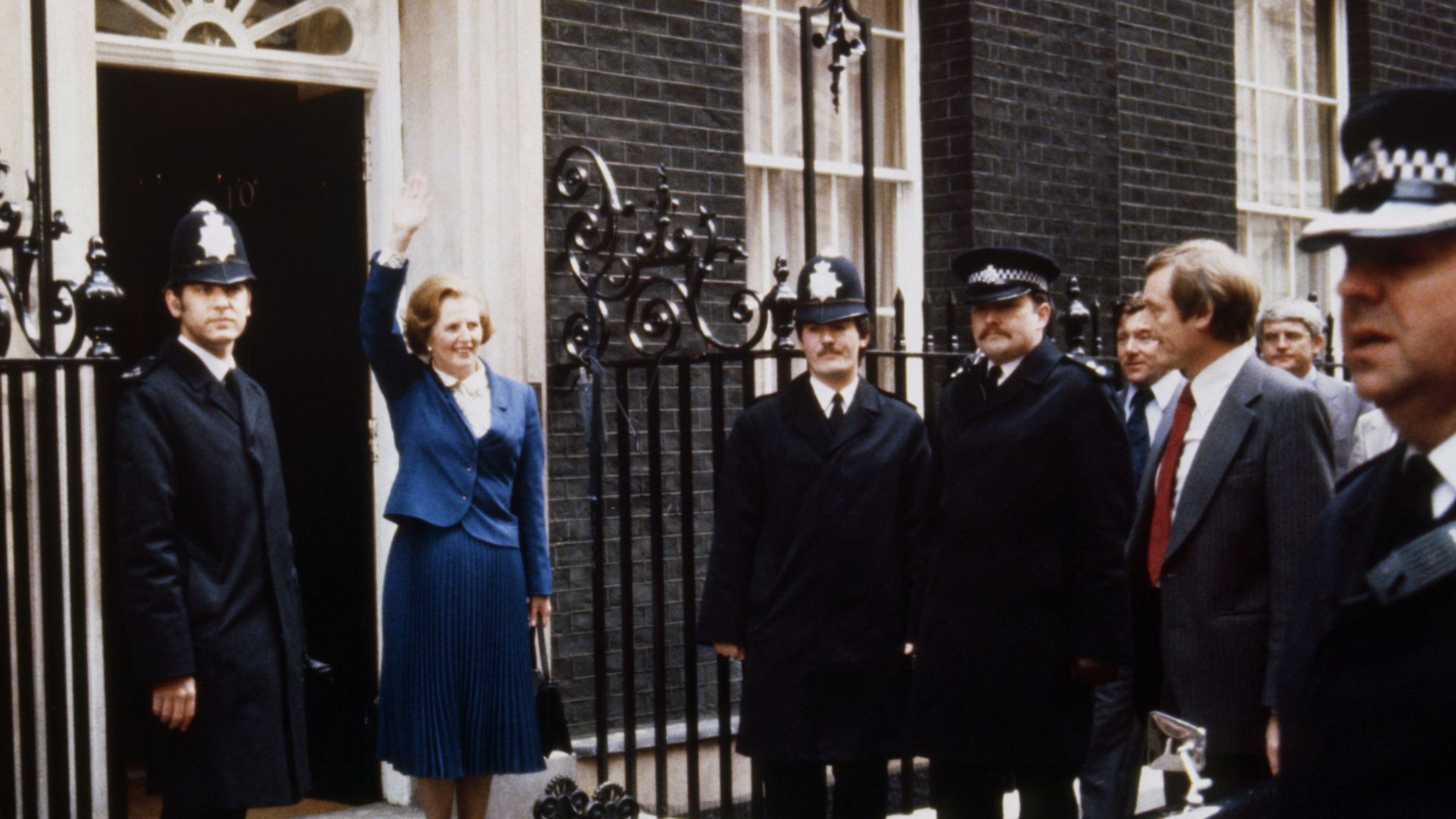
It is hard to write dispassionately about Mrs Thatcher, especially given what followed her coming to office. Elected on 4 May 1979 in her capacity as Leader of the Conservative and Unionist Party, she was the first female prime minister of the United Kingdom – and in due course as Britain’s longest serving since 1827. Standing outside 10 Downing Street with her husband, she quoted the words of St Francis of Assisi:
Where there is discord may we bring harmony,
Where there is error may we bring truth,
Where there is doubt may we bring faith,
And where there is despair may we bring hope.
Margaret Thatcher set the British economy to rights and helped the United States and the Soviet Union end the Cold War. She believed that personal and economic freedom go together, that personal responsibility and hard work are the path to prosperity, and that market democracies must stand firm against aggression.
Hard-driving and hard-headed, she led her party to three consecutive election wins, holding office from May 1979 to November 1990. In 1979, the UK was crippled by high unemployment, nationalised utilities, punitive tax rates, foreign exchange controls, a stranglehold by trade unions, and a sleepy financial sector. By 1990, all of this had been turned around. She broke the power of the trade unions, broke up nationalised industries, redefined the role of the welfare state, and advanced the free market.
In foreign affairs, she stood up to the European Economic Community, saying the UK paid out more than it got back in benefits. In late 1979, after negotiations at an EEC summit, she said, "We are not asking for a penny piece of Community money for Britain. What we are asking is for a very large amount of our own money back."
By October 1980, the UK faced economic disaster. At the Conservative Party conference that month, moderates saw electoral defeat staring them in the face, but Mrs Thatcher declared, "I am not a consensus politician, I am a conviction politician." She told them she would press ahead with her policies: "You turn if you want to. The lady's not for turning."
In the summer of 1981, discontent boiled over into days of rioting in the inner cities of London, Liverpool, Manchester, and Bristol. Mrs Thatcher called for greater police powers, but was forced to compromise. She later said it was her worst year in office.
Mrs Thatcher was relentlessly opposed to communism. Her hostility to the Soviet Union fuelled fears of nuclear war, and the Soviet press dubbed her the Iron Lady. She agreed with President Jimmy Carter to deploy American nuclear cruise missiles in Britain in response to a Soviet build-up in Eastern Europe. In the early Reagan years, despite large demonstrations in Britain and across Europe, the European NATO allies accepted the deployment of cruise and Pershing missiles.
In April 1982, Argentine military forces invaded the Falkland Islands. As the United States and other allies pushed for talks to avoid bloodshed, the Iron Lady knew where she stood: "We will stand on principle, or we will not stand at all." She ordered a Royal Navy fleet to sail south and land British paratroopers and Royal Marines to retake the islands. They did, in a great display of military prowess. Some 250 British servicemen and over a thousand Argentines were killed in the fighting.
When Mrs Thatcher called an election in June 1983, Labour Party leader Michael Foot campaigned for a unilateral nuclear disarmament, withdrawal from the European Economic Community, further nationalisation of industry, and a huge jobs program. Opponents called his manifesto the longest suicide note in history. The Conservatives won by a landslide.
Mrs Thatcher then broke the power of the trade unions. She took on the powerful National Union of Mineworkers. The coal mines had been nationalised in 1947 and had become unprofitable and outdated. In 1984, the government announced plans to close several mines and decimate the workforce. In response, Marxist NUM leader Arthur Scargill called a nationwide strike. Night after night, TV news showed hundreds of miners battling the police. The strike lasted almost a year, but Mrs Thatcher refused to give in, fighting it to the bitter end.
She refused to be bowed by terrorism. Despite the sectarian violence in Northern Ireland, Mrs Thatcher saw the troubles there as intractable and refused to deal with the Irish Republican Army. After the IRA tried to assassinate her at the 1984 Conservative Party conference in Brighton, killing five people, she insisted on continuing the conference the next day: "The fact that we are gathered here now, shocked, but composed and determined, is a sign not only that this attack has failed, but that all attempts to destroy democracy by terrorism will fail."
She pushed harder to realise her dream of popular capitalism. The sale of state-owned industries shifted almost a million jobs to the private sector. Over a million public housing units were sold to their occupants under Right-to-Buy. Chancellor of the Exchequer Nigel Lawson announced in 1985 that, for the first time in a generation, the Treasury would balance the Budget.
Across the Atlantic, Ronald Reagan cheered the British turnaround. He then invaded the British Commonwealth nation of Grenada following a Communist coup there. Mrs Thatcher protested at not being informed in advance, but their friendship was strong enough to survive the spat. During the Reagan years, the Soviet Union began to show signs of economic failure. The Reagan administration increased pressure by moving ahead with plans for the Strategic Defense Initiative, also known as “Star Wars”. Mrs Thatcher was one of the first Western leaders to recognise that the new Soviet premier, Mikhail Gorbachev, was different from his Kremlin predecessors. "I like Mr Gorbachev. We can do business together," she said. Her rapport with him and her friendship with Ronald Reagan made her a vital link between the White House and the Kremlin in their negotiations to end the Cold War.
Gorbachev was opposed to SDI. Mrs Thatcher was sceptical too and told Reagan, "I know it won't work." But she changed her mind after he told her Britain would get some of the research and development work for it. In December 1984, she helped to assure the Soviets that SDI would not get in the way of arms control talks. In Iceland in October 1986, Reagan and Gorbachev almost agreed to ban nuclear weapons altogether. But the talks fell apart when Gorbachev insisted that Reagan first drop Star Wars. Many people were relieved. Mrs Thatcher said, "The fact is that nuclear weapons have prevented not only nuclear war but conventional war in Europe for 40 years." In April 1986, after terrorist attacks in Western Europe, Reagan sought permission to launch American warplanes from bases in Britain for attacks on Libya. Mrs Thatcher was happy to oblige. She said terrorism demanded a united response.
During those years, Mrs Thatcher's domestic legacy included liberalisation of exchange controls, a huge cut in top income tax rates, liberalisation of labour markets, transformation of the legal position of trade unions and defeat of militant organised labour, sale of much of the public housing stock, privatisation of most nationalised industries, and the liberalisation of finance. After she deregulated the City of London in 1986, the UK became and still remains a global centre for finance and investment.
She aired one principle of her philosophy in 1987 thus. "There's no such thing as society. There are individual men and women, and there are families. And no government can do anything except through people, and people must look after themselves first. It is our duty to look after ourselves and then, also, to look after our neighbours." Having said that, Mrs Thatcher was forced to retreat from plans to privatise the water industry and the National Health Service, replace college grants with a student loan programme, cut pensions, and revamp the social security system. But the economy continued to work in her favour. She won her third general election in June 1987. Wall Street crashed in October.
Mrs Thatcher became increasingly opposed and disruptive towards Europe. In 1988 she said, "We have not successfully rolled back the frontiers of the state in Britain only to see them reimposed at a European level with a European superstate exercising a new dominance from Brussels."
She believed that linking the pound to other currencies would erode British sovereignty. At the Madrid EEC summit in 1989, leading Tories told her the UK must join the Exchange Rate Mechanism. But she resisted the idea that aligning Sterling with other currencies could solve Britain's economic problems, saying, "You can't buck the market." Lawson still however tried to align sterling with the ERM by pegging the pound to the relatively stable German mark. Meanwhile, easy credit was fuelling inflation, and Lawson refused to raise interest rates. When Mrs Thatcher demanded he relent, Lawson raised rates, which threw Britain into recession. Lawson resigned in October 1989.
In 1990, to make local authorities more accountable for how they spent tax money, Mrs Thatcher pushed through the Poll Tax on all adult residents of a community. The tax was seen by some as unfair and was unpopular particularly in Scotland. Protests flared into riots, and the Tories lost faith in their leader.
In the autumn of 1990, the Iron Lady bolstered President George HW Bush in his efforts to build a UN coalition to oppose the Iraqi invasion of Kuwait. She told him, "George, this is no time to go wobbly." That November, the Tories revolted. Deputy PM Geoffrey Howe and former Defence Secretary Michael Heseltine led a rebellion against her. She fought to the bitter end: "I fight on. I fight to win." But she was forced to resign and left 10 Downing Street in tears. She went on to sit in the House of Lords as Baroness Thatcher of Kesteven.