






/file/attachments/orphans/ED_543155_209242.jpg)




























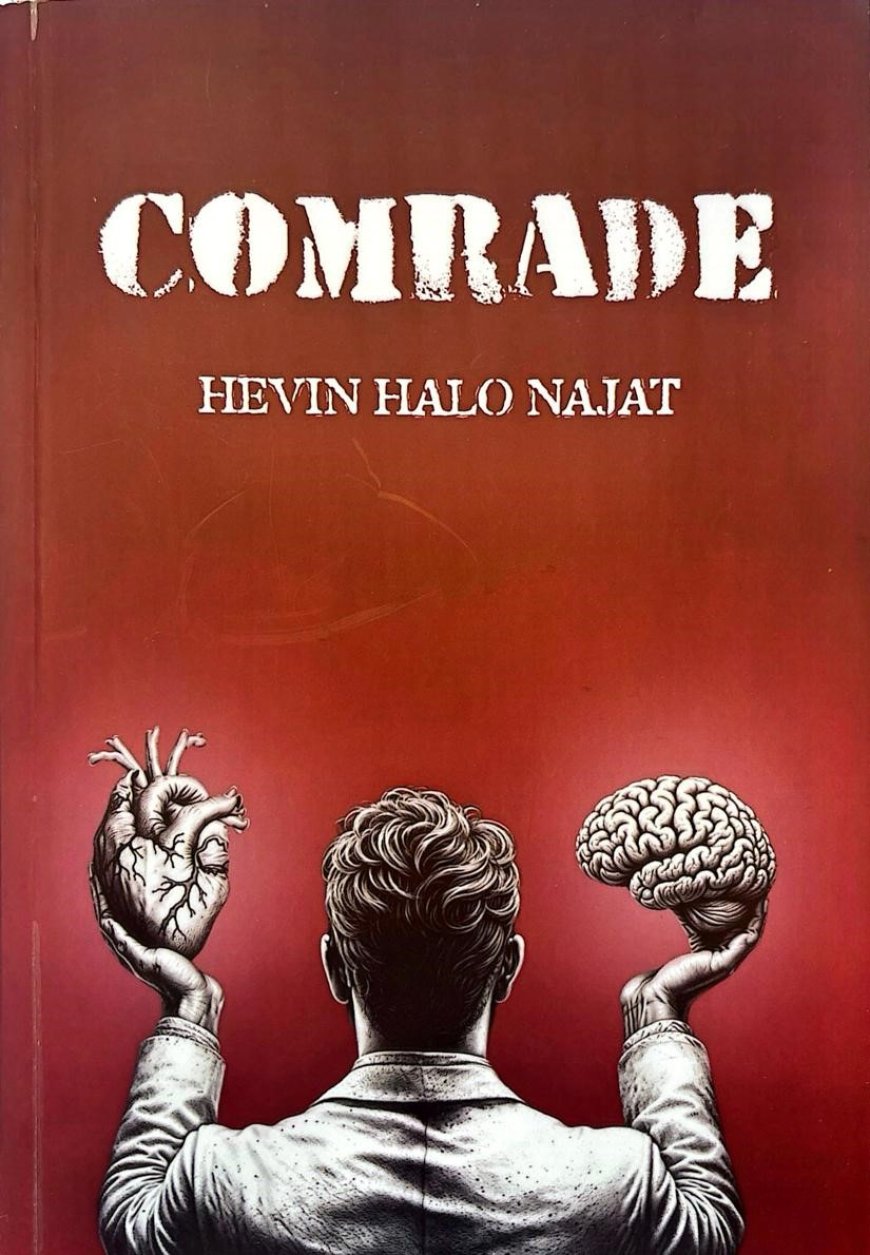
Emotional discipline, spiritual venting and the poetics of balance in 'Comrade' by Hevin Halo Najat
Dr. Sirwan Abdulkarim Ali / political analyst and academic
Existing research across Kurdish, English, Arabic, Persian, and Turkish traditions converges on a shared insight: poetry functions not merely as aesthetic expression, but as a structured medium for emotional articulation, ethical reflection, and psychological regulation. Recent studies in expressive writing and poetry therapy including but not limited to Pennebaker, Mazza, Wassiliwizky and others demonstrate that poetic language enables individuals to process intense emotions while maintaining cognitive control. Parallel to this, philosophical and literary works, from Nussbaum to Damasio, challenge the rigid division between reason and emotion, proposing instead their interdependence.
Within Arabic poetics (Adonis; Stetkevych), poetry has long served as a vehicle of moral counsel and cultural identity, while Persian Sufi traditions, particularly in Rumi and Hafez, frame the tension between ‘aql (reason) and ‘eshq (love) as a necessary stage toward spiritual insight. Turkish literary and psychological studies further confirm poetry’s role in emotional discipline and youth well-being. Yet these strands are rarely integrated. Comrade by the young Kurdish poet Hevin Halo Najat occupies this intersection, synthesizing youth expression, emotional conflict, spiritual reflection, and cultural inheritance into a unified poetic discourse.
At the thematic core of Comrade lies the conflict between mind and heart, introduced with striking clarity in the poem “Warning”: “Do not give full control to your mind… nor your heart”. This statement establishes the collection’s governing principle: imbalance, whether rational or emotional, is destructive. The poet does not romanticize feeling nor privilege intellect; instead, she advocates for discipline and equilibrium, echoing both classical moderation and Sufi balance. This tension intensifies in “Battle III,” where the internal struggle is framed as war: “The war between your heart and mind…”. Here, the personal becomes existential, suggesting that the human condition itself is defined by this ongoing conflict. The language of war is not incidental; it reflects both psychological turbulence and, implicitly, a cultural background shaped by struggle and endurance.
The poems “Repulsion” and “Purgatory” deepen this conflict by presenting the self in states of paralysis and liminality. In “Repulsion,” the divergence between mind and heart produces a crisis of decision, where competing internal “compasses” leave the subject immobilized. This recalls existential uncertainty in modern European poetry, yet Najat’s approach remains grounded in ethical reflection rather than abstraction. “Purgatory,” meanwhile, situates the speaker between opposing states; right and wrong, hope and loss; capturing the transitional condition of youth. These poems do not resolve conflict; they contain it, transforming emotional chaos into reflective space. In this sense, the collection exemplifies what contemporary criticism identifies as structured venting: the articulation of distress in forms that enable endurance rather than collapse.
The movement toward resolution becomes more visible in “Imbalance,” “Intervention,” and “Letter,” where emotional exposure is gradually reoriented through spiritual awareness. “Imbalance” explores the vulnerability of loving without reciprocity, yet frames this pain as a test of self-knowledge rather than mere suffering. “Intervention” marks a crucial turning point: when both mind and heart fail, control is relinquished, allowing a higher force, implicitly divine, to intervene. his aligns with broader spiritual traditions in which human faculties reach their limits and must yield to transcendence. Finally, “Letter” presents an idealized synthesis: a state in which passion and control, strength and tenderness coexist. Here, the earlier conflict is not erased but harmonized, suggesting that resolution lies not in choosing between reason and emotion, but in integrating them within a spiritually guided framework.
Stylistically, Comrade reinforces these themes through its aphoristic brevity, direct address, and didactic tone. The repeated use of second-person address (“dear reader,” “comrade”) creates intimacy while simultaneously establishing authority, positioning the speaker as both participant and guide. The short, declarative structure of the poems reflects contemporary digital-age poetics, yet its function is deeply traditional: to deliver insight, counsel, and ethical orientation. In this regard, Najat’s work resonates with both the confessional intensity of Sylvia Plath and the spiritually inflected narratives of Elif Shafak, while maintaining a distinct voice shaped by youth and cultural inheritance.
It may be said in summary that Comrade demonstrates that contemporary poetry can serve as a means of self discipline, where emotional venting becomes a pathway to balance, and spirituality emerges as the final means of resolving the enduring conflict between mind and heart.