





















Barzani the immortal - 01 March 1979
Michael EJ Phillips
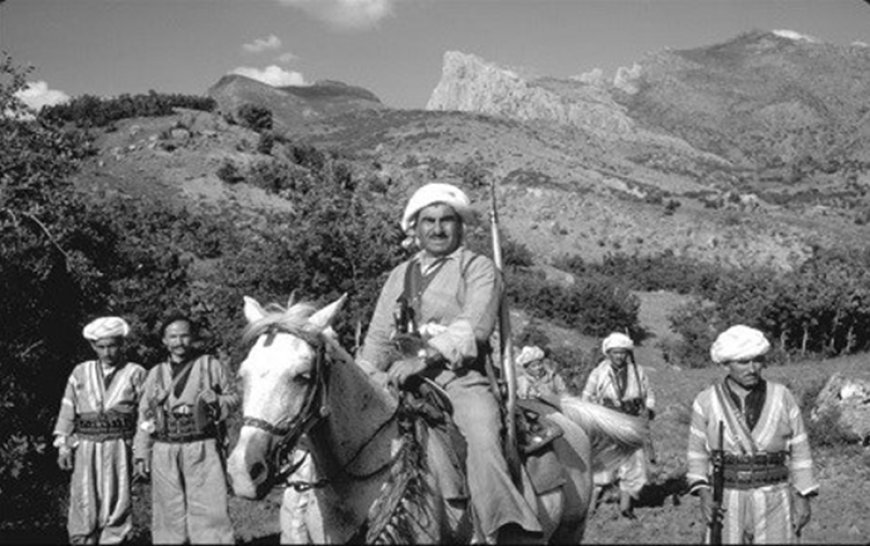
Today, 01 March 2026, marks the 47th anniversary of the death of Mullah Mustafa Barzani, the legendary Kurdish leader. He remains one of the most influential figures in modern Iraqi Kurdish history. Born in 1903 in the village of Barzan, he devoted his life to fighting for the dignity, recognition and lawful rights of the Kurdish people. Across decades marked by exile, armed struggle and negotiation, he combined religious education, intellectual development, military leadership and diplomatic engagement.
From an early age he absorbed the values of faith, service, self-restraint and collective responsibility from his family and in particular Sheikh Ahmed Barzani, often considered to be the architect of Barzani rule in Iraqi Kurdistan and a Kurdish nationalist who brought many different Kurdish tribes under his command. Mustafa Barzani’s first education began in the mosque of Barzan, shaped by Quranic teachings and ethos. Even in later years, when commanding thousands of Peshmerga or negotiating with presidents and prime ministers, he retained the manner of a religiously grounded leader: measured in speech, modest in personal life and conscious of moral accountability.
His childhood, however, was not sheltered. In 1906, at only three years old, he was imprisoned with his mother in Mosul following accusations connected to his brother Sheikh Abdul Salam’s uprising. Exposure to repression at such a young age instilled resilience. Rather than fostering bitterness, it strengthened his resolve and deepened his sense of duty towards his community. The combination of spiritual upbringing and lived hardship shaped a leader who was both determined and disciplined.
In 1934, during exile in Mosul, Barzani expanded his studies. He learned Islamic jurisprudence at the Abdullah Nashat Beg Mosque and studied Persian language and literature. His intellectual curiosity later extended beyond religious scholarship. During his years in the Soviet Union, he enrolled in the Higher Party School in Moscow in 1955, earning a degree in political science. Fluent in Kurdish, Arabic, Persian, Turkish, Russian, Armenian and English, he was able to engage with diverse cultures and political systems. This intellectual breadth strengthened his ability to present the Kurdish question on an international stage.
General Barzani’s emergence as a military leader began during the First Barzan Revolution (1931-2). Commanding Kurdish forces against the Iraqi army, he demonstrated tactical skill and calm authority. When overwhelming force and aerial bombardment led to the destruction of villages, he chose organised withdrawal rather than reckless sacrifice. His decisions reflected not only courage but responsibility, a determination to preserve his people and their capacity to continue their struggle.
The Second Barzan Revolution (1943-5) further established his leadership. He led coordinated campaigns and achieved notable victories, yet he remained open to negotiation. In 1944 he entered talks with Iraqi representatives and secured the release of his brother Sheikh Ahmed Barzani. This pattern of combining resistance with dialogue mirrored the mediating tradition of the Barzan way, key characteristics of which are conflict resolution and communal balance.
In 1946, Mustafa Barzani became chairman of the newly founded Kurdistan Democratic Party (KDP). Re-elected unanimously at successive congresses, he offered steady leadership rooted in personal integrity and shared sacrifice. His authority did not rely solely on military command but on trust built over years of consistent conduct. He sought to unify tribal, regional and ideological differences within a common national framework.
That same year, he played a key role in the Republic of Mahabad in north-western Iran, serving as a general in its army. When the republic collapsed under military pressure, he organised an orderly retreat to prevent unnecessary loss of life. In 1947 he refused surrender and instead led hundreds of Peshmerga on a demanding journey towards the Soviet border. He ensured that all his men crossed safely before him, reportedly being the last to cross the River Aras. This act symbolised the protective responsibility he felt as a leader.
During exile in the Soviet Union from 1947 to 1958, Barzani continued to campaign for Kurdish rights and advocating for them at the highest levels of the Soviet hierarchy, petitioning those such as Stalin, Molotov, Khrushchev and the International Department of the Central Committee of the Communist Party of the Soviet Union regarding Kurdish refugees. In 1956 he expressed solidarity with Gamal Abdel Nasser during the Suez Crisis. His home in Moscow became a refuge for Kurdish exiles, reflecting the hospitality associated with the traditions in which he had been raised.
After the 1958 revolution led by Abdul Karim Qasim, Barzani returned to Iraq. His arrival was greeted with widespread public support and a hero’s welcome in Baghdad on 6 October 1958. In meetings with Iraqi leaders, he emphasised partnership between Kurds and Arabs within a unified state. He did not call for separation but for constitutional recognition and equality.
The September Revolution, beginning in 1961, represented the longest sustained period of armed struggle under his leadership. He reorganised the Peshmerga into structured commands, demonstrating methodical planning. While leading significant battles, he also engaged in negotiations with figures such as Abdul Rahman Arif and later Saddam Hussein. These talks contributed to the March 1970 Autonomy Agreement, which formally acknowledged Kurdish cultural and administrative rights within Iraq. Although later disputes arose, the agreement marked an important recognition of Kurdish identity at state level.
Barzani survived assassination attempts, imprisonment and exile throughout the course of his life, yet he consistently called for unity. In 1970 he pardoned rival Kurdish factions in the interest of national cohesion. This commitment to reconciliation demonstrates the mediating role he had long practised, and illustrates the importance of dialogue, the cornerstone of President Nechirvan Barzani’s approach to government, diplomacy and conflict resolution.
After the suspension of the Kurdistan Revolution in 1975, he entered exile once more, continuing to advocate for Kurdish rights until his death in 1979. His remains were later returned to Barzan, where large crowds gathered to honour him. He rests alongside Idris, his son, who died in 1987.
The life of Mullah Mustafa Barzani was defined by steadfast commitment to the dignity and lawful rights of the Kurdish people. From a childhood marked by faith and hardship to decades of leadership in revolt, negotiation and exile, he balanced resistance and struggle with dialogue, authority with humility. Forty-seven years after his death, his legacy endures not only in the political institutions and national consciousness he helped shape, but also in the enduring ideal of principled, unified and morally anchored leadership for the Kurdish cause.
It is worth ending this on one of his most famous sayings. “If you cannot serve your nation, at least do not betray them.”







/file/attachments/orphans/ED_543155_209242.jpg)