

/file/attachments/orphans/ED_543155_209242.jpg)





















Out of the ruins: will Aleppo ever be rebuilt?
Years of civil war have turned whole areas of the city into rows of empty husks. But after the fall of Assad, Syrians have returned to their old homes determined to rebuild

The kebab stall stood in the shadow of a building whose three upper floors had been sheared in half, leaving behind concrete slabs that seemed to hang in mid-air. Under a tarpaulin, its edges weighted with cinder blocks, stood a thin man with a thick white beard. Smiling, he stoked the fire in a narrow grill. Walking back and forth to a table set atop a wheelbarrow, he tenderly inspected a dish laid out with tomatoes, greens and a few skewers of meat. A torn mat covered the floor, while a plastic ice box and a few more cinder blocks provided seating for the customers who were yet to appear.
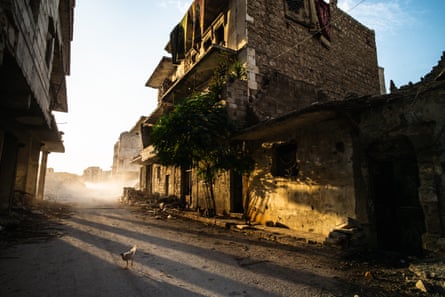
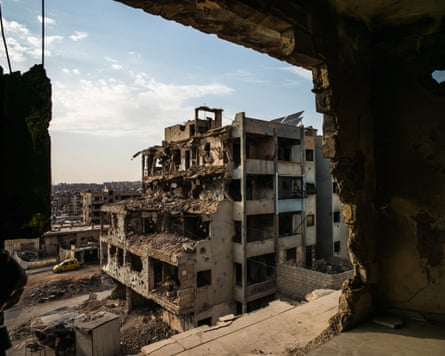
The streets were largely deserted here in Amiriya, a dilapidated suburb of Aleppo that once formed the frontline between the rebel-held enclave and government-controlled areas. But there were a few signs of life: children hopping on and off a rusty motorcycle, a woman selling cigarettes and water from a shack, a young man digging through the rubble with his hands, pulling out pieces of limestone and stacking them in a neat pile to use later in rebuilding his own house. “They are much better than the new ones,” he told me.
Across Syria, there are thousands of streets just like this one. A year after Bashar al-Assad fled the country and his regime collapsed, nearly 3 million Syrians have returned from abroad and from the refugee camps in the north. Many drifted back into ghost neighbourhoods, places without water or electricity, where darkness swallowed entire blocks. With housing scarce, inflation soaring and rents massively increasing, many have no choice but to seek shelter in the wreckage of their former homes. The scale of destruction is so vast that rebuilding a single neighbourhood would be a daunting task even in the best of circumstances. But people are trying.
In Amiriya, a man with dirty black jeans and a red T-shirt that said Burn Your Past on the back, beckoned me to come closer. “Don’t talk to him,” he said, nodding towards the kebab stall. “He stole a bag of cement from me.”
The man introduced himself as Abu Arab, and pointed to a roofless corner building. It was his family home, he said, and he had just moved back into it after 13 years. It stood with its columns and flooring slabs exposed, scarred by years of fighting. But there were also signs of recent works: a new cinder-block wall on one side, and freshly fitted metal shutters.
He pushed through the door and led me into a dark corridor where a few bags of cement were lined up. “They keep stealing them, so now I have to sleep here to guard them,” he said, his oily black hair falling on his forehead. We picked our way up the stairs. Some sections had collapsed, and others he had recently recast. I held on to the edges for balance. “Be careful,” he said. “Don’t lean on the wall, it’s buckling.”
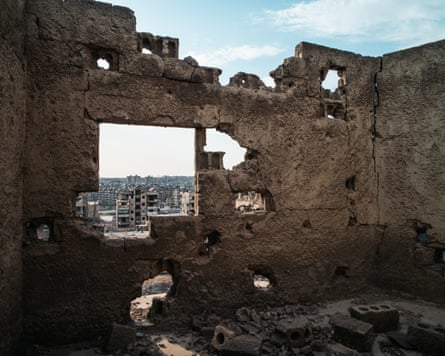
He made his way up nimbly, despite a pronounced limp. I followed him into a small corner room on the third floor. The roof was gone and it opened to a pale autumn sky. “This was my room,” he said. “My desk was here on the left, a single bed on the right, and a narrow cupboard in between.” He gestured as if he could still see the furniture, still remember its colours and smells. “It was the smallest room in the house, but I wasn’t married then,” he added with a faint smile. His wife and children were staying in a rented apartment in the hills outside Amiriya, waiting for him to finish work on the house before they could join him, he said.
The walls were black with soot and punctured with holes, though these were larger than the usual bullet marks. He led me to one and told me to look through it. “This was a sniper’s position,” he said proudly. “It overlooks the whole area. My cousin was stationed here for a while.”
A local politician in Aleppo, who did not want to be named, told me that nearly two-thirds of the city is in ruins. The destruction is so vast that it will take years just to clear the rubble, let alone start rebuilding. He said it would take decades for Aleppo to return to the city it was before the war. All the reconstruction efforts so far are local, with individuals – like Abu Arab – trying to rebuild their own homes and places of business. This unorganised restoration is dangerous, he believes, because most of these buildings are structurally unsound. “But what can people do?” he asked. “They can’t afford rents and don’t want to live in tents any more.”
Amiriya, straddling a line of hills on the southern outskirts of Aleppo, emerged in the second half of the 20th century, when the city – like many across the region – began expanding: absorbing neighbouring towns and villages, consuming orchards and fields, and turning them into vast working-class districts of identical concrete blocks.
Abu Arab told me that his father, a medic, had built this house himself in the early 80s. It was a multi-storey building with a basement, ground-floor storerooms, and three floors above for his wife and children. “He used the best-quality concrete to cast the columns and floors,” Abu Arab said, patting the wall gently.
After the family moved into their new house, the ground-floor garage and store room were converted into a clinic where Abu Arab’s father and elder brother worked, administering local remedies and injections, and dispensing medicine. The basement, like countless others in the neighbourhood, had been packed with the family’s winter provisions: dried bulgur, olive oil and rows of preserves and pickles in jars.
On the roof, his mother had once tended to her little garden of tin cans filled with basil, mint and tarragon, and even a small lemon and olive tree. On warm summer nights, Abu Arab and his brother would sit for hours on the metal swing, smoking and breathing in the mingled scents of herbs and dust. From that rooftop vantage point, the brothers would gaze at the lights of Aleppo, the highway snaking south toward Damascus, the distant outline of the hills, but most of all, they watched the city itself: a sea of blinking lights shimmering into the night.
For 5,000 years, Aleppo has been a great metropolis at the heart of a region that stretches from the shores of the Mediterranean, across the fertile lands of what is now southern Turkey, and all the way to Mosul in modern-day Iraq. Throughout the centuries, Aleppo prospered as a trade hub and manufacturing centre. It endured its share of invasions, plagues, civil strife and natural disasters, yet somehow managed to preserve a distinctive character evident in its architecture, cuisine and the social fabric of its multilingual, multi-ethnic communities, all of which could be observed in the old souks of al-Madina, the historic city centre.
In 2011, when demonstrators, and later rebel fighters, filled Syria’s streets, Aleppo’s lack of revolutionary zeal, and the near absence of protests in the city, became at first a source of ridicule and later of anger at the population’s perceived indifference. Finally, in the summer of 2012, more than 15 months after the start of the Syrian uprising, a coalition of rebel groups advanced on Aleppo from their staging grounds in the surrounding countryside. “We had to force the people into the revolution,” one rebel commander, a native of Aleppo, told me at the time.
When the fighting reached Aleppo, Abu Arab’s family abandoned their home. Like many residents in their neighbourhood, at first they believed it would only be a matter of time before they could return. Soon, however, they joined the exodus of Syrians fleeing the war. Abu Arab still remembers, and grieves, the belongings the family left behind, especially the ton and a half of tomato paste his mother had spread out on the roof to dry for the winter. “You know how we Halabis [Aleppians] care for these things,” he said, smiling and patting his large belly.
The urban warfare that followed, some of the most brutal in recent memory, was shaped by the very architecture built by men like Abu Arab’s father. The design of these districts, with their narrow streets, close balconies and cuboid buildings, offering a clear line of sight, made them ideal terrain for snipers. A single gunman perched on a rooftop, or concealed in a corner room, could dominate an entire cluster of streets. The long, confined roads became death traps. In response, the rebels burrowed tunnels underground, first as supply routes and escape passages, then packed them with explosives and set them ablaze, collapsing entire buildings into the earth.
During the lulls in the fighting, Abu Arab – who was squatting with his family in an unfinished concrete structure on the other side of hills facing Amiriya – would return to the house. Like other civilians, he had to brave the journey across the frontlines, passing first through government, then rebel checkpoints. Then came the dash across sniper-dominated alleyways.
Each time he reached the house, he found it more derelict than before. “First the neighbours broke in,” he said. “They took things like the gas canisters. That was fine. People needed them.” But piece by piece, the house was stripped bare. Even his beloved metal swing from the roof disappeared. “When I saw them sifting through my mother’s and sister’s clothes, our family pictures and papers, even my father’s certificates …” He paused, unable to finish the sentence.
In those years, people’s lives and homes became intimately entangled with those of the fighters. At night, the fighters slept in commandeered apartments where the belongings of the original owners still lay scattered about. Empty Styrofoam meal packets, spilled rice and plastic bottles lay beside piles of women’s clothing.
Fighters smashed large holes in tower block walls to create makeshift corridors through abandoned apartments. Once, during the years I reported on the fighting in Aleppo, I followed a group of insurgents as they navigated one of these corridors. They tumbled through a hole in one apartment’s kitchen, stepping on to the marble sink. The fridge door hung open and was full of rotten vegetables. The old occupants had left behind jars of pickled olives and chillies sitting intact on the cupboard shelf.
From the kitchen, the fighters walked down the apartment corridor, which was covered with thick layers of white dust and the boot marks of dozens of men. We then walked into the children’s room, where toys were neatly stacked in a blue plastic box, and through another hole in the wall into the neighbour’s bedroom, where we stepped over piles of clothes and women’s shoes scattered across the floor. The journey reminded me of the cross-section drawings I had studied in architecture school.
After the anti-Assad fighters retreated in 2017, Amiriya became one of the many ghost suburbs encircling Aleppo: rows of hollowed-out buildings, their facades peeled back, concrete slabs jutting out like broken ribs, entire streets lined with skeletal frames rising from mounds of greyish-brown concrete like tombstones. In many areas, the Assad regime barred residents from returning to former rebel-held districts, especially those with military significance. The military commanders in charge of these districts “sold” entire blocks to contractors, who sent in workers to strip everything of value: cables, pipes, switches, rebar, leaving nothing behind but the large portraits of the dictator, in sunglasses, looking down and marvelling at the tidy job his men had carried out.
For decades prior to the civil war, Aleppo remained apart from many of the ideological battles that shook Syria. One notable act of resistance came when the Old City was threatened by a urban-modernisation plan that would have destroyed entire historic quarters. Despite the Ba’athist regime’s oppressive rule, Aleppians successfully resisted the project, securing Unesco world heritage status for the Old City in the 1980s.
More than any other city in the Middle East, Aleppo managed to preserve its historical identity into modern times, not only by safeguarding old buildings and artefacts, but in maintaining the Old City as a living economic and social organism, where traditional crafts were still practised in the old workshops. The Old City and its famous al-Madina souk – the largest covered market in the world – remained at the heart of the city’s entrepreneurial life, clustered around its ancient khans. A two- or three-storey complex of rooms built around a central courtyard where merchants, pilgrims and travellers could rest, stable their animals, store their goods and conduct trade, khans ranged from humble roadside inns to exquisitely ornate complexes endowed by the wealthy families and rulers of the city.
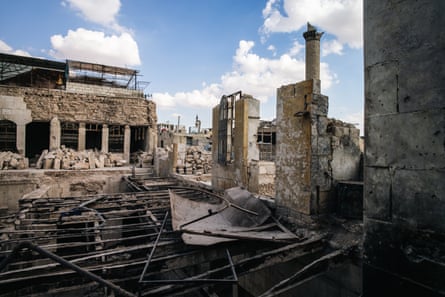
Late last year, in the souk’s maze of covered alleyways, I found a man named Annas sitting in the courtyard of his old khan, with one of his sons and two merchants beside him. The khan itself was in ruins. In 2023, an earthquake shook the region, causing severe damage to an old city already weakened by years of fighting. As we spoke, Annas’s emotions swung between pain, as he recounted his own losses and those of his city, and the exhilaration of being back in the old souks.
Before the war, Annas had been a moderately wealthy businessman who owned garment factories in the old city and several properties across town. Back then, he liked to be the first to arrive at the khan, before the covered market filled with noise and crowds. He would look around the courtyard, admiring the graceful arched and tall windows. If he craned his neck just a little, he could glimpse the slender 16th-century minaret of a nearby mosque.
Once the fighting in Aleppo began, it was only a matter of time before the historic districts burned. The first fires tore through parts of the al-Madina Souk in 2012. Sections of the Great Mosque were consumed by flame, and the library in its eastern wing, home to invaluable manuscripts, was incinerated. Soon after, the minaret collapsed. One by one, khans, hammams and buildings of incomparable historic and religious significance vanished. As the rebels dug tunnels beneath the ancient quarter, enormous underground charges detonated beneath Ottoman-era barracks, sucking entire structures into the cavities created by the blasts.
By his own account, when the uprising began in 2011, Annas had little interest in politics. It wasn’t until a year later that he was radicalised, after a humiliating incident at the hands of Assad’s police, who hit him and arrested him, forcing him to kneel on the ground in his beloved souk in sight of other merchants. After an $800 bribe, he was released. But, he told me, this one moment of public shame set him on a trajectory he could not escape. “On that day, I decided I would sacrifice my life, my wealth, even my children’s lives, to topple that regime,” he said. He went on to form a small rebel group composed mainly of local people from the old city: some of his factory workers and even a few of their sons. They based themselves in the alleyways of the souks, around the Antakya Gate.
Eventually, in 2017, after the rebels retreated from Aleppo, Annas smuggled himself into Turkey and decided to start over, doing what he knew best: making garments. The business thrived and, after a few years, he managed to make enough money to settle his children into their own apartments and expand his operation.
Yet the pain of exile never left him. Every night he sat with his family, repeating the same stories of his father’s and grandfather’s journey into Aleppo and its old souks, and of how everything they had built there was now gone. “Even my wife and sons were bored with me repeating the same old stories about Aleppo,” he told me. “I had no one left to tell these stories to except my youngest grandchild.” Every Sunday, he would take the boy to a park in Istanbul and repeat the same tales: “We had lands and factories in the greatest city in the world.”
“The poor boy would listen quietly. Sometimes, he would say, Jido[grandad], I know all of that, but he still listened without complaining.”
The al-Madina Souk is made up of a network of smaller souks, each devoted to a trade: spices, ropes, olives, fabrics and so on. Nine of 54 souks have been renovated, and when I visited, they were full again with people: shoppers jostling, merchants shouting, porters clearing paths for their pushcarts, customers testing underwear and bras by pinching the fabric between index finger and thumb.
Many of the souks remain in ruins. Grass grows on the roofs of caved-in stalls, and domes have collapsed, casting sharp shadows. Shop shutters are still twisted and riddled with bullet holes. In one ancient khan that served as a barracks during the war, iron bars that once formed part of elegant facades, now prop up half-destroyed walls. Inside, on the day I visited, there were still stacks of sandbags, rusted cans of army rations and filthy mattresses. Fires had turned a vaulted ceiling black, and bits of plaster were then punctured by bullets, giving the impression of stars sparkling in a dark sky. In the middle of what was once a busy thoroughfare, an old guard’s sofa sat abandoned.
At one point, as I wandered along a dark alleyway, the sound of a drum rose from a hammam. A small crowd gathered as young men danced a groom out towards his wedding party. Some people hurried past the ruins towards the parts of the souks that have been renovated, while others lingered to take selfies.
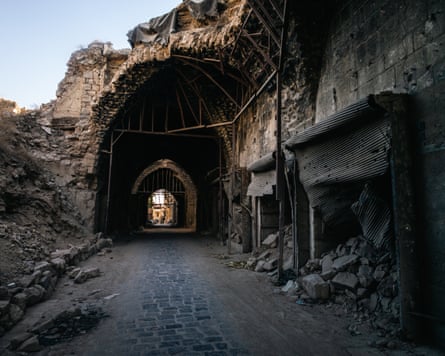
In one of the oldest and most magnificent khans, a dozen or so young men crouched on the floor, in semi-darkness, shaving soap bars into perfect cubes, as if war had never come to this city, but outside, the ruins and rubble stretch for hundreds of metres on each side. Some ceilings remain charred. Others have been repaired. A number of renovations are delicate, respectful of the old fabric; others look like the corridors of a shopping mall. Even in those souks where everything is still burned, where entire market lanes sit dark and abandoned, men have returned to sit on plastic chairs outside their ruined shops, waiting, watching, refusing to leave the place that once made them who they were.
Annas told me that his newest challenge came from far away: China. Since the fall of the regime, customs duties had been removed and tariffs slashed, flooding the old markets with cheap imported merchandise and crippling Aleppo’s remaining industries. “If they don’t stop the imports, I won’t be able to reopen my workshops,” Annas told me. “Do you know how many people work to make a single bra? There’s the one who sews, the one who glues the sponge, the one who attaches the elastic, and then …” He stopped, counting on his fingers. “Thirty-five people. Thirty-five people work in the process of making a single bra.”
He looked around the ruined courtyard, the broken arches and fallen stones. “I don’t need the UN or the Americans,” he said. “Just close the border to Chinese goods, and we’ll find work for thousands of workers.”
In recent weeks, two Kurdish enclaves in Aleppo have come under fire, and reports say that more than 300 Kurds have been detained. These areas were considered relatively safe during the war, and are packed with people – Arabs, Kurds and Christians – who fled their homes when their houses were destroyed. The local politician I spoke to has been involved in negotiating safe passage for civilians trying to escape this new outbreak of fighting. “I can see the columns of smoke rising from Sheikh Maqsoud [one of the two areas], and the scenes of the people fleeing are breaking my heart. It’s like the early days of the war,” he said.
The recent violence, he says, stems from the two sides being unable to reach a solution. “The government can’t accept the presence of armed formations inside the city [the Kurds], and the Kurds don’t want to give up their weapons because they don’t trust the government.”
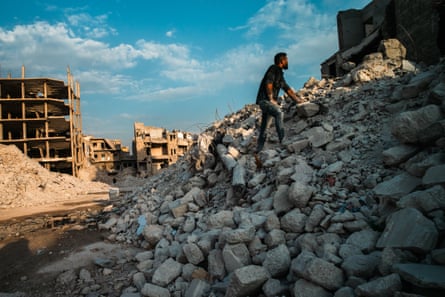
Walking through the ruins of Aleppo, it often feels as if the conflict is not over, as if snipers might still be peering from their hideouts. Cities such as Beirut, Sarajevo and Mosul feel as if they continuously live in the shadow of their former wars. And maybe the only way to defeat that fear is not by erasing the ruins and building anew, but by following Abu Arab’s way of confronting the destruction little by little, fixing a frame, fitting a door, patching a wall, conquering the ruins brick by brick.
I asked Abu Arab if he had tried to come back and live in the house after the fighting in Aleppo ended in 2017. He said yes. A few months after the rebels left, he had tried to return to the house again. This time, he found it occupied by a company of government soldiers. The walls were blackened with soot, and whatever had not already been looted was now gone. The soldiers did not believe his story that he was visiting his family home. They detained him immediately, hoisted him by his arms from the ceiling, and began interrogating and torturing him: wasn’t this house occupied by terrorists? Who were they? Did he permit them to establish their sniper post upstairs?
His detention and torture were brief. The soldiers found nothing on him, except that he had never completed his reserve military service. He was promptly conscripted and sent to serve in the army for two years. During one of the battles, he was wounded in the leg, an injury that never healed. (This was the cause of his limp.) After that, he had waited for the regime to fall before he dared return.
Before leaving, he led me into what must once have been the living room. It was filled with old soldiers’ mattresses and trash. From behind a paint canister, he pulled out the flag of the former regime: red, black and white with green stars.
“Why do you still keep it?” I asked him.
“I don’t know,” he said. “You never know what might happen in this country.”
“Do you really think Assad might come back?” I asked, incredulous.
“I don’t know,” he said quietly. “We have seen a lot … and been burned many times.”
[Source: The Guardian]

/file/attachments/orphans/GettyImages-173171038_666041.jpg)