








/file/dailymaverick/wp-content/uploads/2025/04/Krill_school_1_credit-Aker-Qrill.jpg)



































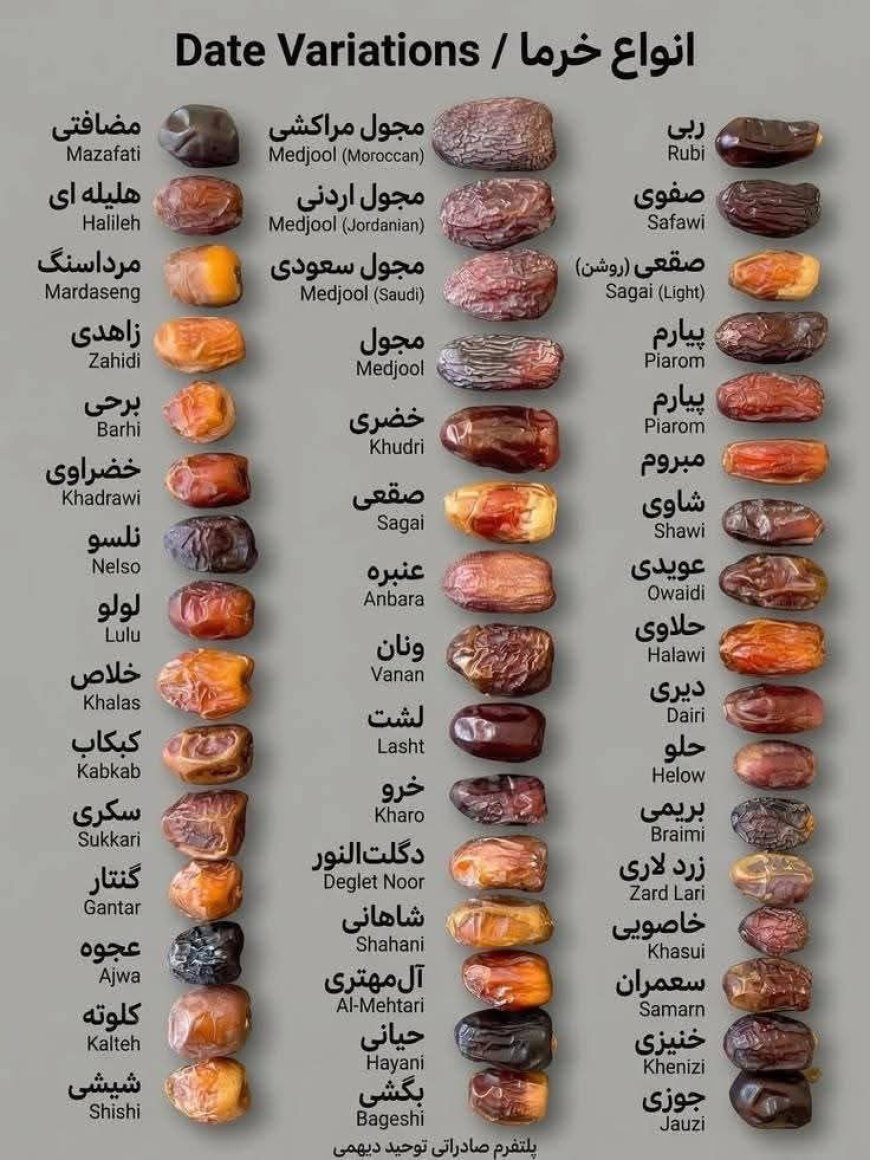
The different types of date
An image from Masakan Terengganu and some general information.
Dates have been cultivated in the Middle East and the Indus Valley for thousands of years, and there is archaeological evidence of date cultivation in Mehrgarh, a Neolithic civilisation in western Pakistan, around 7000 BC and in eastern Arabiabetween 5530 and 5320 BC. Dates have been cultivated since ancient times from Mesopotamia to prehistoric Egypt. The ancient Egyptians used the fruit to make date wine and ate dates at harvest. In the Levant, the earliest traces of dates appear during the Chalcolithic period, at sites such as Nahal Mishmar (Israel) and Teleilat el-Ghassul (Jordan). Evidence of cultivation is continually found throughout later civilisations in the Indus Valley, including the Harappan period from 2600 to 1900 BCE.

One cultivar, the Judean date palm, is renowned for its long-lived orthodox seed, which successfully sprouted after accidental storage for 2,000 years. In total seven seeds about 2000 years old have sprouted and turned into trees named Methuselah, Hannah, Adam, Judith, Boaz, Jonah and Uriel. The upper survival time limit of properly stored seeds remains unknown. A genomic study from New York University Abu Dhabi Center for Genomics and Systems Biology showed that domesticated date palm varieties from North Africa, including well-known varieties such as Medjool and Deglet Nour, share large parts of their genome with Middle East date palms and the Cretan wild palms, P. theophrasti, as well as Indian wild palms, Phoenix sylvestris.
An article on date palm tree cultivation is contained in Ibn al-'Awwam's 12th-century agricultural work, Book on Agriculture. In later times, traders spread dates around southwest Asia, northern Africa, and Spain. Dates were introduced into California by the Spaniards by 1769, existing by then around Mission San Diego de Alcalá, and were introduced to Mexico as early as the 16th century.
[Source: Wikipedia