

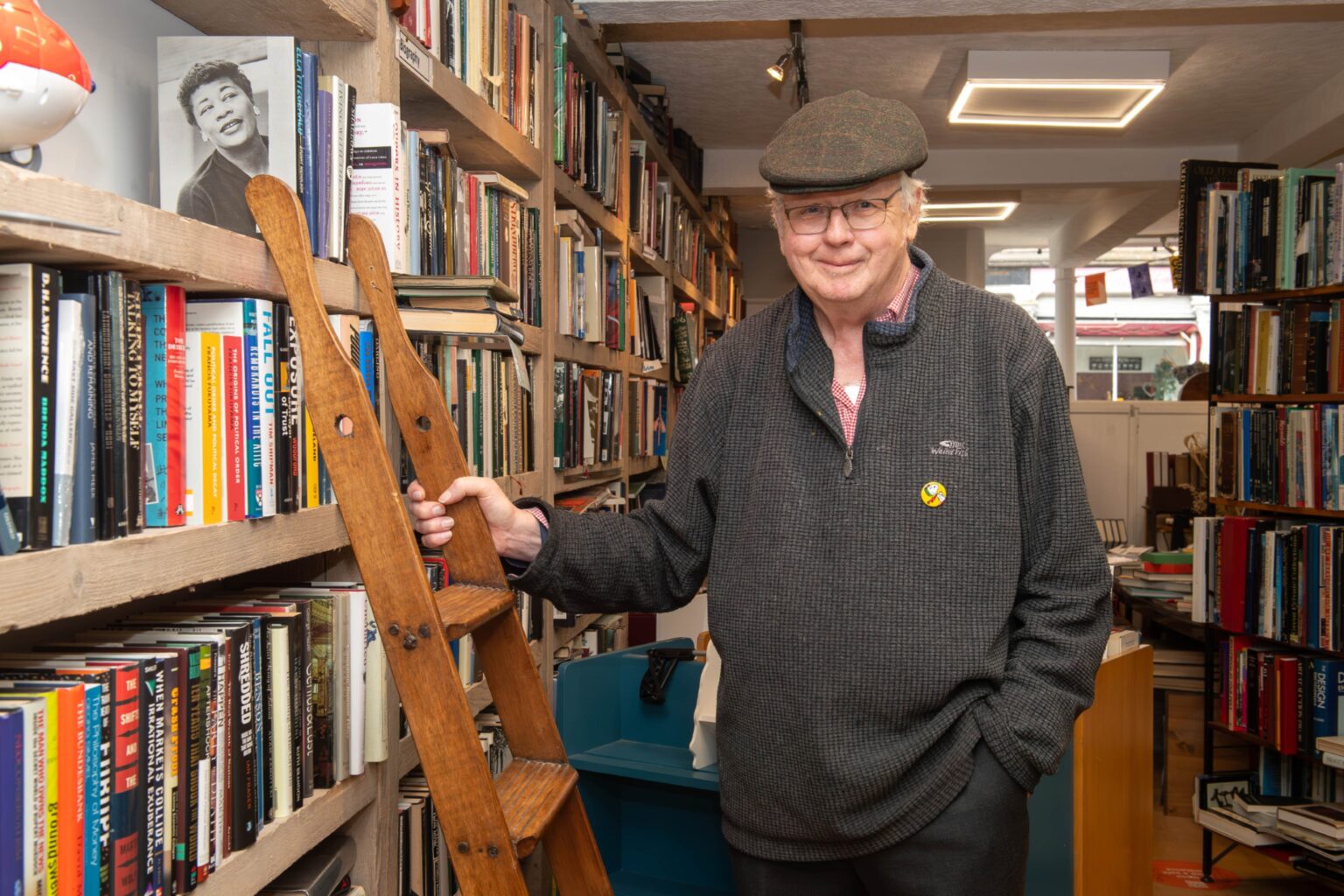



















Simon Richards, popular Conservative activist whose campaigning helped pave the way for Brexit
He was devoted to Margaret Thatcher, and planned to conduct tours of her home town, Grantham

Simon Richards, who has died of a suspected heart attack aged 67, was not a politician in a conventional sense, but his role as a campaigner for the Conservative movement over several decades was significant – not least in setting the course for Brexit, well before the term existed.
He never held elected office, or showed ambitions in that direction. Though he was a staunch Conservative Party member his focus was not on party politics. While personally convivial, he avoided the limelight, preferring to sit at the back rather than be up on stage.
In 2006, a decade before the EU referendum, Richards co-founded Better Off Out (BOO) and served as its chief executive. At that stage, very few Conservative MPs were prepared to advocate withdrawal from the European Union, in public at least. Douglas Carswell, who later defected to UKIP, was one, and Daniel Hannan was among the select group of Conservative MEPs to sign up.
David Cameron, elected Conservative leader in 2005, had said that the Party was not to “bang on about Europe”, and while BOO was not quite a proscribed organisation, a clear signal went out from Conservative headquarters and the party whips that involvement in it was considered “unhelpful”. John Maples, deputy chairman with responsibility for candidate selection, indicated that the leadership would form “a dim view” of any candidate who signed the BOO pledge.
Yet gradually more signed up, boosted by an endorsement from Lord Tebbit. It was a cross-party campaign: Labour’s Austin Mitchell and the UKIP MEP Nigel Farage were backers.
But its significance was its work among Conservatives. David Nuttall became chairman of BOO soon after his election to Parliament in 2010, and the following year he tabled a Commons motion calling for a referendum on EU membership by 2013; 81 Conservative MPs voted for it despite a three-line whip to vote against. This huge rebellion prompted Cameron to promise a referendum in the subsequent Conservative manifesto, and in 2016 Britain left the EU.

BOO was a spin-off from the Freedom Association, which had been left a £300,000 legacy and used the funds for the campaign to leave the EU. There was grassroots activism: a leaflet asking: “Did you know that the European Union cost your family £6,000 last year?” was pushed through letterboxes and handed out at street stalls. Conferences were held and pamphlets produced.
Richards also undertook a broader political role with the Freedom Association, becoming its director in 2008. He had joined as a schoolboy in the 1970s, when it was called the National Association for Freedom, founded by Norris and Ross McWhirter, and mainly focused on curbing the power of the trade unions.
Sensing that the Conservative Party conferences had become rather dull affairs, catering more for lobbyists than the membership, he spearheaded the Freedom Zones that sat next to the Conservative Party conferences but were never part of them. Tory delegates would face the rigorous intellectual challenge of free-market think-tankers. Nigel Farage and other UKIP figures would also come along and speak. This offered a chance for Eurosceptics to cross-fertilise – another important preparation for the EU referendum.
With a flair for eccentricity, Richards arranged for the Freedom Association to maintain an office in HMS President (1918), berthed in the Thames on the Victoria Embankment in the City, close to Blackfriars.
Richards studied history at King’s College London from 1977 to 1980; as chairman of the Conservative Association there he hosted meetings with prominent Conservatives such as Rhodes Boyson, prompting protests from Leftist students.
Richards played an important role in mobilising support for the national takeover of the Federation of Conservative Students (FCS) from Tory “wets” in 1980. He then served as its vice-chairman of FCS, alongside its chairman Peter Young, campaigning for reductions in taxes and the size of the state, and in particular to end public funding for the Left-dominated National Union of Students.
Although a firm supporter of Margaret Thatcher, the new prime minister, he challenged her in a meeting with the FCS Committee over public spending. “We have all this talk of cuts,” he said, “but total public spending is going up.” Mrs Thatcher found the challenge rather refreshing.
Simon Timothy Richards was born in Cardiff on June 23 1958, the third of four children. His parents, Michael and Margot, were both GPs. Simon attended Shrewsbury School, where he was a keen motor racing fan. As a member of the Chequered Flag club at school he attended the Monaco Historic Grand Prix – more to his taste than the modern grands prix – and he retained an interest in classic cars for the rest of his life.
He did a management training programme at British Home Stores, first in Liverpool, then in London, in the lighting department at a time of IRA bomb scares. His duties included ushering women out of the cloakrooms during the occasional evacuation.
Despite his fervent belief in capitalism and his flair for applying an innovative and enterprising approach to political activity, he did not achieve particular success in the business world. After he was transferred to Cheltenham, where he ran the BHS lighting department, he set up his own lamp shop in the town called The Light Brigade, which went out of business during the recession of the early 1990s. He then ran the Cheltenham Museum gift shop for several years. He spent much time visiting museums, objecting to serif fonts on signs, feeling that it made them less readable.
In 2025, Richards moved to Newark, where he had a flat in the former billiard room of the Ossington Coffee House, an 1882 temperance tavern. He wanted to be near Grantham, as he had hopes of giving Margaret-Thatcher-related tours; an earlier idea had been a dedicated Thatcher museum.
On the day of Mrs Thatcher’s funeral, Richards organised an event at the Pavilion End Pub in Bow Lane which gave ordinary people the chance to speak and exchange stories of her. It was so successful, with more than a thousand attending, that they ran out of beer.
Though he detested the EU, Richards was keen on continental travel; friends could find his thoroughness exhausting. The Scruton Cafe in Budapest was considered an essential detour. In Turin, he wanted to visit many of the locations from The Italian Job.
Sir Mark Worthington, who served as private secretary to Margaret Thatcher from 1992 until her death in 2013, and was Chairman of the Freedom Association from 2014 to 2018, said: “It has often been said that Simon Richards was ‘the nicest man in politics’. That was true. But what perhaps is more remarkable about that accolade is that he earned it while holding a set of strong political beliefs and principles which were unwavering throughout his life.
“He applied these with such genuine warmth, good humour and courtesy that opponents almost felt guilty in disagreeing with him. Having known him since university, I never once saw him lose his temper.”
Richards was a happy warrior, comfortable in his own beliefs. Though he did not have much in the way of fame or fortune, and never married, he enjoyed considerable success in his battles. He was fond of quoting a maxim from one of his heroes, Ronald Reagan: “There is no limit to the amount of good you can do if you don’t care who gets the credit.” That was the approach that he followed.
Simon Richards, born June 23 1958, died February 21 2026
[Source: Daily Telegraph]