



/file/attachments/orphans/RC2EHLAVWW1L_103363.jpg)









/file/attachments/orphans/iStock-802203090_325419.jpg)

















Aberdeen fights to survive Miliband’s North Sea destruction
‘Granite City’ struggles as oil and gas, the engine of its prosperity, dies out

In the picturesque backstreets of Aberdeen, Angela Bardbrook still remembers when her tearoom did a brisk morning trade.
“We had queues out the door before we opened. I just couldn’t keep up,” she says. “Now, business is terrible. We’re clinging on.”
Bardbrook, 57, started Cup, her small café, back in 2013 when Aberdeen was flying high.
Now an eerie quiet has descended over the “granite city”. Aberdonians are struggling because the North Sea oil and gas sector, the engine room of the city’s prosperity, is dying.
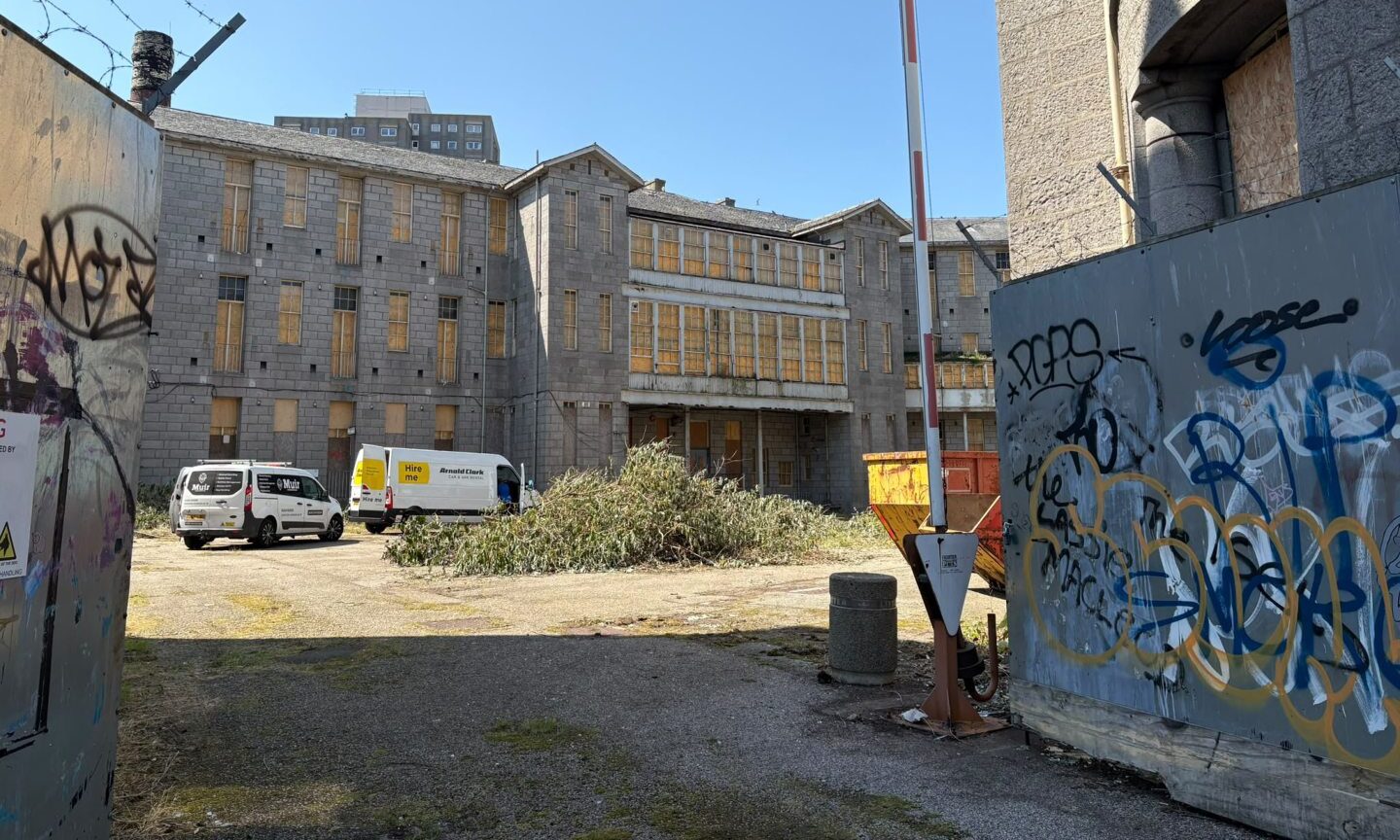
Shops in the city sit vacant, offices are being demolished and everyone knows someone who has been made redundant.
People in the city blame one man for the turmoil: Ed Miliband.
“I despise him,” says Seth Flower, 47, who has just returned from weeks offshore working as an engineer on the UK’s North Sea oil and gas platforms.
Flower has been watching contractors get laid off in significant numbers. “There is hatred and anger at the level of ignorance of the people we are being run by,” he says.
The Energy Secretary is the figurehead for Britain’s rapid decline in oil and gas production.
Companies have exited, 1,000 workers are getting laid off per month and production is plummeting far more quickly than previously expected.
Oil bosses warn rigs are getting decommissioned prematurely and billions of barrels of oil are going to be left untapped in UK waters.
Sky-high taxes began under the Conservatives. But Labour has increased the rates and banned new exploration licences. Miliband has insisted that increasing domestic production would be “precisely the wrong thing for our country” while he pushes towards net zero.
But this is also a massive economic and environmental own-goal for the country.
Less domestic production does not mean the UK consumes fewer fossil fuels. It means we import more from overseas, which is more expensive, brings in no tax revenues and often produces higher carbon emissions.
By 2035, the UK will rely on liquefied natural gas (LNG) from the US for 60pc of its gas supply, up from 9pc today, according to a forecast from Wood Mackenzie, a consultancy. This comes with precisely triple the greenhouse gas emissions of North Sea gas production.
“I find it disgusting that we lose jobs to fund other countries and save nothing,” says Flower.
Miliband may yet become Andy Burnham’s chancellor. But for both men, the crisis of the North Sea is a political time bomb that could detonate at any moment.
Last month the Conservatives won the Aberdeen South by-election, the first Tory by-election victory in Scotland in more than 50 years, on a pro-North Sea platform. “Ed Miliband is seen as the destroyer of the North East’s oil and gas sector,” says Douglas Lumsden, who won the seat.
The stakes are high for Aberdeen’s economy, its politics and its people.
North Sea survivors
Aberdeen’s oil and gas industry rises early and is obsessively preoccupied with safety.
Visitors to the head offices of the oil majors must watch induction videos detailing best practices for parking. Even coffee cups are banned from one flight of stairs.
This comes with the territory of offshore work.
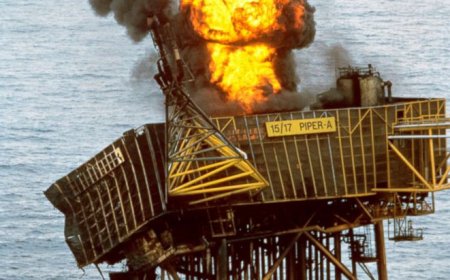
Everyone in the city knows the details of the 1988 Piper Alpha disaster, when a platform exploded, killing 167 people. Anyone working offshore must first undergo a week of intensive safety training, which includes finding their way out of a helicopter submerged upside down in a swimming pool.
Nobody denies that the North Sea basin is in decline, or that we must eventually shift to renewables.
Output has dropped by more than three quarters since its peak in the 1990s. Yet the UK is one of only two countries in Europe, alongside Norway, that is producing more than a million barrels per day.
“This is a major strategic asset and a national treasure for the country,” says Paul de Leeuw, the director of Robert Gordon University’s energy transition unit.
But government policy means we are losing this asset much faster than we should.
“UK oil and gas production is coming down, which is partly geological but it is partly because of systemic failure in the stewarding of what is a national asset by successive governments,” says Iain Lewis, the chief financial officer of Ithaca Energy, one of the North Sea’s largest independent producers.
“The development opportunity is still there. If we change course, there is a material amount of oil and gas and economic prosperity that could still be delivered.”
The Climate Change Committee has forecast that, if the UK meets its net zero target, the country will still need to use between 13 billion and 15 billion barrels of oil and gas equivalent by 2050. Of this, the Government expects about four billion barrels to come from the North Sea.
“The choice the nation has is between producing it ourselves or importing it. We still need it,” says de Leeuw.
If the policy environment were more favourable, the UK could produce about eight billion barrels, says David Whitehouse, the chief executive of Offshore Energies UK (OEUK), the industry’s trade body.
“You could go from meeting a third of our needs to something in excess of half.”
Domino effect as oil majors quit
Instead, and despite Donald Trump calling it the UK’s “treasure chest”, Whitehouse warns the North Sea is in “very rapid decline”.
As recently as 2018, the UK was producing 1.7 million barrels of oil and gas per day. By 2024, this had slumped by 36pc to 1.09 million, according to the North Sea Transition Authority (NSTA) – 17pc lower than the regulator had forecast in 2019.
It now expects production by 2031 will be just 580,000 barrels per day, which will be a 67pc drop in 13 years.
Oil and gas fields are also being taken offline much more quickly than expected.
In 2020, NSTA survey data showed that 122 fields would be decommissioned between 2025 and 2030. But last year this number increased to 141, reflecting the higher-than-expected closure rate.
Oil companies who get the oil and gas out of the ground have been merging at an unprecedented rate, with the number of producers dropping from 77 in 2015 to just 43.
Those who have exited include ExxonMobil, which sold the last of its North Sea assets in 2024.
In the same year, Shell announced it would be combining its UK upstream assets in a joint venture with Equinor, Eni sold off nearly all of its UK oil and gas-producing assets, Chevron announced it was quitting to focus on more “competitive” areas, and APA, the US operator formerly known as Apache, said it would cease all North Sea production by the end of 2029.
John Christmann, APA’s chief executive, said this was “well ahead of what would have been an otherwise reasonable timeframe” and blamed government policy for making extraction “uneconomic”.
Last month, the Financial Times reported that BP, the last super major standing in the North Sea, had held talks about selling off its North Sea assets.
There is a domino effect as companies move out, says John Underhill, Aberdeen University’s expert on energy transition. The infrastructure is highly integrated.
Several oil and gas platforms are getting taken offline years earlier than planned because they are dependent on their connections to others that are now getting decommissioned.
“Things feel far, far worse now than they did at the beginning of the Labour administration,” says Sam Long, the chief executive of Decom Mission, the decommissioning trade organisation.
“Acceleration is the word, and it is intentional. We are either on the cusp of or we are in the middle of a tipping point beyond which there isn’t much coming back.”
This acceleration will create a cliff-edge in jobs that is entirely avoidable, warns Whitehouse.
In a rapid-decline scenario, the 200,000-strong workforce employed directly or indirectly by UK oil and gas would halve by 2030, he says.
Net zero jobs, or zero jobs?
But if the decline of the North Sea can be slowed, the skills base could survive long enough to be able to transfer into offshore renewables.
“We call it the Goldilocks zone. If we get it just right, you can take the ... workforce from one industry to the other, prevent job losses and build a new industrial heritage on the back of the old capabilities,” says de Leeuw.
This is difficult, not only because the Government is accelerating the decline of the North Sea, but also because problems with grid connections and planning consents are holding back renewable development.
Three years ago, the Port of Aberdeen invested £420m to build a new harbour as part of plans to diversify and support the energy transition.
“We are seeing a very slow pick-up in the renewables sector,” says Bob Sanguinetti, the port’s chief executive. “We draw more than 50pc of our revenue from oil and gas activity and we only get 1pc of our revenue from renewables.
“If that is a snapshot of how the energy transition is going, I would argue that it is not going very well.”
Aberdeen at the sharp end
For Aberdeen, the vanishing jobs will put it at the sharp end of the North Sea’s decline, leading to wider decay.
The city, where 232,000 people live, has long been associated with the vast riches flowing from the offshore oil and gas industry.
But with jobs going, well-paid energy workers are leaving the city and taking their deep pockets elsewhere.
“I sit here and think, ‘Why are all these shops closing down?’ There used to be so many people here. It makes me feel weird,” says Ian Jones-Barlow, 74, a local resident.
In the past decade, house prices in Aberdeen have plunged by 29pc, according to the Registers of Scotland – in stark contrast to the rest of Scotland, where house prices soared by 41pc.
The job losses flowing thick and fast in Aberdeen are also changing the city’s politics.
Cameron, 38, has worked in oil and gas since he graduated in 2014. Last year he became one of the 700 people who have been made redundant by Harbour Energy, the largest producer in the North Sea, since late 2023.
Other companies announcing cuts in Aberdeen in recent months include energy consultancy Xodus Group, engineering firm EnerMech, energy services firm Nexos and oil and gas company Spirit Energy.
Cameron, who spoke using a different name, was unemployed for eight months before he found a job at another energy company. “A lot of people are looking for jobs and there are very few roles coming up,” he says.
He is a resident of the Tories’ new Aberdeen South constituency, and he voted Conservative for the first time because of the party’s stance on oil and gas.
“The vast majority of people who work at oil and gas companies agree that fossil fuels need to be phased out. The disagreement comes in because we are turning off our own production without reducing our demand for oil and gas,” he says.
“It feels as though the decisions are being made by people that are very disconnected from Aberdeen and see this as a political point rather than as the livelihoods for hundreds of thousands of people employed here.”
For those losing jobs in oil and gas later in their careers, redundancy is brutal.
Lors, who didn’t want to give her full name, was in her 50s when she lost her job last year. Her company was no longer working on enough projects to sustain her role.
“I had worked from the age of 12, starting with a paper round, and then all of a sudden you lose this thing that is tied to your self-worth, your value,” she says.
In anticipation of a coming tsunami of redundancies, local charity Aberdeen Cyrenians has opened a centre called Northbridge, where newly redundant oil and gas workers can find careers support.
Donna Hutchinson, the charity’s chief executive, says: “A lot of the people that we’re seeing have masters’ degrees. We’re talking about geologists, reservoir engineers, geoscientists. They’re not people who would ever have expected to be in this situation.”
Many also note the stark change in the treatment of oil and gas workers since the pandemic.
Kirstie Langan, from local engineering consultancy PDi, says: “In lockdown, they were deemed key workers and they had to leave their families and live in quarantine hotels so that they could keep going offshore because we needed energy. They don’t understand why, a couple of years later, there is nobody coming for them.”
The toll is spreading across the city’s wider economy, including to cafes such as Bardbrook’s Cup.
Kirsty Blackman, the Scottish National Party MP for Aberdeen North, says: “I have never been so concerned for my city as I am right now.
“I can see a situation where the hospitality industry in the city is decimated.”
In his speech at the end of June, Andy Burnham spoke directly to Aberdeen. He said that he would give “powers for areas undergoing industrial transition, like Port Talbot, Scunthorpe and Aberdeen.”
Russell Borthwick, the chief executive of the Aberdeen Chamber, was wary of the comparison to the two deindustrialised steel towns. “They have effectively lost their core industries and require regeneration in the same way that former mining communities do,” he says.
“Aberdeen is not there yet. This is not a region nor an industry that needs subsidies. It just needs the Government to stand out of the way and allow it to do what it has been good at for the last 50 years.”
Crushed by taxes
To get out of the way, the Government – and Miliband in particular – would need to change three key policies that have hammered the production outlook.
The first is the energy profits levy (EPL). North Sea oil and gas companies already paid three separate profit-related taxes. Then in May 2022, then-chancellor Rishi Sunak announced a new 25pc EPL, to run only until the end of 2025.
The first iteration of this tax was economically literate, says Lewis. It included big allowances to encourage investment. But the environment changed fast.
In November 2022, Jeremy Hunt raised the tax to 35pc, extended it to 2028 and reduced the allowances during his time at the Treasury. Then in 2024, Rachel Reeves raised the rate to 38pc, extended the tax to 2030 and scrapped all of the allowances.
The combined tax rate on oil and gas profits is now 78pc, more than double that in America.
“International investors reference the UK all the time to us as having an almost third world-type unstable fiscal approach,” says Lewis.
“We are a UK success story but of course our board asks regularly about the level of investment in the UK and how much capital should we move overseas.”
In the last decade, North Sea capital spending has plunged from £8.8bn in 2016 to an anticipated £3.8bn this year, with no adjustment for inflation, according to the NSTA.
By 2031, this will have more than halved again to just £1.68bn.
‘Eventually you go bust’
Miliband has also delivered on Labour’s manifesto promise to issue no new exploration licences.
Last year, for the first time since the 1960s, no new exploration wells were drilled in the UK’s North Sea basin.
“It’s like running a corner shop and just never refilling the shelves – eventually you go bust,” says Whitehouse.
On top of this is Miliband’s ongoing anti-oil and gas rhetoric.
As oil prices soared following the outbreak of the war in Iran, the Energy Secretary said that the “essential lesson” was that the UK needed to become less dependent on fossil fuels. His stance has fuelled huge uncertainty for producers.
Nothing encapsulates this more than the outlook for the Jackdaw and Rosebank oil and gas fields, which were approved by the Conservative government in 2022 and 2023 respectively.
Jackdaw could produce 6pc of the country’s national gas supply while Rosebank contains between 300 million and 500 million barrels of oil, making it the largest unexploited field in UK waters. Their owner, Adura, has poured £3bn into the two projects to date and the rigs are in place.
But production has been blocked by legal claims brought by Greenpeace against the approvals, which the campaign group argues did not take into account the impact of so-called scope three emissions. This means the emissions from burning it when it is used by households and businesses.
Ithaca is a part-owner of the Rosebank field. “When our oil and gas demand as a country is forecast to continue for decades and we are increasingly a net importer of oil and gas, none of these decisions make any sense,” says Lewis, the company’s finance chief.
“All we are doing is agreeing to take oil from further away at higher emissions and at vastly higher net cost to the UK.”
Adura says the emissions from producing gas at the two fields would be eight times lower than imported LNG.
Yet in August 2024, the Labour Government said it would not contest the legal challenges.
In early 2025, the previously granted consent was ruled unlawful. Miliband must now make the final decision.
He has signalled that he wants to sign off Jackdaw to improve his chances of becoming Burnham’s chancellor but Rosebank may not get the same treatment. In opposition, Miliband described the field as “climate vandalism”.
If the projects are not signed off, after such enormous investments have already been made, it would send shockwaves through the North Sea.
Miliband’s approach has made the UK an international outlier. Norway is drilling just across the water in the same geological area. In January, the Norwegian energy ministry issued 57 new production licences, 31 of which were in the North Sea.
‘Get rid of Miliband’
Aberdeen’s woes are not just a problem for Burnham in terms of jobs, but the public finances and carbon emissions too.
The Office for Budget Responsibility forecasts that tax receipts from North Sea oil and gas will plummet from £4.1bn in 2025-26 to just £100m by 2030.
This is primarily because of the expected fall in oil and gas production, as well as the end of the EPL (it will be replaced with a new mechanism).
There is also a serious climate argument for protecting production.
The UK’s gas production is more carbon-intensive than pipeline imports from Norway, but it is far lower than LNG. As of 2024, LNG made up 15pc of our gas supply but 46pc of our gas emissions. This is what we will become increasingly reliant on as our domestic production declines.
Underhill says: “What we’re doing is offshoring our carbon footprint elsewhere.”
Steve Gray, a managing partner at Ventex, a venture studio in Aberdeen focused on climate transition, says: “If the UK stops oil and gas production tomorrow, global carbon emissions will go up, not down. It’s all about consumption, not production.”
A government spokesman said: “Oil and gas production will be with us for decades to come, and we will manage existing fields for the entirety of their lifespan – while actively scaling up clean energy industries in the North Sea.
“Issuing new licences to explore new fields cannot give us energy security and will not take a penny off bills.
“Our ambitious plans will make the North Sea a clean energy powerhouse and support up to 40,000 new jobs in Scotland by 2030.”
But for Peter McCutcheon, 75, who has lived in Aberdeen since the main drivers of the local economy were not oil and gas but fish and granite, the answer is simple.
“My personal opinion is that we should get rid of Ed Miliband. I just feel like really he hasn’t got a clue what he’s talking about.”
[Source: Daily Telegraph]