



























The Gunpowder Plot and Fragile States
Dr. Sirwan Abdulkarim Ali
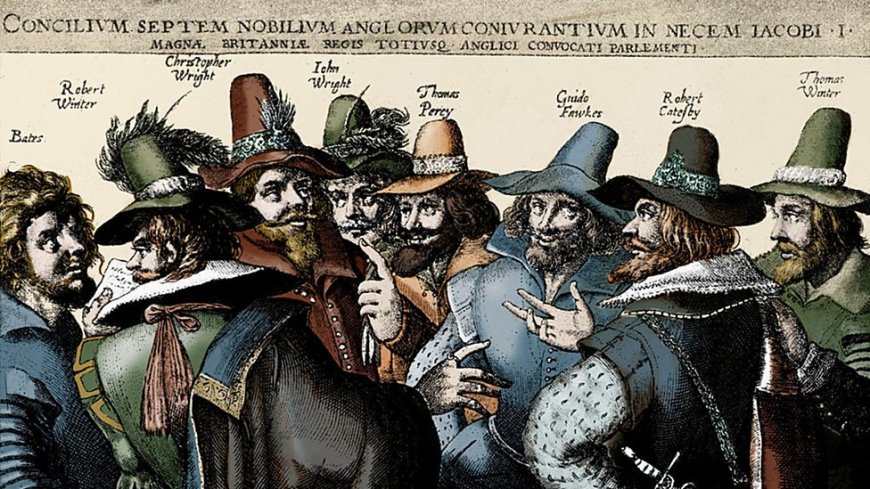
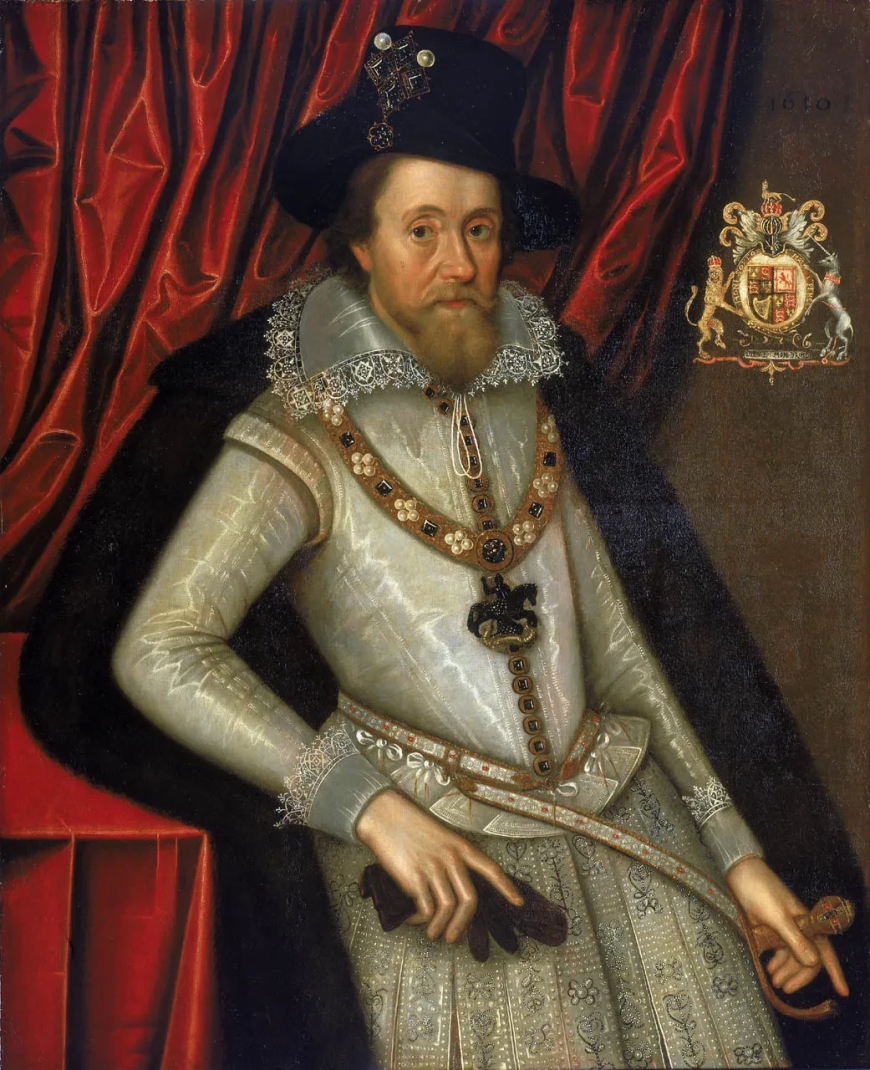
The Gunpowder Plot of 1605 was an unsuccessful attempt by a group of English Roman Catholics led by Robert Catesby to assassinate James I of England and VI of Scotland.
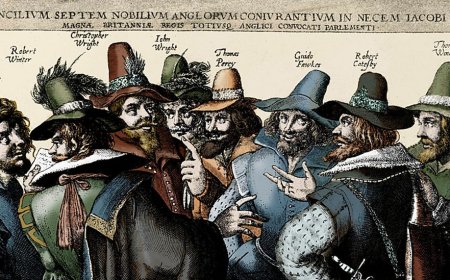
Guy Fawkes and his co-conspirators from a 1606 illustration (BBC)
The plan was to blow up the House of Lords during the State Opening of Parliament on 5 November 1605, before a popular revolt would take place and his nine-year-old daughter, Princess Elizabeth, would be installed as a Catholic puppet-queen. Catesby may have instigated his conspiracy during a time when hopes for enhanced religious tolerance under the reign of King James I were disintegrating. This was a development that engendered profound disillusionment among numerous English Catholics.
Portrait of James I of England (BHC2796, National Maritime Museum)
In early 1604, James I mentioned his extreme dislike of the Catholic faith during a speech delivered to Parliament. He subsequently ordered all Jesuit and Catholic priests to leave the country. Following this, Catesby and other Catholic conspirators conspired to depose the Protestant government.
On 26 October 1605, Lord Monteagle, a Catholic, received an anonymous letter from a servant. A mysterious figure presented Monteagle with a missive, cautioning him against attending the inaugural session of Parliament. Following the king's return to London from a hunting expedition in Cambridgeshire, the letter was presented to him on 1 November.
On 4 November, a stash of firewood was discovered in a cellar by a group of men loyal to the king. This led to Guy Fawkes’ arrest. He identified himself as John Johnson and claimed ownership of the firewood, which he stated belonged to his employer, Thomas Percy. This further increased suspicion, given Percy's documented history of causing disorder and fomenting dissent through his efforts to incite opposition to the government.
James I ordered a second search, and in the early hours of 5 November, Fawkes was found wearing a cloak and hat, boots and spurs, and carrying fuses and matches. He was thus apprehended by the authorities. Subsequent to the initial discovery, a total of 36 barrels of gunpowder were found. Guy Fawkes was subjected to torture, after which he gave the identities of himself and his fellow conspirators. The planned Catholic uprising was unsuccessful. Some conspirators were killed while attempting to escape the authorities, but the remaining eight of the thirteen were apprehended and found guilty of treason on 27 January 1606, subsequently being executed on 30 and 31 January in London.
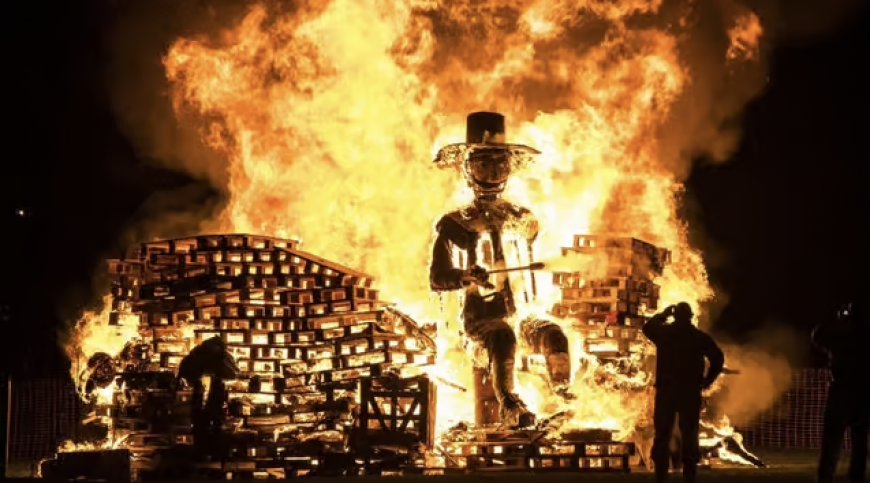
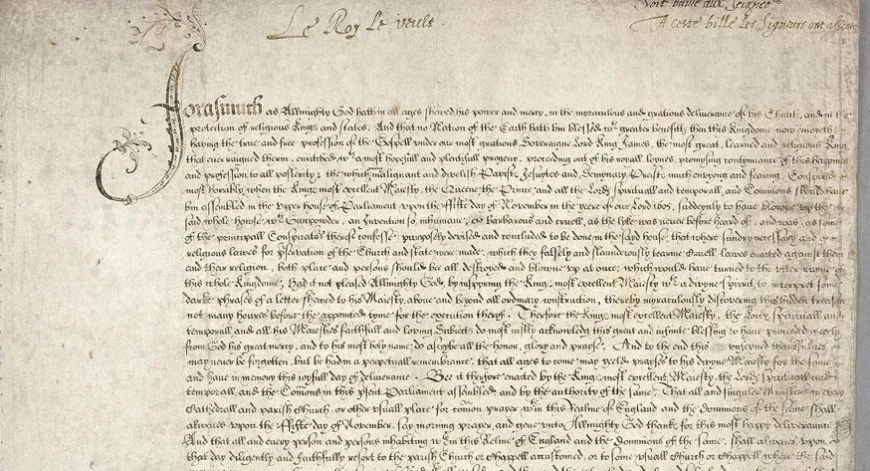
Following the failure of the Gunpowder Plot, an Act of Parliament was passed, stipulating that the event should henceforth be commemorated annually. The act stipulated that church attendance on 5 November was compulsory, and that congregations should offer thanks for the failure of the conspirators. The contemporary celebration of Bonfire Night, comprising firework displays and bonfires draws its origins from the tradition of commemorating the unsuccessful attempt on the life of James I on 5 November. The event usually includes burning effigies, or 'guys', in the conflagrations. Another tradition that emerged in the aftermath of the Gunpowder Plot was the practice of searching the Houses of Parliament. Prior to the State Opening of Parliament, the Yeomen of the Guard undertake a meticulous search of the cellars of Westminster in order to ensure the absence of any explosive devices.
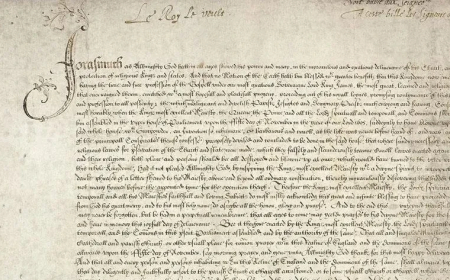
An Act for a Public Thanksgiving to Almighty God every Year on the Fifth Day of November (Parliamentary Archives)
It is possible to argue that England was a "fragile state" at the time. Institutional frameworks may in themselves serve to perpetuate the conditions of crisis. From an economic perspective, this may be evidenced by institutions (particularly relating to property rights) that perpetuate stagnant or low growth rates, or that embody extreme inequality in wealth, access to land, or means of subsistence. From a social perspective, institutions may be observed to embody extreme inequality or complete lack of access to healthcare or education. From a political perspective, institutions may entrench exclusionary coalitions in power based on ethnic, religious, or perhaps regional lines, or extreme factionalism or significantly fragmented security organisations.
England found itself at a crossroads at the time of the Gunpowder Plot, see-sawing between the flamboyance of the Tudor era and the dysfunction and disaster of the Stuarts. The country thus experienced a kind of institutional instability, as one disaster befell another, from near invasion to the Gunpowder Plot, from the Civil Wars and Charles I's execution to the Great Fire of London. The situation is exemplified by James I's erratic relationship with Parliament, his profligate tendencies with money, and his favouring of young court members.
James’s finances were a significant concern. It was unfortunate that he was saddled with Elizabeth's financial problems from her latter years on the throne; a debt of £300,000 would be a considerable setback for any monarch. However, James's attitude towards money served only to inflame the sentiments of his critics, though his casual altruistic approach undoubtedly garnered him a number of devoted followers. James' ostentatious spending further impacted his budget, to the extent that the Chancellor of the Duchy of Lancaster (the Earl of Salisbury) showed James, in actual real money, the extent of his expenditure in order to make an impression upon him.
It is accepted that a monarch should conform to prescribed standards of appearance; his wife, Anne of Denmark, dressed beautifully and ostentatiously in accordance with her status as queen. James’ court was characterised by a series of over-the-top displays, the most notable of which were the 'ante-suppers'. Such displays of affluence entailed the meticulous preparation of an entire banquet, which was then presented to James' guests. Once having seen it, it was all thrown away, to be replaced by another equally elaborate and impressive banquet.
South Africa may be given as a contemporary example of a fragile state. Aside from its own Department of Employment and Labour statistics, showing an unemployment rate of 33.2% in the second quarter of 2025, particularly among youth, the country is also afflicted by widespread corruption, a decaying rule of law, and a deteriorating infrastructure. This is particularly evident in townships but also in large, formerly prosperous and successful cities such as Johannesburg. The misappropriation of state funds is rife, with those in leadership positions engaging in what is effectively widespread theft. The health service is dysfunctional, and there is a lack of functioning infrastructure, such as electricity and water. While it may be able to protect its national boundaries and function as a sovereign nation-state in the modern world system, it is widely acknowledged that its government has lost legitimacy in the eyes of its people. The nation is already experiencing profound internal discord, and its capacity to deliver for its populace is increasingly constrained.
The issue of restlessness and irritation among unemployed youth is becoming increasingly difficult to ignore. Those engaged in employment within state institutions and substantial state agencies – in roles contingent upon political or tribal patronage – encounter delays in the disbursement of their salaries. It is evident that financial and administrative corruption is prevalent in the majority of key state agencies. The present situation has been compounded by the administration of a political system that is both fragile and mismanaged.
These crises and challenges would constitute factors for the imminent collapse of any system in the world, not just in South Africa. Compounding these concerns, the nation's incumbent political leadership appears to adopt a stance of indifference towards the potential ramifications of the system's anticipated collapse. The focus has instead shifted towards the distribution of the remaining resources, rather than addressing the pressing national and moral responsibilities to deal with the numerous crises in South Africa and prevent the onset of further collapse. The parallels that can be drawn with James I and those in his inner circle are therefore very apparent.
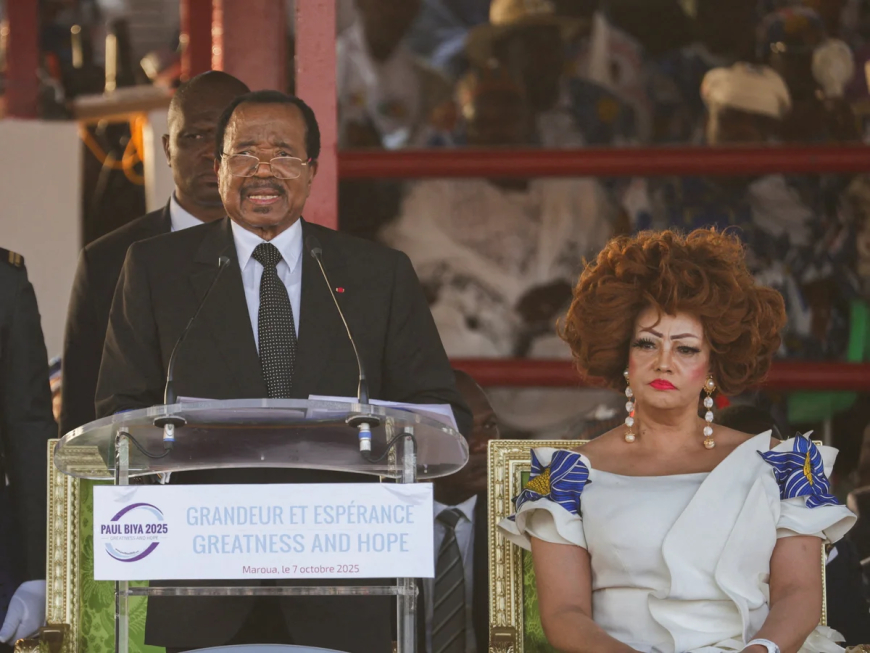
As has been seen in recent times, the spectre of revolt and revolution is only too apparent. Madagascar saw the overthrow of its government in October – the President, Andry Rajoelina, himself having appointed following a previous military coup. Across Africa, there is now an established gerontocracy in power: Denis Sassou-Nguesso, 81, in the Republic of the Congo for 41 years; Yoweri Museveni, 81, in Uganda for 39 years; Teodoro Obiang, 83, in Equatorial Guinea for 46 years; and Paul Biya, 92, re-elected recently for the eighth time in continuation of his 43-year rule among just four examples. Each has accumulated fortunes of at least hundreds of millions apiece, not to mention their extended families and tribal ties. These countries are all classified as either failed, failing or fragile states just as England was in the early 17th century and so many others across Africa and the Middle East are in the present day.
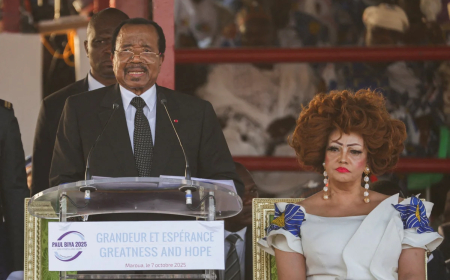
President Paul Biya of Cameroon (The Guardian)
History has the habit of repeating itself, which could be one reason why the Gunpowder Plot is commemorated each year to the present day in the United Kingdom.