

























Pistachios
Pistachios naturally crack their shells while ripening on the tree, making them one of the very few nuts that open.
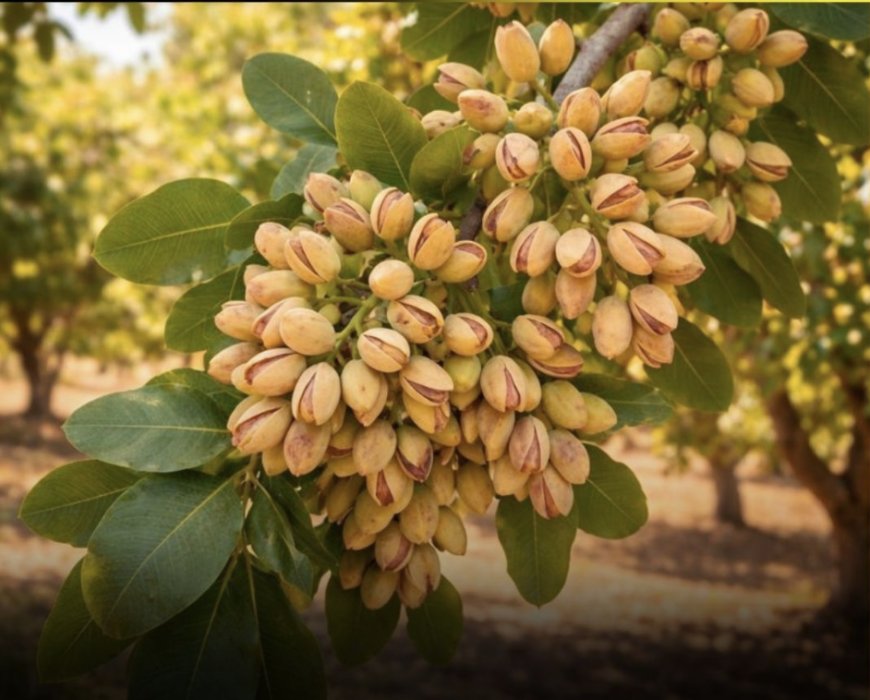
Pistachios are one of the rare foods that reveal their readiness before they are ever picked. As they ripen on the tree, their shells naturally split open, offering a visible sign that the nut inside has reached maturity. This unique trait sets pistachios apart from almost all other nuts harvested around the world.
Biologically, this shell splitting happens because the kernel inside grows faster than the hard outer shell. As the pistachio matures, internal pressure increases until the shell gently cracks open along its natural seam. Farmers often use this natural opening as an indicator of quality, since fully ripened pistachios tend to have better flavor, texture, and nutritional value.
From a nutritional perspective, pistachios are rich in plant protein, fiber, healthy fats, and antioxidants. Their ripening process supports the development of these nutrients, making naturally opened pistachios especially valued. Unlike many processed foods, this change happens without human intervention, guided entirely by nature’s timing.
There is also a reassuring lesson in this process. Pistachios show that growth does not need force. When conditions are right, nature signals readiness clearly and gently. This principle resonates beyond agriculture, reminding us that development often follows its own rhythm.
For consumers, understanding how pistachios mature encourages appreciation for natural food processes and mindful eating. Choosing foods that reach maturity naturally often means enjoying better taste and greater nutritional benefits.
Sometimes, the simplest signs are the most reliable. When something is ready, it opens on its own, just as nature intended.
[Source: Explaining the World]
The tree grows up to 10 metres (33 feet) tall. It has deciduous, pinnate leaves 10–20 centimetres (4–8 inches) long. The plants are dioecious, with separate male and female trees. The flowers are apetalous and unisexual and borne in panicles.[

The fruit is a drupe, containing an elongated seed, which is the edible portion. The seed, commonly thought of as a nut, is a culinary nut, not a botanical nut. The fruit has a hard, cream-colored exterior shell. The seed has a mauve-colored skin and light green flesh, with a distinctive flavor. When the fruit ripens, the shell changes from green to an autumnal yellow/red and abruptly splits partly open. This is known as dehiscence and happens with an audible pop. Humans selected the trait of splitting open.[ Commercial cultivars vary in how consistently they split open.
Each mature pistachio tree averages around 50 kilograms (110 pounds) of seeds, or around 50,000 seeds, every two years.
Etymology
Pistachio is from late Middle English pistace, from Old French, superseded in the 16th century by forms from Italian pistacchio, via Latin from Greek πιστάκιον pistákion, and from Middle Persian pistakē.
Distribution and habitat

Pistachio is a desert plant and is highly tolerant of saline soil. It has been reported to grow well when irrigated with water having 3,000–4,000 ppm of soluble salts. Pistachio trees are fairly hardy in the right conditions and can survive temperatures ranging between −10 °C (14 °F) in winter and 48 °C (118 °F) in summer. They need a sunny position and well-drained soil. Pistachio trees do poorly in high humidity conditions and are susceptible to root rot in winter if they get too much water and the soil is not sufficiently free-draining. Long, hot summers are required for proper ripening of the fruit.

Cultivation
The pistachio tree may live up to 300 years. The trees are planted in orchards, and take around 7 to 10 years to reach significant production. Production is alternate-bearing or biennial-bearing, meaning the harvest is heavier in alternate years. Peak production is reached around 20 years. Trees are usually pruned to size to make the harvest easier. One male tree produces enough pollen for 8 to 12 drupe-bearing females. Harvesting in the United States and Greece is often accomplished using equipment to shake the drupes off the tree. After hulling and drying, pistachios are sorted according to open-mouth and closed-mouth shells, then roasted or processed by special machines to produce pistachio kernels.[citation needed]
History
The pistachio tree is native to Iran and Central Asia.[12][13][14][15]
Archaeological evidence shows that pistachio seeds were a common food as early as 6750 BCE.[16]The earliest archeological evidence of pistachio consumption goes back to the Bronze Age Central Asia and comes from Djarkutan, modern Uzbekistan.
The Romans introduced pistachio trees from Asia to Europe in the first century AD. They are cultivated across Southern Europe and North Africa.
Theophrastus described it as a terebinth-like tree with almond-like nuts from Bactria
It appears in Dioscorides' writings as pistákia (πιστάκια), recognizable as P. vera by its comparison to pine nuts.
Pliny the Elder wrote in his Natural History that pistacia, "well known among us", was one of the trees unique to Syria, and that the seed was introduced into Italy by the Roman proconsul in Syria, Lucius Vitellius the Elder (in office in 35 AD), and into Hispania at the same time by Flaccus Pompeius.
The manuscript De observatione ciborum (On the Observance of Foods) by Anthimus, from the early sixth century, implies that pistacia remained well-known in Europe in late antiquity.
An article on pistachio tree cultivation was brought down in Ibn al-'Awwam's 12th-century agricultural work, Book on Agriculture.
Archaeologists have found evidence from excavations at Jarmo in northeastern Iraq for the consumption of Atlantic pistachio.
The Hanging Gardens of Babylon were said to have contained pistachio trees during the reign of King Marduk-apla-iddina II about 700 BCE.
[Source: Wikipedia]