


/file/attachments/orphans/ED_543155_209242.jpg)



















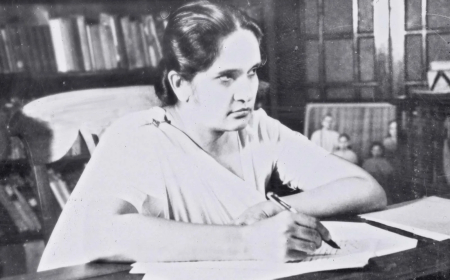

Morag MacDougall, chief of a Highland clan who protected the family’s heritage for posterity
As a speech therapist she worked with children and stroke patients, and she was much in demand to play the organ in Herefordshire churches

Madam Morag MacDougall of MacDougall, who has died aged 86, led somewhat of a double life.
To her neighbours in Shobdon, Herefordshire, she was the unassuming Mrs Morag Morley, housewife, speech therapist and church organist. But on her regular visits to Scotland, and eventually in retirement there, she inhabited an entirely different persona, that of hereditary chief of one of the leading Highland clans.
Her chiefly line is long and illustrious. The eponymous Dougal, who flourished in the early 13th century, was the eldest son of Somerled, a sea-borne adventurer of mixed Gaelic and Norse heritage, who had carved out a kingdom for himself in the west. Somerled’s realm extended from the northern Hebrides to the mainland, including both Argyll and Kintyre.
Dougal, meaning “dark stranger”, was a euphemism for Viking. By means of their fleet of galleys, the MacDougalls wielded immense power and were poised at one time to add the Isle of Man to their kingdom. However, their mainland possessions were richer and less troublesome. Basing themselves in Lorn (northern Argyll) and eventually coming to terms with the King of Scots, they dropped their royal title and were soon fully assimilated into the Scottish aristocracy.
An alliance with the mighty Comyn family proved fateful for the MacDougalls and has affected their fortunes ever since. In 1306, Robert the Bruce murdered John “the Red Comyn”, who opposed his claim to the throne, making John’s uncle, Alasdair Mòr MacDougall of Argyll, his “capitale ennymy”.
Soon afterwards, Alasdair Mòr defeated his bedraggled army at Dalrigh. As the Bruce fled the field, a MacDougall clansman is said to have gripped his plaid and pulled it from his shoulders. The plaid and its clasp, consisting of a quartz charmstone set in a brooch, were presented to the victorious chief.
Now in a studded silver setting of later date, the “Brooch of Lorn” remains the proud possession of the family, and, until the 19th century, was regularly worn. Madam Morag, who kept it safely in the bank at Oban, eventually presented it, on indefinite loan, to the National Museum of Scotland, where it is displayed with other Brucian memorabilia.
Succeeding to the chiefship in 1990, and with pride in her family “in her bones and soul”, Madam Morag made it her mission to preserve her inheritance, much diminished by the Bruce’s ultimate victory in 1308.
The MacDougall lands had been forfeited and redistributed among assorted Campbells, Stewarts and MacDonalds; but in 1452, thanks to the generosity of his maternal uncle, the then chief had recovered a small but significant part of their former estate. It included the castle of Dunollie (founded by the original Dougal in the early 1200s) and the Isle of Kerrera, which it overlooks across the Firth of Lorn.
With a view to protecting this heritage and making it more accessible – both to the local community and to the wider clan – Madam Morag established the MacDougall of Dunollie Preservation Trust in 1996, which manages the ruined castle and grounds as a visitor attraction.
Dunollie had been the austere residence of the chiefs until 1744. The family now occupies a handsome “laird’s house” at the foot of the castle mound, the earliest wing of which, the so-called “1745 House”, is a museum housing the family’s extensive collections.
Morag Hadfield was born at Beer, Devonshire, on November 21 1939, to Dr Stephen Hadfield, the local GP, and his wife Jean, one of the three daughters of Alexander James MacDougall of MacDougall, an army surgeon. Jean’s elder sister, Coline, was to succeed him as Chief in 1953.
Though married, Coline had no issue, so Morag, the elder of two sisters, was heir apparent from her early teens, picturesquely styled “The Maid of Lorn”. Growing up at Cutmill, near Guildford, she developed a deep love of the countryside. Under the influence of her headmistress at Sherborne School for Girls, she also became a committed Christian.
Trained as a speech therapist at the Kingdon-Ward School in Cavendish Square, Morag practised in Cardiff for some years, working primarily with children and stroke patients. In 1966 she married Richard Morley, a chartered engineer, who shared her interest in country dancing, hiking and Quakerism. They soon settled down to family life in Shobdon.
Having taught herself to play the organ, Morag was much in demand in the local churches. She also played the recorder with local groups. Her acquaintances in Herefordshire are said to be unaware to this day of her alter ego as a clan chief.
A profoundly decent woman, gentle and conscientious, Madam Morag was buried among generations of MacDougall chiefs in Kilbride Cemetery. She is survived by her son, Robin MacDougall of MacDougall, and her daughter Fiona.
Madam Morag MacDougall of MacDougall, born November 21 1939, died January 22 2026
[Source: Daily Telegraph]