



/file/attachments/orphans/ED_543155_209242.jpg)





















Foul food and flagrant corruption: A look behind the Iron Curtain
In 1989 Tony Scotland journeyed through Soviet Eastern Europe. Its governments – and inhabitants – were grim, primitive and menacing

Good travel writing is more about people than places. Buildings and landscape one can find in a guidebook; the people make a place distinctive. So it is in an excellent, recently published travelogue by Tony Scotland, Shadows: Behind the Iron Curtain (Shelf Lives, £25).
It recounts a journey he made in the spring of 1989 through Eastern Europe, then under the Soviet yoke but soon – indeed within months – to begin a rapid process of liberation as the Berlin Wall fell and the Eastern Bloc followed. Scotland passed through East Germany, Czechoslovakia, Hungary, Romania and Bulgaria: countries now familiar to British tourists and offering Western European standards of welcome and hospitality, but which in the 1980s, after more than 40 years of communist rule, were primitive, grim and often menacing. And, as his book shows, much of the menace – and much of the colour – came from the inhabitants.
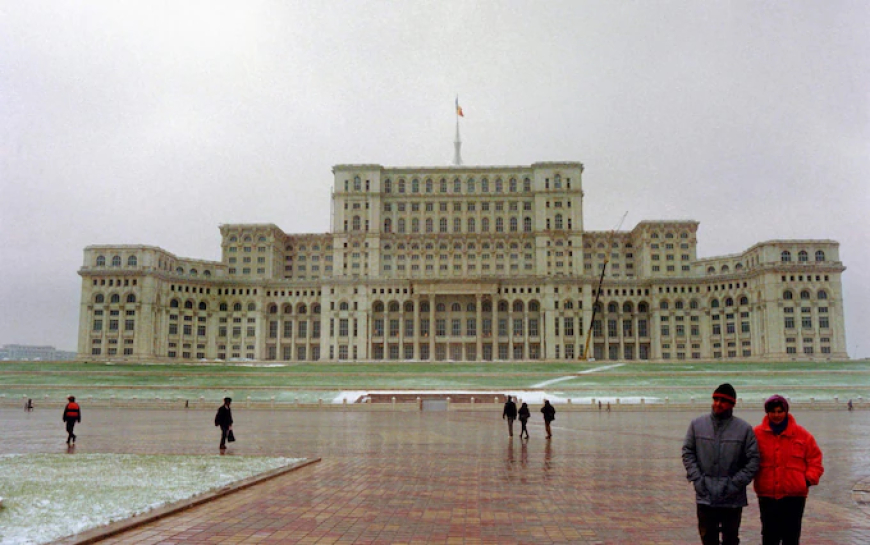
The new palace built by Nicolae Ceauşescu in Bucharest, pictured in 1989, the year Scotland visited Credit: Gerard Fouet/AFP via Getty Images
Scotland had been inspired to make this problematical journey by the policies of Glasnost and Perestroika promoted by Mikhail Gorbachev when he took over the Soviet Union in 1985. Leaving on a boat from Harwich to the Baltic, the author managed to enter East Germany and, travelling by train, made his way to Leipzig, a city rich in musical associations. Scotland was at the time one of the main continuity announcers on Radio 3 – in an era when it was not obligatory to have an interesting regional accent to be a presenter – and used a sabbatical to make his journey.
Taking in musical treats along the way – an Italian opera in Leipzig, whose former resident JS Bach appeared then to be barely commemorated, and later on Parsifal in Hungarian in Budapest and The Merry Widow when he reached Bulgaria – Scotland found his attentions dominated, inevitably, by everyday life in those rather grim totalitarian states.
The world changed for him when he crossed the Iron – or, in fact, barbed wire – Curtain an hour after leaving Hamburg. As a traveller at this time, he was something of a pioneer: it was not routine, in the 1980s, for British or Western citizens to visit the Soviet bloc. The author found a somewhat barren environment – 26 railway tracks terminating at a quarter-mile wide concourse at the main Leipzig railway station, on which there was not a single retail outlet. He takes in a handsome spa town in Bohemia, sensing that the Czechs at least had sought to maintain some civilised standards despite the inevitable privations brought by the miracle of communism – poor food, shabby clothes, rust-bucket vehicles, retrograde technology, a police state and above all absence of choice.
This attempt at individualism became perhaps more evident when he reached Budapest – to meet an English friend who had caught the tide of change early and was working there – a city in which pursuing a progressive lifestyle had become an increasing means of defiance since the thwarted 1956 uprising, and people arrive on trains from Vienna laden with western goods.
Then we reach the heart of the book, and its most revelatory part: his visit to what he is warned is “third world” Romania. He is told not to take a camera, or to say he works for the BBC, and to pack supplies of Kent cigarettes for bribes, and a torch because there is no street lighting. He found a country oppressed by the Securitate, the omnipresent secret police of the hated Ceauşescus, and in which getting a hotel room or a plate of foul food required a bribe. Indeed, the border police relieved him of $140 just to allow him into Romania.
At one point, Scotland was “befriended” by a thuggish young soldier, a Saxon to whom he spoke in German, who drank dementedly and even when sober felt it acceptable to grope the waitress in an inn while ordering food (even more alarmingly, the waitress seemed to regard it as quite routine). The friendship ended when Scotland prevented him from grabbing a pair of schoolgirls. He left Romania shortly after peeping through a security fence at the new palace Ceauşescu was building for himself in Bucharest, and being chased by the police: though part of what he thought was a chase turned out to be the dictator’s motorcade coming into the neighbourhood.
Although Bulgaria was little better, he was relieved to get there: and on the train encountered a jolly factory girl, herself relieved to be getting out of Romania, who started to sing Qué Séra Séra and told him “I love English songs”. Scotland has a genius for observation, and for jokes: that, coupled with his superb style and the key moment of history he captures, makes this is a wonderful book.
[Source: Daily Telegraph]