

/file/attachments/orphans/ED_543155_209242.jpg)






















Deprivation and segregation: Gorton and Denton is a dismal preview of the future of broken Britain
A bitter, sectarian by-election in this fractured Manchester seat exposes the fault lines reshaping British politics
The electoral ward of Longsight in Manchester was still predominantly Irish when Noel and Liam Gallagher – its most famous exports – were born there more than half a century ago.
Though Mancunian by birth, the Oasis stars had parents who were Irish immigrants from Co Mayo and Co Meath. Streets of red-brick terraces and semi-detached houses like the one in which they were raised were filled with families whose ancestors had crossed the Irish Sea in search of work and wages.
Times have changed. Walking Longsight’s pavements this week, I had a Robert Jenrick moment: mine was the only white face.
The sheer scale and pace of migration-induced demographic change in south Manchester recently has resulted in near-complete population turnover. Longsight today is just 23 per cent white, down from 53 per cent in 2001 and 58 per cent in 1991. Eight mosques now serve a community which has put down ever-deeper roots here since the 1970s, when families mostly from the Mirpuri Pakistani diaspora began settling in large numbers.
More recently, since the so-called post-Brexit “Boriswave” influx, new migrants from across Africa and the Middle East have added further layers to a complex social fabric. At a local Lidl, a Bangladeshi migrant who arrived in Britain a few years ago tells me she is a fan of Reform, her stance easily explained with familiar arguments: as an NHS nurse, she is concerned about newer arrivals placing too much strain on public services.
Three miles east, in Denton, in the borough of Tameside, the picture is inverted. Some 83 per cent of residents are white; close to 90 per cent are UK born. Here, boarded-up shops sit across from abandoned roadworks that look like they’ll never progress. In the tatty town hall there is a deserted library and computer room, with no staff member in sight.
These two communities may exist cheek by jowl but they cannot be considered what politicians like to call a “multiculturalism success story”. Marked by discrete cultural, linguistic and political preferences, the two areas share an MP but are different worlds.
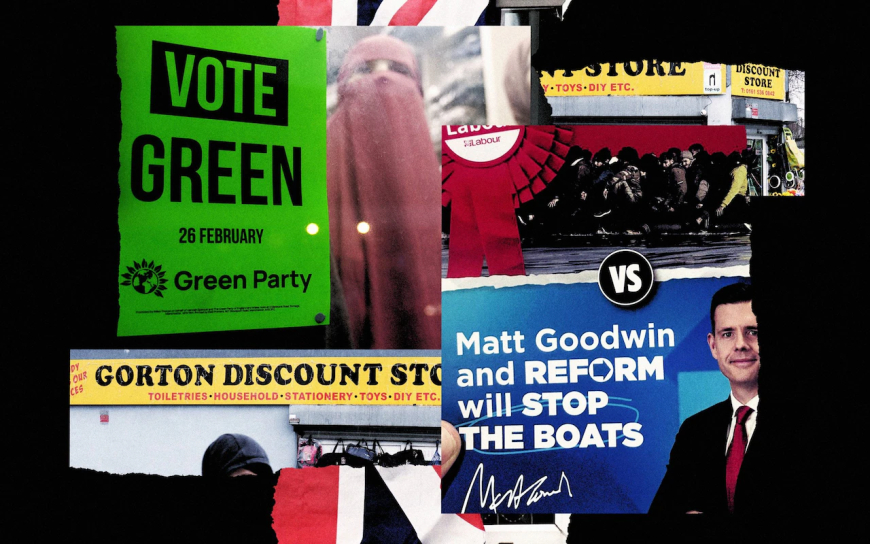
And this week, they are in the national spotlight. For together they contribute to one of the strangest constituencies in Britain: Gorton and Denton, subject of a by-election on Thursday, February 26, that is expected to say much about the fragmented state of politics in Britain today.
It is a contest widely seen as a three-way marginal between Labour – whose vote share was once impregnable – Reform and the Green Party.
The constituency, formed by boundary changes in 2024, reflects national trends. The white, working-class vote has drifted to the Right. Muslim voters lean heavily Left; it’s why the Workers Party’s Shahbaz Sarwar was elected councillor in Longsight in 2024, on a “bring our community’s voice to council decisions” platform.
‘This is what realignments look like at the start’
It also feels like a portent: Britain is heading into a period of politics that could become more bitter, vicious and polarised than anything we witnessed during the Brexit years. But what runs through this constituency, as much as anger or ideology, is weariness, a strong sense of disillusionment with the political class.
“This is what realignments look like at the start,” says historian Dr Stephen Davies. In the US in the 1820s and Britain in the 1830s, old parties cracked and new allegiances formed. Old loyalties dissolved and new ones hardened. Sectarianism was prevalent. In time, both sides moderated, but it took decades to reach a modus vivendi.
Even geographically, the south Manchester seat looks dangerous – its boundary marking out the vague shape of a battle axe on the map. Not all of it is demographically polarised: three wards – Gorton and Abbey Hey, Burnage and Levenshulme – are melting pots where students, young professionals, Muslims and black communities all rub along together. With Longsight they make up the four wards along the axehandle that are on average 42 per cent white and 40 per cent Muslim. Some 42 per cent of residents are graduates or current students. These are precisely the voters Labour has been haemorrhaging in recent years: urban graduates and one-issue Muslims flocking to the Green Party’s embrace.
It is in Denton – eastwards, on the blade of the axe – where Nigel Farage sees opportunity: voters are white working class and many feel both culturally and economically dislocated. Reform’s HQ, in a former fire station, is a whirring factory churning out leaflets and organising activists who are not in short supply. Groups of canvassers take to the streets four times every day: 10am, 1pm, 4pm and 6pm. This later session is necessary because, as their candidate Matthew Goodwin tells me, “our people work”. Around a third are in routine or semi-routine jobs (one definition of working class). In other words, it’s exactly the kind of place where Labour has cause to worry about a Reform challenge.
This is the pincer movement – from both Left and Right – that Labour will surely face at a national level. What happens in Gorton and Denton matters.
A Green win ‘would spark mass panic’ among Labour MPs
Electorally, Gorton and Denton has been “deep red but fading”, observes Robert Ford, professor of political science at the University of Manchester. Labour, which was able to fuse white working class and Muslim voters into a stable coalition, won 50.8 per cent of the vote in 2024 – though this share was down sharply on an estimated 67.2 per cent in 2019. A Labour stronghold since 1906, and one of just 70 seats where the party won an absolute majority in 2024, it’s difficult to convey just how damaging a defeat would be for Starmer. Suddenly, even Labour MPs with a comfortable lead in other constituencies would start to shiver. “A Reform win would make waves. But a Green win would spark mass panic in the Parliamentary Labour Party,” Dr Davies warns.
The Conservatives, meanwhile, have withered. In 2024, they lost more than half of their vote, falling from 18.9 per cent and a clear second place to 7.9 per cent and fifth place. On the day of my visit, their candidate, the impressive-on-paper Charlotte Cadden, is attending an event in Edinburgh.
In short: Gorton and Denton could be the scene of an upset not witnessed since Reform’s Sarah Pochin won Runcorn and Helsby by six votes last May. Reform insists a strong second would be seismic. A win could shake Britain’s political foundations.
Speak to residents across the constituency and on one issue they are searingly united: that Manchester’s much-hyped economic miracle has yet to reach Gorton and Denton. The city has topped the list for house price growth over the past 10 years, with some parts witnessing a rise of 90 per cent. “I would be really really careful about how much you spend [in Levenshulme]. It has been ‘up and coming’ for at least five years but barely anything has changed.” Those were the words of Green candidate Hannah Spencer in 2021.
Nearly half of households in Gorton and Denton claim Universal Credit. Average weekly earnings stand at £665, below any surrounding seat. Zoom out and, according to the 2025 Index of Multiple Deprivation (IMD), it is the 15th most deprived constituency in England – and one of the few in Greater Manchester (of 29 constituencies) that has grown more deprived relative to the national average over the past six years. In Gorton, more than 65 per cent of households are deprived in at least one of the categories laid out by the IMD.
This despite the fact that, just a few miles west, cranes crowd Manchester’s skyline. GDP per head in the city has nearly tripled since the late-1990s, reaching just under £66,000. In the Denton wards, GDP per head has barely doubled from a much lower base, from £10,000 to £20,000. Job growth tells a similar story: a 29.4 per cent increase in Manchester over the past decade, compared with just 6.1 per cent in Gorton.
“The economic strategy has been all about a combination of finance, high-end services and real estate,” Dr Davies says. “As such, what you see is lots of shiny development which is highly clustered and concentrated in places such as Salford Quays, but which isn’t large enough to spill over much into the rest of Greater Manchester.”
On the streets of Denton, the mood is sour. Rain lashes against bright red-brick semis and boarded-up parades of shops. Susan, who bucks the trend and only heads to the ballot box for local elections, complains they “keep voting for one thing and getting another”. Viv knows the former MP Andrew Gwynne personally, and was “disappointed” by his actions. Gwynne was suspended from the Labour Party over his involvement in a WhatsApp group sharing unpleasant comments about elderly constituents, later resigning and prompting this by-election. Viv won’t back Labour now, but Nigel Farage, she shudders, gives her the “creeps”.
Anecdotally, these residents take little interest in the finer points of policy, much less the scandals over Peter Mandelson and Matthew Doyle. They are worrying about bills. Some, in their 30s and juggling multiple jobs, still live with their parents because they cannot afford to rent. They look at Manchester city centre and wonder why prosperity hasn’t spread south to their neighbourhoods. They might tolerate hardship if they felt improvement was coming. They are less forgiving when they see others charging ahead as they struggle to get by.
The divergence between a gleaming, graduate-retaining urban core and surrounding areas that appear to have stalled has become one of the defining features of modern Britain. Studies have consistently shown poverty is a significant catalyst for racial and communal strife. When resources are scarce – housing, GP appointments, secure work – competition intensifies. In such conditions, communities edge ever further away from each other in distrust and suspicion. Without decisive action, this is likely to deepen, leaving white working-class Britons in particular feeling stranded at the bottom of society, convinced that every other group is faring better.
This by-election won’t help: Prof Ford points out that everything about it “seems very negative”. Each party, he says, is telling residents “vote for me to stop the other guy”. It’s a referendum on the Government or an opportunity to stop Reform. No one is promising sunshine and rainbows, perhaps an implicit admission they cannot fix what ails these left-behind neighbourhoods.
Perhaps that is why turnout in the 2024 general election was just 47.8 per cent. Driving across the constituency now, you would struggle to know a potentially momentous contest is underway. There’s a smattering of Green posters in windows, a few Reform placards, one or two Labour signs. A lot will ride on which party can most effectively mobilise their voters, and this is what makes this by-election so hard to predict. Despite some optimistic reporting for Reform and Goodwin’s ebullience, it is worth bearing in mind that the two blocs in this seat are not equally matched: the axe-handle wards had 55,000 registered electors in them in the 2024 local elections, while the eastern Tameside wards, where he is favoured, had just 26,000. So the balance of electoral power splits about 2:1 in favour of the more ethnically-diverse, graduate-heavy Manchester wards. On Friday, the first constituency poll of Gorton and Denton, carried out by Omnisis, put the Greens on 22 per cent, Reform on 20 per cent and Labour on 18 per cent. Some 31 per cent of respondents were still undecided.
Goodwin argues immigration is a major issue. He says he meets recent migrants angry about high inflows, citing competition for jobs and pressure on services. He recently posted a video declaring he knew of “20 homes in Denton that have been turned into houses of multiple occupation”.
‘We have to stop the boats’
Local residents aren’t happy. At Manchester Gorton Market – a windowless, dimly-lit mix of stalls selling fresh produce, electrical equipment, clothing, carpets and sports equipment – James, who runs barbershops in the constituency, complains that the needs of “asylum seekers” are being put above those of local people. “I voted Labour before. But we have to stop the boats. It’s just not sustainable. People here can’t get homes.” He thinks the Green Party is fine, but wouldn’t vote for them. “They’re not strong enough on immigration.”
Labour’s candidate Angeliki Stogia – hurriedly selected after the National Executive Committee blocked Greater Manchester Mayor Andy Burnham from standing – insists immigration is not the dominant doorstep issue. A local councillor, she insists that: “Manchester is a beautiful tapestry of people that were born here, people that were drawn here; but we all live together, and we call this home.”
She adds that local constituents understand how migration has supported the city, claiming the real concerns are bread and butter: anti-social behaviour, fly-tipping, NHS access. This doesn’t quite chime with what one Denton resident had told me earlier: “There was a shooting round the corner the other day. We’re becoming America.” It is Gorton which has the significantly higher crime rate, nearly 70 per cent above the national average.
Stogia and I meet at Cha Cha Chai by Longsight Market, a fast-food restaurant offering up “desi food” from the Indian subcontinent. Next door, the Local Plug offers “smart phones unlock and repair” and international calling cards. A nearby grocery store sells “Asian, Continental Arabian, Mediterranean, Polish and Bangladeshi food”. Inside, I meet four Iraqis, only one of whom speaks English. I talk to a Syrian mother through her young son and translator: they have been in Britain for a year. No one seems to be taking much interest in the by-election.
For Stogia, the argument is competency. “We must go further and faster,” she says, likening the machinery of government to an old tractor, its engine slow to turn after 14 years of Tory neglect. Labour needs time, she insists, and voters must trust it to deliver.
The Greens selected Hale councillor and plumber Hannah Spencer, emphasising her Mancunian roots. That she is a youngish white woman will not necessarily make it easier to win over Muslim voters. Then again, says Prof Ford, “they do prefer local candidates, too”. They are playing an avowedly pro-Palestine card to consolidate Muslim and progressive voters, with George Galloway’s earlier success showing how quickly turnout can surge in Muslim areas where the Gaza conflict is salient.
And indeed, the decision of Galloway’s Workers Party not to field a candidate is telling. Perhaps Galloway calculated that patriarchal Muslim networks would not deliver this time and judged the risk of humiliating defeat too severe. More likely, he did not want to be accused of splitting the Left-wing vote in such a way that would allow Reform to advance through the middle. It has echoes of Nigel Farage’s decision to stand down Brexit Party candidates in 2019 in order to stop Jeremy Corbyn.
A new fault line between workers and non-workers
There is a sense that Gorton and Denton is a microcosm of the realignment now gripping Britain. Five-party politics is being compressed into a system designed for two. We have two broad blocs of voters, with minimal movement between them, because primary aligning issues – identity, immigration, work – cleave the electorate in twain. Although anxiety over immigration is rooted more in culture than economics, Nigel Farage is convinced a fresh fault line is emerging, between workers and non-workers. That those who rise early and work hard will increasingly resent paying ever higher taxes to fund the lifestyles of those on benefits, even where such claims are legitimate.
More than 1.3 million foreign nationals now claim Universal Credit, according to the Department for Work and Pensions. In Manchester, the January figures show just half of claimants were white. Stronger economic growth would ease these tensions. But it would require a pace well beyond 1.5 per cent a year – and even that is a stretch under the current Government. The latest from the ONS shows that as of the end of last year, GDP per capita in real terms had risen just 0.9 per cent relative to when Labour took over.
The danger, then, is that politics ceases to be transactional and becomes existential. That opponents are no longer merely wrong, but illegitimate, even evil.
Prof Ford warns that after the next general election there may be a substantial slice of the electorate that does not merely dislike its representative but considers them totally unacceptable. In seats split three or four ways, MPs may be elected on the narrowest of margins. Legitimacy could begin to seem fragile. “That’s what can lead to authoritarianism. Best case scenario,” warns Dr Davies. “We have lots of people not normally involved in politics mobilising to block things they disagree with.”
All of which makes abuse and even violence not unthinkable – bricks through windows, protests at school visits. It has happened before.
Already politicians are seeing a coarsening of language. Goodwin has been accused of suggesting those who have been here most of their lives still cannot be one of us. In November, he said: “It takes more than a piece of paper to make somebody ‘British’.” When questioned about his remarks in January, amid criticism from political opponents that they were “abhorrent”, Goodwin declined to say whether he stood by them. The former professor and GB News presenter might retort that he was speaking specifically about Manchester Arena bomber Salman Abedi; or Jihad al-Shamie, the 35-year-old British citizen born in Syria who attacked worshippers at Manchester synagogue last year on Yom Kippur in nearby Crumpsall. At the same time, Green Party leader and “eco-populist” Zack Polanski labels his political opponents “fascist” and “racist” so routinely that the terms risk dilution.
Out on the trail, Goodwin says he has encountered abuse. He recalls with a wry smile one lady coming to the door in her dressing gown, mid-morning. She pointed at him, her eyes narrowing. “You’re Reform,” she said, and he nodded. “You’re Matt Goodwin,” again, he nods. “You’re a w---er”. And with that, she shut the door. There are reports Spencer has left X because of harassment and threats received through direct messaging.
Sectarianism is of course not unprecedented in British politics. At the start of the 20th century, the Liberal vote had a denominational element in parts of the country. Later, in cities such as Liverpool, Glasgow and parts of Manchester, Irish Catholic identity became a strong predictor of support for Labour. In some places, it remains so. Religion and community have long shaped political allegiance.
What feels different in 2026 is the more explicit mobilisation of Muslim voters behind candidates who campaign primarily on issues framed as speaking for that community. When this bloc was firmly aligned with Labour, the Party was not presenting itself as the vehicle of specifically Muslim interests; the relationship was part of a wider coalition.
Now, however, there are signs of something narrower emerging: a politics more openly organised around communal identity. Candidates present themselves as representatives of a particular community first, and of the broader electorate second. But as Prof Ford points out, representative democracy depends on parties that aggregate interests across society. They are meant to draw together different classes, faiths and regions into workable majorities. If mobilisation becomes concentrated within single communities, the ability to build those broad coalitions is weakened. It can also invite counter-mobilisation from other groups who feel excluded or threatened. The result will be a drift towards polarisation that considers compromise a dirty word. And that is ominous. Just how ominous we might begin to find out as the votes are counted next Thursday night.
[Source: Daily Telegraph]
/file/attachments/orphans/6I1A0890_807344.jpg)