





/file/attachments/2996/04ED_610405_518242.jpg)
































At nearly 654 km/h, JCB Hydromax breaks hydrogen engine speed record
Recorded on the Bonneville Salt Flats, the Hydromax’s performance shatters the previous record certified by the International Automobile Federation (FIA) for a hydrogen internal combustion vehicle, set by BMW in 2004.
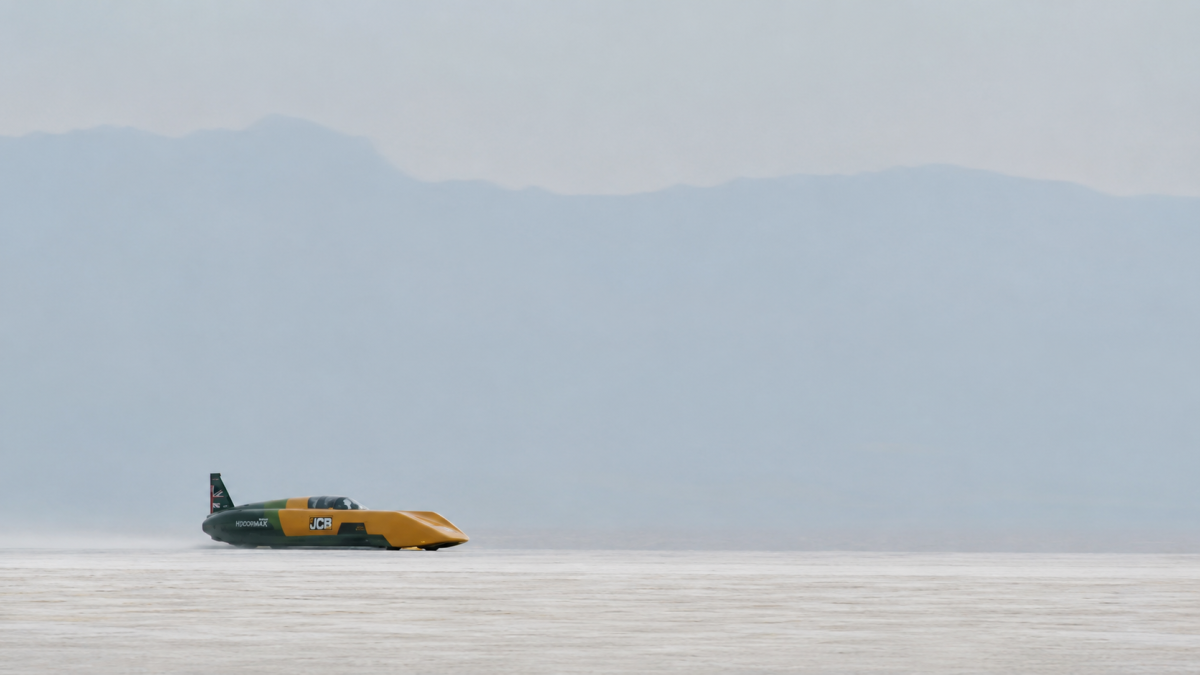
The British construction equipment manufacturer JCB officially announced on Aug. 11, 2026, that its experimental Hydromax had set a new speed record for a hydrogen-powered vehicle. Hydrogen, a component of water, could emerge as a serious alternative to hydrocarbons for certain applications if some major technical hurdles can be overcome.
In accordance with International Automobile Federation (FIA) standards, the Hydromax recorded an average speed of 406.32 miles per hour, or 653.91 km/h, over two runs: 400.623 mph on the first and 412.135 mph on the second. With nearly 10 meters of raw aerodynamics, it has thus become the fastest hydrogen-powered vehicle in history, across all technologies.
This feat smashes the previous FIA-certified record for a vehicle powered by a hydrogen internal combustion engine: 185.5 mph (almost 299 km/h), set by the BMW H2R in 2004. At the time, the famous German brand was already investing heavily in developing hydrogen-powered vehicles, notably with the Hydrogen 7, unveiled in 2006 but which never progressed beyond very limited production.
The JCB teams, based in Foston, United Kingdom, arrived in Bonneville at the end of July, where the topography has made the site one of the favorite proving grounds for those seeking land-speed records. The Hydromax had already broken the 368.347 mph (592.80 km/h) barrier at the famous Bonneville Speed Week, organized by the Southern California Timing Association (SCTA), setting an initial record.
"Bonneville is the spiritual home of the land-speed record, and the JCB Hydromax has now written its name into this story. The car was fantastic: stable, solid and fast," commented Andy Green, who drove the vehicle.
New plant in Texas
No stranger to record attempts, this former British fighter pilot is the fastest man on Earth. In 1997, at the controls of the ThrustSSC, he reached 763.035 mph (1,227.986 km/h), becoming the first — and still the only — person to break the sound barrier in a land vehicle. He was also at the wheel of the JCB Dieselmax when it set the FIA world speed record for a diesel-powered vehicle at Bonneville in August 2006, with 350.092 mph (563.27 km/h), a record that still stands.
For JCB, which aims to mass-market construction vehicles equipped with hydrogen engines, the record set on the salt flats of Bonneville, Utah, represents a bold and successful bet on the future, as it prepares to open its new factory in San Antonio, Texas. This $500 million investment is expected to employ 1,500 people to manufacture machines for the American market.
The record was achieved with two hydrogen engines designed by JCB based on its production engines for construction machinery, jointly producing 1,600 horsepower and built at its Foston plant in Derbyshire, United Kingdom. According to JCB, these same engines are now being installed in equipment rolling off its UK production lines, as part of a hydrogen program in which the company has invested 100 million pounds.
“This is precisely the goal of the JCB Hydromax: to show that hydrogen works, and that it works today at the highest level, with zero emissions,” said JCB Chairman Anthony Bamford. In reality, a hydrogen combustion engine does not emit CO2 but can generate nitrogen oxides.
JCB’s engineering director, Ryan Ballard, who leads the project, praised his teams’ work: “This record belongs to the team of engineers who took a hydrogen construction engine and made it the fastest of its kind on Earth [the two engines develop a combined 1,600 horsepower]". FIA President Mohammed Ben Sulayem, for his part, described the achievement as “a truly historic step for motorsport,” saying it demonstrates “how innovation, performance, speed and sustainability can go hand in hand.”
Renewed interest
This record also marks a milestone in the history of a technology whose beginnings date back to the early 19th century, but which, more than two hundred years later, has still not been widely adopted. However, direct hydrogen combustion is experiencing renewed interest, especially for construction vehicles, heavy transport and certain electricity-generation applications. JCB also began marketing a generator powered by its hydrogen combustion engine in 2026.
In the automotive sector, Toyota is among the manufacturers that continue to bet on direct hydrogen combustion, particularly in racing. BMW has chosen another path and is preparing to enter the mass market with the iX5 Hydrogen, with mass production planned for 2028. Developed with Toyota, the vehicle uses a different technology: the hydrogen is not burned in an engine, but used in a fuel cell to generate electricity that powers the vehicle.
But the main obstacles to the large-scale deployment of hydrogen remain its storage, its high cost and the energy efficiency of the entire supply chain, according to several specialist sources consulted by L’Orient-Le Jour. It is a real chicken-and-egg problem: manufacturers are reluctant to invest heavily until they are certain of the sector’s economic viability, while it can only truly prove itself and reduce its costs if deployed on a larger scale.
[Source: L'Orient Today]