









/file/dailymaverick/wp-content/uploads/2025/04/Krill_school_1_credit-Aker-Qrill.jpg)





























2026 Year of the Horse: Humans and horses go way back
Highly valued in diverse cultures, the horse gallops to pole position in the Chinese zodiac. Famous horse babies include Nelson Mandela and Jackie Chan.
The first day of the Chinese New Year falls on February 17 this year. Also known as the Spring Festival or Lunar New Year, the festival marking the advent of spring is widely celebrated in China and several East Asian countries.
Families traditionally gather during this time to share sumptuous meals, while children are often given money in red packets known as "hong bao."
The start of the Lunar New Year also marks the rotation of the Chinese zodiac, which runs over a 12-year cycle, each represented by an animal.
There are several stories explaining the zodiac. One legend goes that the Jade Emperor — an important Chinese deity — invited all the animals to a "great race," with the first 12 winning his favor.
The 12 who made it in order of appearance are the rat, ox, tiger, rabbit, dragon, snake, horse, goat, monkey, rooster, dog and pig.
Famous horse personalities
If you were born in the years 1918, 1930, 1942, 1954, 1966, 1978, 1990, 2002, 2014 or 2026, you are a horse.
Each animal year is further associated with one of five elements: wood, fire, earth, metal or water. So more precisely, 2026 is the year of the Fire Horse.
In traditional Chinese culture, the horse symbolizes strength, speed, courage, loyalty, freedom and talent. Those born under this zodiac sign are often said to be brave, steady, upright, faithful and independent.
Notable horses include South Africa's first Black president Nelson Mandela, Chinese kung fu film star Jackie Chan, filmmakers Ang Lee and Martin Scorsese, "Avatar" actor Zoe Saldana, ex-Beatle Paul McCartney, and British celebrity chef Gordon Ramsay.
And, the first man on the moon, Neil Armstrong, who upon setting foot on the lunar surface famously declared: "That's one small step for [a] man, one giant leap for mankind."
Humans and horses: An enduring bond
Horses have long powered human life. They drew chariots in ancient Egypt, featured famously in Greek myths and thundered around Rome's Circus Maximus in the 6th century BCE.
They were also highly valued in ancient China, where the mausoleum of its first emperor, Qin Shi Huang, featured his "afterlife army" that included hundreds of life-size terracotta horses standing in formation beside chariots and cavalry.
Archaeology suggests that humans began domesticating horses around 6,000 years ago on the western Eurasian steppe — in the broad belt stretching from modern Ukraine through southwest Russia to northern Kazakhstan. As domesticated herds spread, communities repeatedly captured and bred local wild mares into them, creating the wide genetic diversity seen in horses today.
Even today, Kazakh and Mongolian riders value horses for transport and livelihood, and as symbols of their nomadic heritage — a role the animals have played since the days when Genghis Khan's cavalry crossed continents on horseback.
In the Arabian Peninsula, Bedouin breeders preserved their most prized horse bloodlines through the traditionally oral nature of record-keeping rather than written records, passing down pedigrees by memory.
For millennia, horses were humanity's fastest and most reliable form of transport. They carried armies across continents, pulled plows, wagons and mail coaches, connected far‑flung trade routes, and powered the expansion of empires long before steam or petrol engines reshaped global mobility.
They were, in many ways, the world's first vehicles: in the automotive world, "horsepower" remains the unit used to measure engine power.
Of running and free and 'standing hibernation'
Almost every horse breed carries a backstory, and the Mustang and the Yakutian are no exception.
Horses had been extinct in North America since the end of the last Ice Age. So when Spanish expeditions reintroduced them in the early 1500s, the animals that escaped or were released from colonial herds became the forebears — or rather, "fore horses" — of today's Mustangs.
Even the name "Mustang" comes from the Spanish mesteño, meaning a stray or ownerless horse or animal.
Once found roaming the grasslands of central North America, these horses formed free‑roaming herds that Indigenous nations quickly adopted, bred and traded, transforming mobility, hunting, trade and warfare.
The horse's speed and freedom later inspired the name Ford Mustang, one of the most iconic cars of the 20th century.
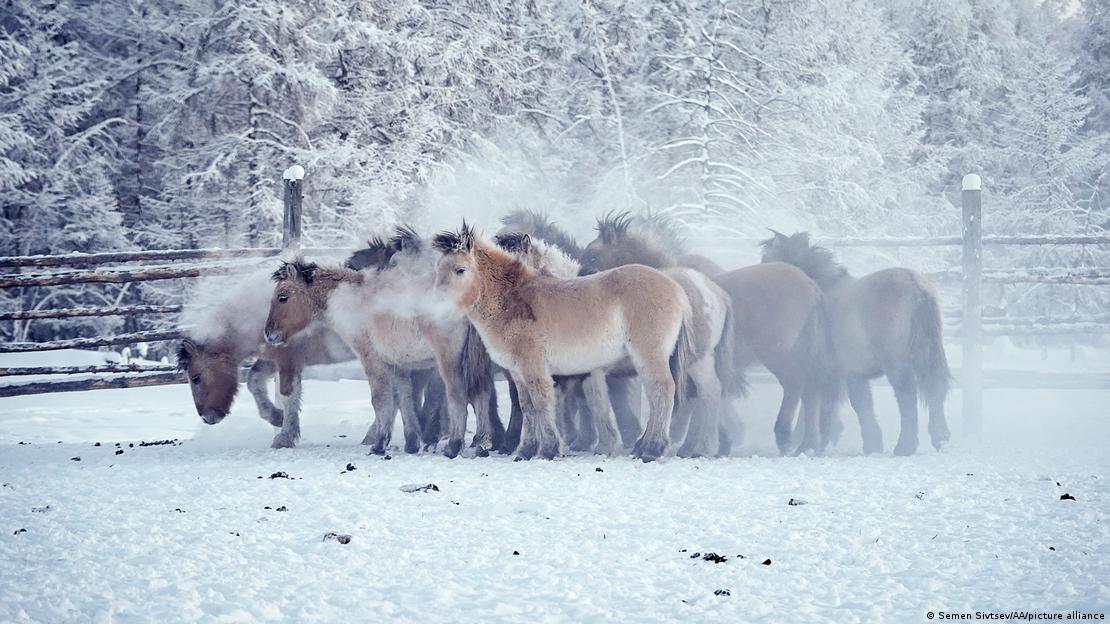
In northern Siberia, Yakutian horses have adapted to some of the coldest winters on Earth. Their dense coats and stocky build help them survive temperatures that can plunge below minus-60 degrees Celsius.
Even more remarkable is their ability to lower their metabolic rate and core body temperature — a kind of "standing hibernation" that lets them conserve energy while remaining awake and active. Unlike true hibernators, they don’t retreat into deep sleep; they keep grazing and moving through the Arctic winter. No other horses are known to do this, and scientists describe their rapid adaptation as one of the fastest evolutionary shifts ever recorded in the species.
Equine healers and coaches
In recent decades, horses have taken on new roles that place them in far closer partnership with humans. Equine‑assisted therapy (EAT) now supports people with PTSD, autism, anxiety and physical disabilities, drawing on the horse's extraordinary sensitivity to human body language and emotions.
That same sensitivity has made horses valuable partners in leadership training. They notice the little things — when someone suddenly tenses up, holds on a bit too tightly, or gives a signal that doesn't match what the rest of their body is doing — and they respond immediately. In these workshops, a horse's willingness to follow or disengage gives humans pause for thought on how they lead, listen and set boundaries.
From transport and warfare to therapy and leadership, the human-horse partnership has continued to evolve — shaped by history, culture and the new roles horses play in our lives today.
[Source: DW English]