































Ref watch: Was Celtic’s winner against Aberdeen offside?
A controversial encounter between the Dons and Celtic at Pittodrie.

Aberdeen were beaten 2-1 by Celtic at Pittodrie in a game filled with talking points.
Nick Walsh was the referee for this encounter, being supported by Chris Graham on VAR.
The first big refereeing call came after Celtic took the lead when the Dons found a way back into the match from the penalty spot.
Liam Scales was judged to have fouled Aberdeen striker Toyosi Olusanya by referee Walsh.
At the time it looked a clumsy challenge.
Olusanya managed to get his foot in front of Scales as he attempted to clear the ball.
It was obvious the Aberdeen player got in front and took a touch of the ball.
For me, this was a clear penalty.
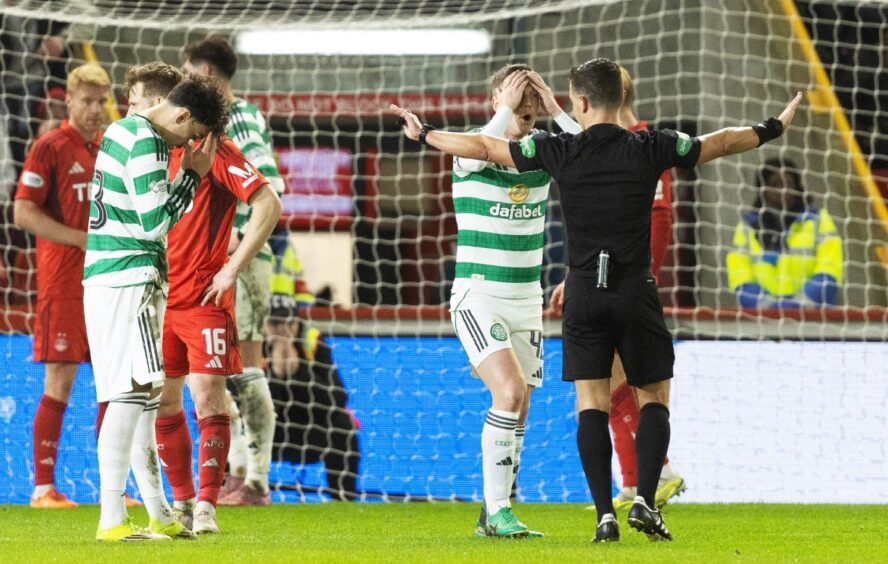
Could Olusanya have been sent off?
The Celtic players were claiming for a potential red card when Olusanya caught Kieran Tierney whilst in possession of the ball.
It was accidental contact, he didn’t mean to bring his studs down on the foot of Tierney.
Thankfully for Aberdeen, he caught his foot flat and the contact wasn’t higher up on his ankle.
A yellow card was the correct call.

The Milne handball incident
The visitors were again calling for VAR to get involved, this time for a penalty.
Jack Milne blocked a cross into the box, with the ball hitting his arm.
This is the exact type of handball I don’t think should be given.
His arms are in a natural position, given he is moving sideways and jumping to block the ball.
There is nothing wrong with that and I am glad the referee and VAR never awarded a penalty.
Should Celtic goal have stood?
The final bit of controversy came as Celtic regained the lead.
At the time I thought the goal looked good but VAR announced a check for offside and it appeared to be a tight one.
Having seen a replay, I first thought Nygren looked offside but on another angle he looked onside.
It also looked as if VAR may have been using the wrong freeze frame from when the ball was played.
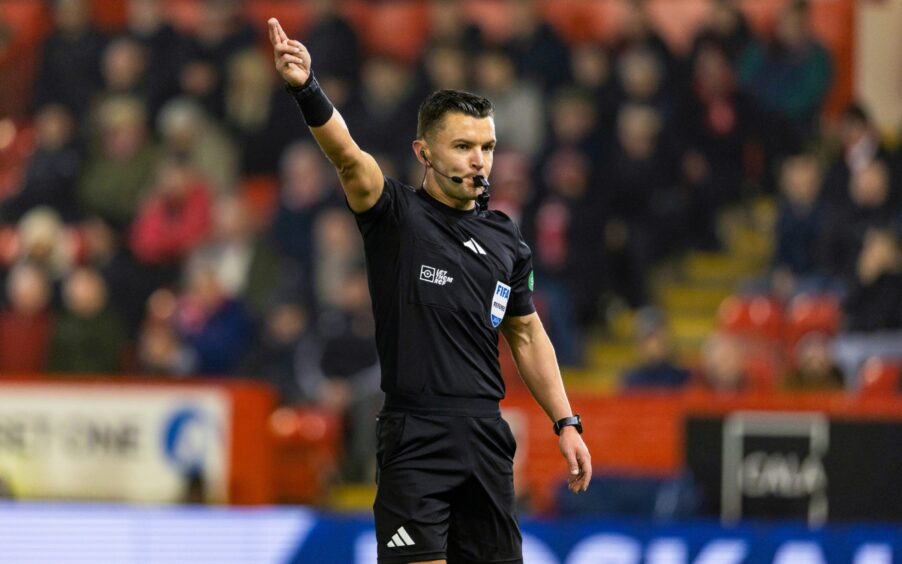
Whether or not you think he was offside or onside, this goal highlights the issues with Scottish football not having the infrastructure to properly use the technology.
There are not enough angles and the cameras aren’t good enough.
I also don’t think the lines are good enough in this scenario to know if it is the correct decision.
Due to the lack of angles it is difficult to create a straight and correct line.
In that situation I always tend to argue for the on-field decision, which was a goal.
So in tight instances like this, I’d rather they stick with that call.
With the current state of Scottish VAR, there is no way to get a conclusive result.
[Source: Press and Journal]