
/file/dailymaverick/wp-content/uploads/2023/10/CovidGrant-1.jpg)
























Mecca Accords: More than a symbol, not quite a game changer
Between deterrence, military cooperation and growing autonomy from Washington, the pact signed by Riyadh, Ankara and Islamabad has yet to stand the test of reality.
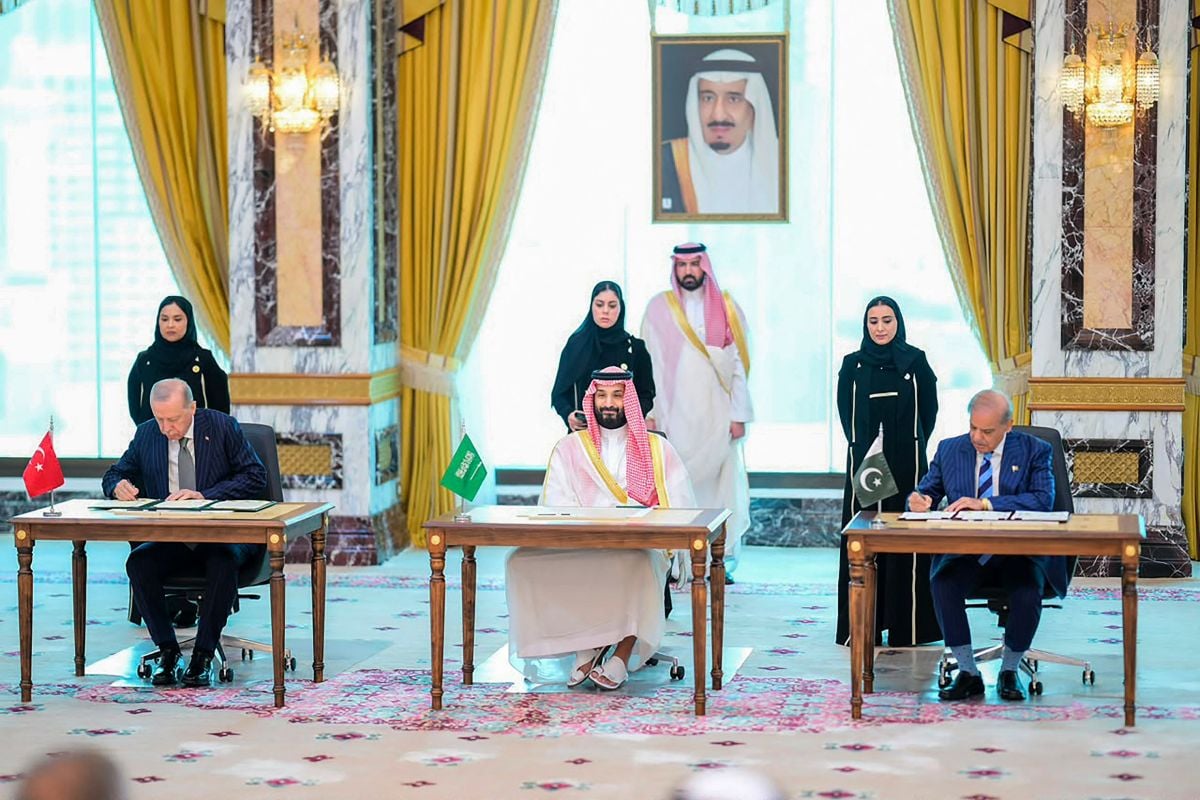
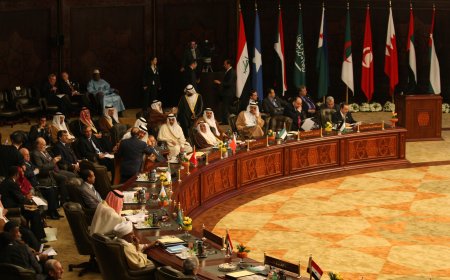
In Mecca, after signing a joint defense agreement, Mohammed bin Salman, Recep Tayyip Erdogan and Shehbaz Sharif prayed together facing the Kaaba. It was a highly symbolic image: three major Muslim powers pledging to take greater responsibility for their own security amid a rapidly shifting regional landscape.
Signed on Aug. 7, the agreement stipulates that an attack on any one of the three countries would be considered an attack against all three. Erdogan described it as "collective deterrence," while his foreign minister, Hakan Fidan, compared the principle to Article 5 of NATO, under which an attack on one member is considered an attack on the entire alliance.
Pakistan, for its part, stressed the pact’s "purely defensive" nature, while the signatories left the door open to other states joining. Is it a new Middle Eastern NATO? Not quite. But nor is it the mere "paper agreement" dismissed by Tehran.
How far does collective defense go?
The comparison with NATO is tempting: Pakistan’s nuclear capability, Turkey’s military and industrial weight, and Saudi Arabia’s financial clout. On paper, the combination is formidable. Yet, at this stage, the pact is more of a "political-security alliance" than a genuine military alliance, according to Allison Minor, director of the Project for Middle East Integration at the Atlantic Council.
The precedent set by Saudi Arabia and Pakistan is telling: despite Islamabad sending around 8,000 troops and air-defense capabilities after Iranian attacks on the kingdom this year, "it was not a level of military support that could change the equation," she notes. Nor did it amount to a genuine application of the principle that "an attack against one is an attack against all."
The central question remains: how far would each of the three countries really be prepared to go to defend the other two? "A military response sits at the far end of the spectrum, and I do not necessarily expect to see one immediately, unless there is a major event," says Yasmine Farouk, director of the Gulf and Arabian Peninsula program at the International Crisis Group.
In her view, the real test will initially be the intensification of military coordination and interoperability, particularly Turkey’s integration into an already longstanding and advanced Saudi-Pakistani cooperation framework.
Hakan Fidan himself has significantly qualified the comparison with Article 5. Asked by Anadolu Agency on Aug. 8 whether a response would be automatic, he said the agreement contained broad commitments whose implementation would depend on "discussions and decisions by the relevant bodies." The country under attack would first have to request assistance and specify its needs, with support potentially ranging "from intelligence and logistics to ammunition or, if necessary, military units."
"These three states have tended, since the start of this war, and more broadly since 2023, to favor de-escalation over immediate retaliation," Farouk notes. "I therefore do not think this clause will be activated automatically or easily in every scenario."
That is particularly true since their primary threats differ: Riyadh is primarily focused on Iran and its allies, Islamabad on India, while Ankara is seeking to contain both the risks posed by Iran and Israel’s growing regional influence.
This divergence explains why, according to Minor, responses will remain "highly context-dependent." She also notes that these arrangements do not yet have the institutional architecture needed to mount a military response comparable to NATO’s.
The pact is nevertheless beginning to build such an architecture: a political-military committee bringing together ministers and chiefs of staff, a permanent secretariat in Saudi Arabia, intelligence sharing, joint exercises, interoperability and industrial cooperation.
A new security architecture?
"I think this agreement may be most powerful as a communications tool, but also because of the diplomatic leverage that this kind of political-security alliance provides," Minor says.
The three governments have been keen not to identify the adversary they would seek to deter. "We have not identified any common threat in the text," Fidan said. Pakistan’s Foreign Minister Ishaq Dar likewise stressed the pact’s "purely defensive" nature.
This ambiguity is precisely what allows the three countries to avoid antagonizing certain regional actors.
In Tehran, the reactions were mixed. MP Ebrahim Rezaei dismissed it as a "paper agreement" that, in his view, would do little to provide Riyadh with greater security than its past reliance on Washington. Other Iranian officials, however, reacted more favorably to the principle of regional states taking responsibility for their own security.
"In a way, Iran could even see this as a positive sign of the declining role of the United States in regional security," Minor says.
This contradiction neatly captures Tehran’s dilemma. The pact could constrain its room for maneuver, but its underlying philosophy — greater regional autonomy and less reliance on American power — also echoes a position Iran has championed for years.
For Israel, the problem is almost the opposite. Israeli officials played down the immediate military threat while expressing greater concern about the political implications of a regional framework in which Israel is neither the central partner nor the organizing principle.
Unlike the logic behind the Abraham Accords, the Mecca pact begins with security cooperation among Muslim powers, without making normalization with Israel a prerequisite for regional integration.
"What has brought these states closer together is the hegemonic behavior they have witnessed over the past two years — from both Israel and Iran — more than Israel or Iran themselves," Farouk says.
Riyadh, for its part, did not sever diplomatic ties with Tehran during the war. Nor has Saudi Arabia definitively closed the door to the possibility of normalization with Israel.
Hence the caution about viewing the region as two fixed blocs: an "Abraham axis" centered on Israel and the UAE, facing an "Islamic axis" centered on Riyadh, Ankara and Islamabad.
"The regional picture is much more fluid," Farouk insists. Turkey and Egypt want to cooperate with Riyadh without defining themselves in opposition to Abu Dhabi ; Saudi Arabia and the UAE, despite their differences, are both combining dialogue with deterrence toward Iran.
"Just a few years ago, Turkey and Saudi Arabia did not have meaningful diplomatic relations," Minor recalls. "So this is a constantly evolving network of partnerships."
Perhaps that is precisely what the Mecca framework is designed to enable. "It is a group of countries that believe the outcome of these regional transformations should ensure long-term stability," Farouk says. "Any country that shares this vision, as well as the principles and norms underpinning it, is welcome."
Underlying all this is the erosion of confidence in the American security umbrella. "It was never a formal security guarantee," Minor points out, but rather a set of "implicit assumptions."
Recent wars have deepened those doubts, with several Gulf states close to Washington finding themselves exposed to Iranian missiles and drones. There is now near-consensus that the U.S. posture in the region will evolve.
"I think we will see more agreements of this kind, in which middle powers in the region and its neighborhood strengthen their cooperation while continuing to work with the United States," Minor says.
This article first appeared in L'Orient-Le Jour and was translated by Joelle Khoury.
[Source: L'Orient Today]