
/file/dailymaverick/wp-content/uploads/2023/10/CovidGrant-1.jpg)























Iraq’s Kurds are caught in the crossfire of a war they didn’t start
For Iraqi Kurds, the math has not changed in a century: they are surrounded by larger powers with warring interests.

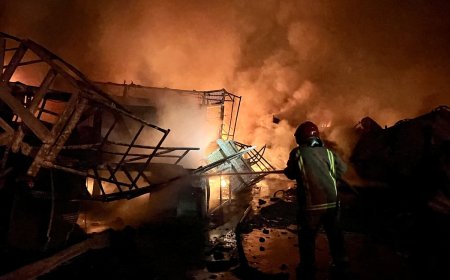
ERBIL, Iraqi Kurdistan — Six Kurdish Peshmerga fighters died and 30 were wounded Tuesday when Iranian ballistic missiles struck their base north of Erbil, the capital of Iraq’s Kurdistan Region. It appears to be the first direct Iranian attack on Peshmerga forces; Iran and its allied militias in Iraq had until then stuck to attacking U.S. installations and Iranian Kurdish opposition training camps operating within Iraqi Kurdistan. Striking the Iraqi Peshmerga directly is, by any measure, an escalation.
The Kurdistan Regional Government’s Ministry of Peshmerga Affairs said six ballistic missiles struck the headquarters of the 7th Infantry Division of Region 1 and a unit of the 5th Infantry Division of the Peshmerga forces, located in the northern Soran district.
“We strongly condemn this attack, as well as all terrorist acts against the Kurdistan Region,” the ministry said in its statement, while reiterating its right to respond to any aggression. “We call on all parties to keep war and instability away from the Kurdistan Region.” KRG President Nechirvan Barzani also condemned the strike.
But condemnation is about all the KRG can do right now. The Kurds have no air defenses, no seat at the negotiating table and no way to stop an increasingly uncontrolled war from rolling over their hard-won safe haven.
Since the U.S. and Israel launched their war against Iran on Feb. 28, Iraqi Kurdistan has suffered more than 250 drone and missile strikes, according to a senior security official in the KRG who was granted anonymity because he was not authorized to speak with the media. Most of those attacks have targeted Iranian opposition camps scattered throughout the mountainous territory. The opposition groups’ presence has been tolerated, if not quite welcomed, by the KRG.
As the conflict drags on, the attacks have expanded well beyond those camps. Counter-rocket, artillery and mortar systems light up the night sky over U.S. installations near Erbil almost every night. According to Mustafa Raad, an Erbil-based security consultant who has advised Western NGOs and companies, there have been at least four or five explosions in and around U.S. facilities near Erbil.
Now, Iran has hit the Peshmerga directly. This escalation comes as the war enters a new, uncertain phase. Earlier this week, President Donald Trump said he would suspend strikes on Iran’s energy infrastructure for five days while negotiations proceed, though Tehran denies formal talks are underway. On Thursday, Trump extended the deadline until April 6.
Meanwhile, the Strait of Hormuz remains effectively closed, and thousands of marines are headed to the Middle East to prepare for potential ground operations in Iran, should Trump order them.
The Militia Problem
Despite its deadliness, this week’s attack on the Peshmerga base in Soran is an outlier. The more immediate danger for Iraq’s Kurds comes from the Popular Mobilization Forces, an umbrella group of predominantly Shiite militias that are formally part of Iraq’s security apparatus, even though many of them are operationally aligned with Tehran.
The KRG is trying to build a professional military before the next crisis arrives. Whether that crisis is imminent remains to be seen.
In an interview with WPR, a senior KRG security official described the PMF as functionally part of the Islamic Revolutionary Guard Corps, with Iranian advisers embedded in their ranks. He said the militias manufacture weapons in Iraq’s eastern Diyala province, which borders Iran, and elsewhere.
A deputy commander of Harakat al-Nujaba, a paramilitary group under the PMF, recently appeared to partially corroborate the Kurdish official’s claim. In a social media post, he confirmed militia weapons production through what he called “a long and complex supply chain” that relies on “small workshops using fast and low-cost production lines.” The process, he added, is “like making traditional holiday sweets in Muslim homes.”
The Trump administration has repeatedly demanded that the Iraqi government in Baghdad bring the PMF to heel, threatening harsh economic penalties if Baghdad fails to disarm the militias. This has proven to be a tall order for successive Iraqi governments, and with no coalition government in power following elections last November, Baghdad is certainly in no position to do so now.
The militias were quick to jump into the fray after the Iran war began. The Islamic Resistance in Iraq, a front for several PMF militias, claimed 27 attacks on American bases in a single 24-hour period in early March. U.S. forces have responded in kind; on March 24, they struck positions belonging to Hashed al-Shaabi in western Iraq, killing seven fighters and wounding 13, according to Gulf News.
What makes this moment particularly dangerous, the senior KRG security official argued, is that the usual chain of command—from Tehran through the IRGC Quds Force to the Iraqi proxy militias—may no longer be functioning. With the U.S. and Israel claiming to have killed some 40 senior Iranian officials since Feb. 28, including much of the IRGC’s top leadership, the proxies may be operating without meaningful oversight. As an example of the confusion that reigns in Tehran, the official pointed to the disconnect between Iranian President Masoud Pezeshkian’s televised apology for strikes on neighboring states and Supreme Leader Mojtaba Khamenei’s categorical denial that Iran or its allies were behind attacks on Turkey and Oman.
The implications of such a leadership vacuum could be severe. Proxy forces with the ability to manufacture their own weapons but under diminishing command and control from Tehran represent something closer to freelance armed groups than disciplined strategic assets.
The Neutrality Trap
At the same time, Trump has publicly mulled the idea of backing Iraq-based Iranian armed opposition groups, encouraging them to invade Iran. The KRG has tried to thread this needle carefully, publicly declaring that it will remain neutral and not allow its territory to be used as a launchpad against the Islamic Republic. But Iran’s foreign minister has warned that everything becomes a target if opposition groups cross from Kurdish territory into Iran. Before he was killed on March 17, the head of Iran’s Supreme National Security Council, Ali Larijani, issued a stark warning to the Iranian Kurdish opposition groups. “Separatist groups should not think that a breeze has blown and try to take action,” he said. “We will not tolerate them in any way.”
The Kurdish position toward the Iranian opposition groups that have taken refuge in the region has been deliberately ambiguous. Kako Alyar, a senior figure in Komala, one of the Iranian Kurdish opposition parties, told me the KRG has neither encouraged them to act nor attempted to stop them. The result is a posture that satisfies no one but avoids provoking anyone.
For Iraqi Kurds, the math has not changed in a century: They are surrounded by larger powers with warring interests.
The senior KRG security official was blunt about the regional government’s defensive limitations. It is not a sovereign state, he told me, meaning it can’t procure its own advanced weapons systems. It has no capability against the drones and missiles being used against it.
In lieu of that, the KRG is quietly accelerating the process of Peshmerga unification. The Peshmerga, and indeed the entire Kurdistan region, has long been split between two rival Kurdish parties, the KDP, which is based in Erbiland conciliatory toward Turkey and the West, and the PUK, which is traditionally more leftist and friendlier to Iran. The two parties even fought a civil war in the mid-1990s, which saw between 5,000 and 8,000 civilians and Peshmerga killed.
Today, the Kurdish military fields 11 divisions under the authority of the Ministry of Peshmerga Affairs, with the goal of removing all party affiliations, the official said. A unified commander-in-chief is expected within five to six months. Yet implementation of the reforms, backed by a 2022 U.S.-KRG memorandum of understanding, has been uneven: The KDP’s Unit 80 has merged into the ministry structure, but the PUK’s Unit 70 has not yet transferred. Still, the direction is clear. The KRG is trying to build a professional military before the next crisis arrives. Whether that crisis is imminent, as a result of the Iran war, remains to be seen.
The Nightmare Scenario
Since the KRG was established in 1992, it has benefited from independent development of its oil and gas reserves. These resources funded construction of the glass towers, international hotels and malls that give Erbil the feel of a Gulf capital. Yet all of that rests on a promise of stability that is no longer guaranteed.
The senior KRG security official told me he has two concerns. The first is that if the Iranian regime falls, it probably will be a messy transition. “There might be killing,” he said. “There might be civil war. We don’t know yet.”
But his greatest fear is the Islamic State group, which remains a presence in the region, albeit in a diminished state. There are still small armed groups associated with the group’s hardcore Islamist ideology in northeastern Syria that cross the border into Iraq. If Iraq and the KRG become active fronts in the war, he said, those groups could exploit the chaos to take revenge on the Kurds who helped defeat them in the 2014-2017 war against the Islamic State.
To make matters worse, NATO Mission Iraq, the alliance’s training mission designed in part to prevent an Islamic State resurgence, is evacuating as the U.S.-led Operation Inherent Resolve winds down. In truth, the official said, it is no longer effective anyway, as it was designed for a pre-Iran War reality.
The grim arithmetic is straightforward. The forces that were supposed to hold the Islamic State in check—the U.S-Kurdish coalition, NATO, even the PMF—are now all locked in a different fight with different allies and enemies. And the Peshmerga, who bore one of the heaviest burdens of the war against the Islamic State, are absorbing missile strikes they cannot defend against.
For Iraqi Kurds, the math has not changed in a century: They are surrounded by larger powers with warring interests, and their survival depends on making themselves useful to whomever holds the upper hand. What has changed is what they stand to lose. They have built something remarkable: A semi-autonomous quasi-state with a functioning economy, international relationships and a military undergoing genuine reform. The glass towers and unified Peshmerga divisions represent a generation’s worth of investment in the idea that stability could be earned, not simply borrowed.
But it all now sits inside a conflict zone where the KRG has no leverage, no allies with staying power and no air defenses. The next phase of the war could be fought here, whether the Iraqi Kurds want it or not.
[Source: World Politics Review - Christopher Allbritton]
Christopher Allbritton has covered conflicts across the Middle East for TIME Magazine and was Thomson Reuters’ Bureau Chief in Pakistan. His work has appeared in a range of publications including New York Magazine, The Wall Street Journal, The Daily Beast and The Straits Times of Singapore. In 2002, he founded the award-winning blog Back-to-Iraq.com, becoming the world’s first fully reader-funded conflict journalist.