
/file/dailymaverick/wp-content/uploads/2023/10/CovidGrant-1.jpg)

























Iran war leaves Asia with a defence problem
Redeployment of US assets prompts fears in Indo-Pacific region of exposure to North Korean and Chinese aggression

The first four days of the US and Israel’s war in Iran were the most intensive opening air campaign in history.
More than 5,000 munitions were deployed by the US within 96 hours, at a cost of billions of dollars. By the 16th day, this number had more than doubled to 11,000, according to the Payne Institute of Public Policy in Colorado.
Stretched thin in the Middle East, the US was quickly forced to look to its assets in the Indo-Pacific, which had been deployed to deter and protect against China and North Korea, both of which have drastically expanded their military capabilities in recent years.
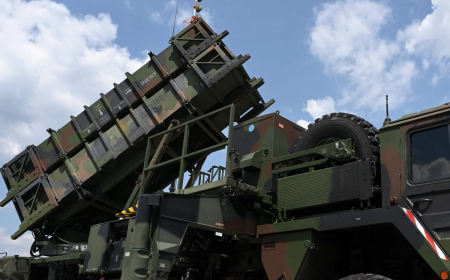
Missiles and interceptors from the THAAD anti-ballistic missile system in South Korea were shipped to the Middle East, and 2,500 marines from a quick-response expeditionary unit were redeployed from Japan.
The USS Abraham Lincoln, a nuclear-powered carrier strike group, had already been moved from the South China Sea to the Arabian Sea before the war broke out.
Until then, American partners in Asia had been watching the war unfold from a distance, concerned with hits to the energy market and evacuating stranded nationals on chartered flights, with little fear of domestic security consequences.
But the redeployment of assets prompted fears of a long-term impact closer to home, with weapon systems and troops no longer in position to defend against North Korea and China if a war broke out.
And the longer the war drags on, the more Beijing and Pyongyang stand to benefit, analysts told The Telegraph.
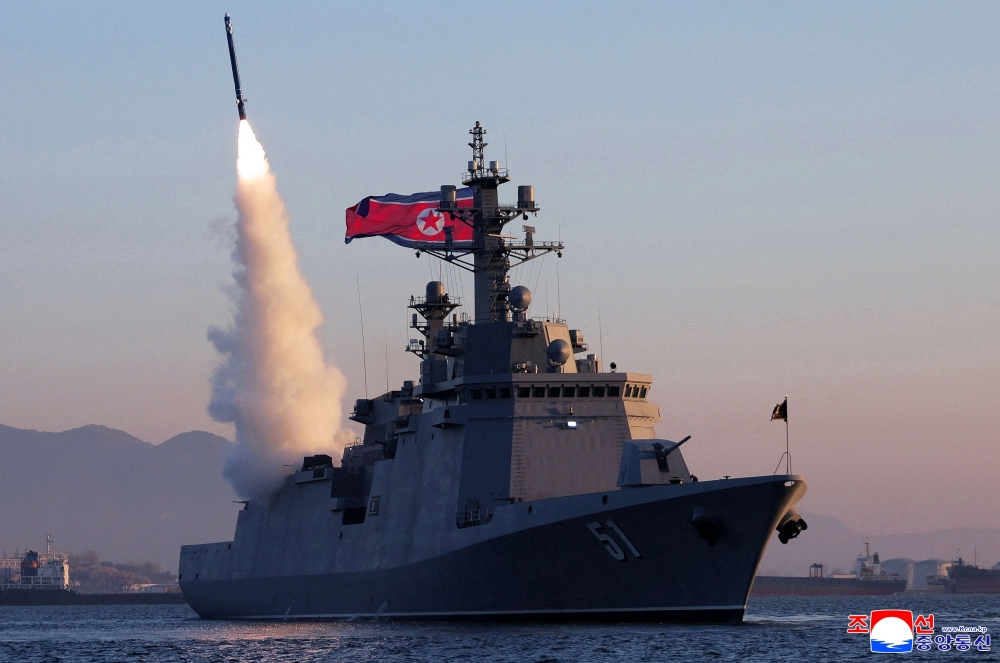
North Korea has used the war to justify its expanding nuclear arsenal, while China – despite publicly pushing for an end to the war – is already strengthening its hand.
“From the Chinese perspective, the longer the US is involved in the region plays into its benefit because it really depletes US stockpiles in terms of missiles and ammunition,” William Yang, a senior analyst for Northeast Asia at the Crisis Group, told The Telegraph.
“That is not only going to affect the US’s own combat capabilities, it’s likely to also create disruption to US supply to allies, especially Taiwan, where there is already a serious backlog even before the start of the Iranian war due to the priority that Ukrainians get given the ongoing war with Russia,” Mr Yang said.
Not only could the war stand to embolden its adversaries, but it could also cause irrevocable damage to allies under the US security umbrella who are losing faith in their main defence partner.
Among the munitions the US has deployed against Iran, the depletion of two long-range cruise missiles, Joint Air-to-Surface Standoff Missiles (JASSMs) and ship-launched Tomahawk missiles, has been of particular concern to Asian allies and partners, especially in Taiwan, which has faced increasing military pressure from China.
Earlier this week, a Taiwanese defence official told the Financial Times that there was concern that “US forces are using up a lot of munitions, which one assumes they would need so that an assault on Taiwan could be blunted”.
The US fired 786 JASSMs and 319 Tomahawks in the first six days of the conflict, according to the Centre for Strategic and International Studies (CSIS).
Taiwan contingency
Defence experts suspect that Tomahawks and JASSMs would be critical in sapping Chinese missile capabilities in the event of a war over Taiwan.
“These are two types of missiles that have been identified as potentially being effective in a potential Taiwan contingency where the US could use to actually come to support Taiwan,” said Mr Yang.
The number of Tomahawks used by the US in Iran represents approximately 10 per cent of its stockpile.
However, RTX Corporation, the firm that manufactures them, builds fewer than 500 per year, and only 57 will be going to the Pentagon this fiscal year.
At this rate, replacing the depleted stock would take more than five years.
The US has a much larger stockpile of JASSMs – estimates put the number between 3,500 and 6,500 – but Lockheed Martin, which produces the missiles, is at least three years behind schedule.
In Taiwan, which imports most of its arms from the US, there is concern that the depletion of missiles in Iran will add further delays to its weapon orders, which are already several years behind schedule, as well as increased apathy from the US generally.
“For Taiwan, the concern is about whether the Taiwan issue will be relegated to the back-burner as US foreign policy and bureaucracy gets overstretched by so many other urgent issues,” said Wen-Ti Sung, a non-resident fellow with the Atlantic Council’s Global China Hub.
Replenishing the US’s weapons stock will also hinge on rare-earth minerals, such as neodymium and samarium, which are key components in the magnets that steer missile guidance systems and interceptors.
However, China controls 90 per cent of the global rare-earth supply chain and has routinely leveraged this monopoly.
“Export controls on rare earth magnets is a subtle bargaining chip in the backchannels, reminding the US that its military endurance against Iranian missile onslaught is constrained by Chinese export controls,” wrote Umair Ghori, a rare-earth specialist, for the Australian Strategic Policy Institute.
For the US, which relied on China for 70 per cent of its rare earth imports between 2020 and 2023, this could prove to be yet another challenge in rebuilding its military might.
Diminishing trust
The war in Iran may also have put a strain on existing security alliances between the US and countries in the Indo-Pacific.
In South Korea, the redeployment of THAAD missiles and interceptors raised alarm bells, given its role as a key deterrent to North Korea.
THAAD interceptors are one of the US’s thinnest-stocked assets. The military fired more than 150 during the 12-day war against Iran in June 2025 and another 150 in the most recent war out of an estimated 534, according to CSIS.
Even more, there have been no new deliveries of THAAD interceptors since August 2023, and none are expected until April 2027.
Unlike other defensive systems that have been redeployed out of South Korea in the past, such as the surface-to-air Patriot system, THAAD has no domestic alternatives.
Lee Jae Myung, the South Korean president, had initially said that he was “expressing opposition to [US Forces Korea] taking some of its assets out due to the needs of other military operations”. However, he later clarified that it “won’t hinder deterrence against North Korea”.
Donald Trump also put South Korea and Japan, two key US allies, in the hot seat when he asked both countries to join his “Hormuz Coalition” and deploy warships to the Strait of Hormuz.
Tokyo, which is constitutionally barred from engaging in any offensive warfare, refused to help while Seoul said it would discuss the proposal and never issued a formal response.
Mr Yang, from Crisis Group, said that the US’s “insistence” that allies deploy assets to the Gulf “could damage the allies’ trust in their defence alliance with the United States”.
“This is more about doubt growing in these countries’ minds about whether they can still trust the durability and sustainability of their defence partnership with the US,” he added.
The alliances between the US and Japan have also been tested by the growing energy crisis created by the war.
Both countries, along with most of Asia, rely heavily on imports for energy supply. South Korea imports 70 per cent of its crude oil from the Middle East, along with 20 per cent of its LNG, while Japan receives a staggering 90 per cent of its supply from the region.
On Wednesday, South Korea entered “emergency mode”, as Kim Min-seok, the prime minister, warned that the government had to prepare for “worst-case scenarios”.
Although Sanae Takaichi, the Japanese prime minister, was all smiles when she met Mr Trump last week, at home, her government is reviewing its entire supply chain of petroleum products to prepare for an emergency.
So far, the Trump administration has done little to alleviate the strain on Asian countries, including its close allies.
One Asian diplomat in the US previously told Politico that no measures had been taken by the White House to ease the pressure. Another said that they “are not receiving any communication from the Trump administration” regarding the impending crisis.
Nothing is inevitable
The US’s weakened posture and alliances do not necessarily mean that China will launch an imminent invasion, especially as Xi Jinping continues to wipe out his top advisers responsible for planning a Taiwan contingency.
“China’s military purges mean that China is in no position to mount any major military invasion or operation against Taiwan any time soon,” said Mr Sung.
US intelligence confirmed last week that Beijing was not planning to invade Taiwan in 2027, but would instead attempt to take control of the island without the use of force.
The US military is also gaining considerable combat experience in Iran, which could make it a more forceful opponent against the People’s Liberation Army, which has never been tested on the battlefield.
But the longer the US remains involved in the war in Iran, the more concerns its allies and partners in Asia might have.
“Asia is certainly more vulnerable now than before the Iran war started,” said Mr Yang.
He added: “The US’s original plan of quickly extracting itself out of this conflict is not working… so Washington has had to remain militarily present in the Middle East for a much longer period of time, which is going to add stress to the US’s ability to maintain the same level of posture in the Indo-Pacific region.”
[Source: Daily Telegraph]

/file/attachments/orphans/WhatsApp-Image-2026-04-27-at-1148_142492.jpg)