








/file/dailymaverick/wp-content/uploads/2025/04/Krill_school_1_credit-Aker-Qrill.jpg)




























British eccentricity is dying out when we need it more than ever
In an age of algorithms, branding and bland conformity, what happened to the gloriously unique characters our nation once celebrated?

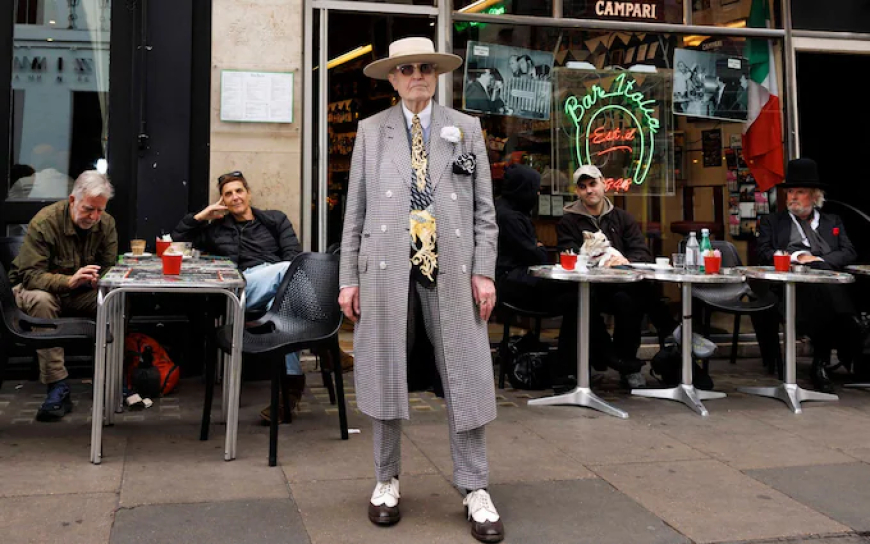
Heads turn as the man known simply as “Soho George” approaches an Italian café in Frith Street, in London’s West End. He is dressed in a houndstooth suit with a custom-tailored calf-length jacket, a pale bolero hat, bowling shoes, dark glasses, chunky gold and silver rings and multiple diamanté brooches.
Some days, George Skeggs, 83, dons a natty double-breasted pinstripe number or an ultramarine suit with a bow-tie. But each day, his routine is the same: he rises at 10am and is outside one of a handful of his favourite Soho spots for a cappuccino by midday.
He then takes a four-mile walk around the West End, frequently interrupted by tourists asking for photographs, with a brief stop for a fried egg sandwich. He has been doing this for the best part of 60 years, full-time since he retired nearly 20 years ago – having worked at the British Museumand in Fleet Street – and has been dressing the same way since he was a teenager.
Soho George in a houndstooth suit with a custom-tailored calf-length jacket, a pale bolero hat, bowling shoes, dark glasses, chunky gold and silver rings and multiple diamanté brooches Credit: Belinda Jiao
“People always say to me, ‘Why do you dress the way you dress, George?’ And I say, ‘I just dress like me,’” he says. “But I don’t stand out deliberately. [And] this part of London has always been full of characters.”
Skeggs has often been described as an eccentric, he says, although he prefers the term “individualist”. He is in good company in Soho, which has always attracted eccentrics, oddballs and creatives. But Soho George is among the last of his kind.
In the past 30-odd years, Soho has lost many of its great eccentrics. Graham Mason, a journalist described in his Telegraph obituary as the “drunkest man in the Coach and Horses [the pub in the heart of Soho]” died in 2002, aged 59. He had competition for that title from Jeffrey Bernard, a legendary drinker who wrote The Spectator’s weekly Low Life column and died in 1997, at 65 (“I didn’t like him,” says Skeggs. “He used to sit in the corner of the pub snarling at people.”) Then there was Eileen Fox, the self-styled “Queen of Soho” – a bohemian and mostly unsuccessful actress who, as a true patriot, often took all her clothes off to Rule Britannia in public. She also died in 2002, aged 79.
Beyond Soho, and in more recent years, we’ve lost the Rev David Johnson, a Church of England priest who had a pet goat and once collaborated with another clergyman to send spoof letters to church dignitaries, ranging from requests for details of the recipient’s toupee makers, to an enquiry about the possibility of installing a monument to the Cumberland sausage in Carlisle Cathedral. He died in 2020, along with Alexander Thynn, the roguish 7th Marquess of Bath, who covered the walls of Longleat with erotic murals and kept a harem of mistresses – whom he called “wifelets” – on the estate.
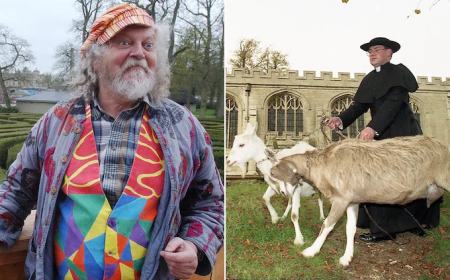
Alexander Thynn (left) and Rev David Johnson were both eccentric but in very different ways Credit: Barry Batchelor/PA Wire | Eric Roberts
The cricket umpire Dickie Bird, who died last year aged 92, gained an early reputation as an eccentric as a player in the 1960s, when he chased a ball, slipped at the boundary edge, and ended up with his head stuck between the pavilion railings (he was only freed with the help of a joiner).
These characters have not been – nor could they be – replaced. In fact, with them, the Great British eccentric is at risk of dying out entirely.
The fading of eccentricity in British life is keenly felt by many Telegraph readers, who increasingly raise the issue in comments online and letters to the editor. Where it does appear, it’s celebrated, such as in a recent article on an aristocrat driving across Saudi Arabia in a 120-year-old car. Reader comments included “The world needs more eccentrics like this” and “Eccentricity at its finest”.
“There aren’t many true eccentrics left,” says Nicky Haslam, the interior designer and social arbiter. Things have changed, he points out; an outlandish dress sense or an unconventional expression of gender – both of which could have marked someone out as an eccentric in years gone by – are par for the course in 2026. “In the old days, one would have thought Grayson Perry was eccentric, and now he’s an establishment figure and a knight,” he says. “Even Tracey Emin seemed eccentric. Now she’s a dame.”
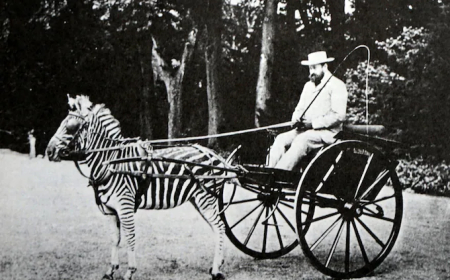
Lionel Walter Rothschild in a carriage drawn by a zebra in 1895 Credit: Universal History Archive/Getty
They used to be curiously overrepresented in Parliament, but eccentrics have all but disappeared from the political sphere, replaced by a steady stream of grey-suited middle management types. Even Sir Jacob Rees-Mogg – perhaps the most “eccentric” MP the last decade has to offer – isn’t a patch on Lionel Walter Rothschild, the 20th-century MP for Aylesbury, a passionate zoologist who once rode a carriage drawn by zebras to Buckingham Palace. Nor George Sitwell, the former MP for Scarborough, who wrote a number of (unpublished) books on esoteric topics including pig-keeping in the 13th century and the history of the fork.
The only constant in politics is the Monster Raving Loony Party, founded by the rock’n’roll performer Screaming Lord Sutch in 1982 (Sutch, who changed his name by deed poll, unsuccessfully ran to become an MP 39 times). He died in 1999, and his friend and mentor Lord Toby Jug died in 2019. But the party still solemnly fields a candidate at every election.
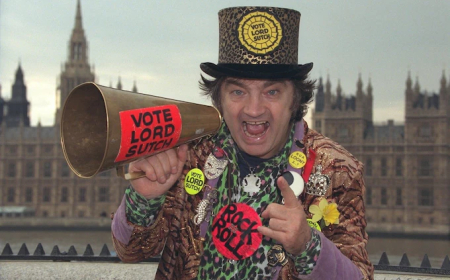
Screaming Lord Sutch founded the Monster Raving Loony Party and served as its leader from 1983 to 1999 Credit: Richard Watt
Many examples of eccentric behaviour from the past – such as when William Cavendish-Scott-Bentinck, the 5th Duke of Portland (1796-1824), became so antisocial he took to living entirely underground, building a network of bunkers and tunnels under his Nottinghamshire stately home – would likely be regarded nowadays as symptoms of mental illness. The line between eccentricity and madness has always been rather thin, but in the culture of modern psychiatry, one could argue it has disappeared entirely.
Others have pointed to globalisation and the Americanisation of our culture as reasons for eccentricity’s demise. “Britain has become oddly uncomfortable with unlabelled strangeness,” writes Jack Burke in an article titled Who killed the English eccentric? He says: “In theory, we live in an age of radical individualism… In practice, we are far more tolerant of difference that comes with a narrative attached. You can be different, provided you explain yourself… What you cannot easily be is odd without commentary, absorbed in something that makes little sense to anyone else.”
It is very difficult to define eccentricity, but someone who is “odd without commentary” is a rather good start. Singularity is one element of it, as his exhibiting behaviour that is unconventional, erratic, or deviates from the social norm. The Telegraph’s obituaries editor Andrew Brown, who compiled Eccentric Lives: The Daily Telegraph Book of 21st Century Obituaries, says eccentrics must possess “a kind of vitality”. An eccentric hobby – collecting 19th-century bayonets, racing pigeons, repairing vintage radios or becoming an authority on crop circles – is a nice addition.
Wealth is usually another essential ingredient. In order to afford an obsessive, outlandish hobby or unusual lifestyle, it helps to have money.
Everything that Edith Sitwell – who was gently eccentric herself – wrote in 1933 in English Eccentrics still rings true. “Eccentricity exists particularly in the English,” she said. “[It] is not, as dull people would have us believe, a form of madness. It is often a kind of innocent pride, and the man of genius and the aristocrat are frequently regarded as eccentrics because [they] are entirely unafraid of and uninfluenced by the opinions and vagaries of the crowd.”
This is the reason why the British aristocracy has typically supplied many of our best-known eccentrics. Francis Henry Egerton, the 8th Earl of Bridgewater (1756-1829), ate at his dining table with his dogs, who would be dressed for dinner in human clothes. Lord Rokeby (1798-1883) was obsessed with swimming – not a common pastime in those days – to the extent that he had a vast water tank installed at his home, in which he spent much of his life floating. The wayward rake John “Mad Jack” Mytton (1796-1834) would race his horse through hotels, perform stunts in his horse and carriage, ride naked in the snow, and once rode a bear through his house in the middle of a dinner party.
Eccentricity is so important to British identity, in fact, that throughout recent history, people have often worried about its loss. “If you look back to the 19th century, they’re complaining and saying, ‘where are the originals? Where are the truly authentic characters?’” says James Gregory, a historian at Plymouth University who has written a research paper on the topic. “They’re always bewailing it. In the 19th century, they’re saying [eccentricity] ended because of the railways – that the particular character of local areas is harmed by the railways connecting them. It’s a similar argument to globalisation today.”
Yet all signs point to eccentricism being well and truly on the way out. The waning power of the aristocracy is one reason contemporary culture has proved such infertile ground for eccentrics. Though she couldn’t possibly have predicted it, Edith Sitwell touches on yet another: social media and how, despite its emphasis on individualism at all costs, it has ushered in a new era of blanket conformity. In an age of internet narcissism, it is increasingly rare for someone to be “entirely unafraid of and uninfluenced by the opinions and vagaries of the crowd”.
“In the marketplace of the internet, you have to stand out, you have to make bold claims,” says Gregory. However, for most, that is a “virtual performance” rather than a sign of true eccentricity.
Yet there are some budding modern eccentrics who break the aristocratic mould. Take the social media personality and obsessive trainspotter Francis Bourgeois, 25, who has racked up more than three million followers on TikTok, or Aaron Arter, the 26-year-old Elvis fanatic who performs multiple times a week in his local neighbourhood of Nunhead, south London, and has become known as “the King of SE15”.
Some classically eccentric hobbies remain alive and well: just ask Roger Davies, who owns a business that designs and sells penny farthings. “Sales have been very consistent since I started selling them in 2012, actually,” Davies says. “I would say our country has always had eccentrics – if we’re going to call them that – and it always will.” The London-based Penny Farthing Club has 120 regular riders.
However, back in Soho, Skeggs bemoans the fact that, nowadays, everybody looks the same. “Trainers, baseball caps, shorts, tattoos… wouldn’t be seen dead in them. I wore jeans as a teenager, but not as a grown man of 60 or 70-something,” he says. “People are scared to stand out. But I’ve got my own mind. I don’t care what people think.”
[Source: Daily Telegraph]