




/file/dailymaverick/wp-content/uploads/2023/10/CovidGrant-1.jpg)































Sex, slaves... and scholars. Welcome to the real Babylon
As a byword for depravity, the ancient city has fascinated everyone from Hollywood stars to dictators. A brilliant new history digs it up

Babylon has long been a byword for orgiastic decadence. The ancient city has been used to describe the extravagance of Second Empire Paris, the perversions of Berlin during the Weimar Republic, and Hollywood’s scandalous excesses; it gave the title to a recent blockbuster movie starring Margot Robbie, and has been invoked in songs by Bob Marley and Lady Gaga.
The associations are old: scripture gave us lurid tales of the Tower of Babel, in the Bible’s first book, and the Whore of Babylon, in the last. Not all the connotations are bad: Babylon’s Hanging Gardens became known to posterity as one of the Seven Wonders of the Ancient World. Alas, they probably never existed.
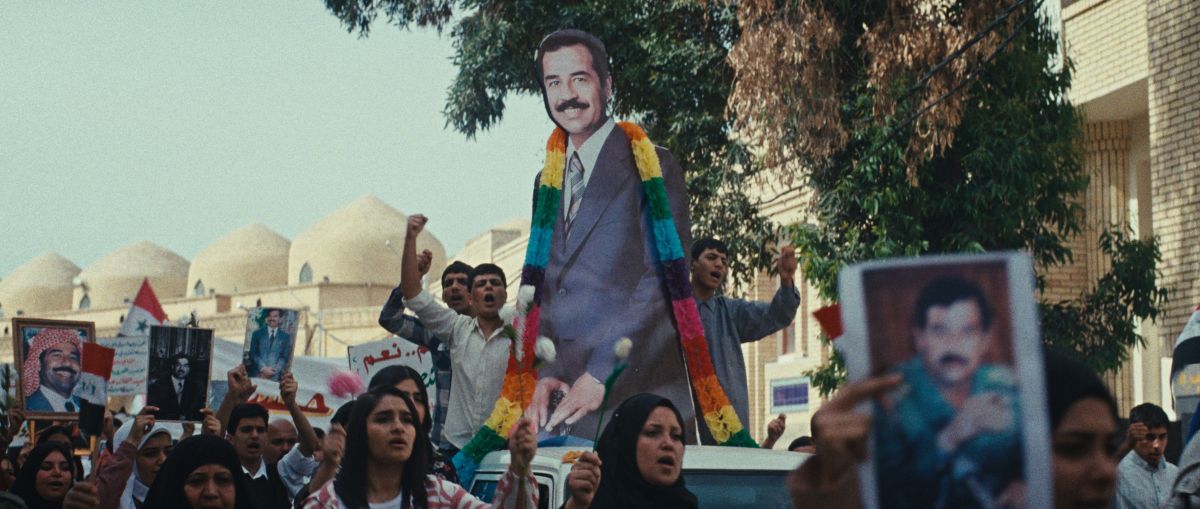
Other great societies of antiquity have, in their monumental ruins, survived: think of the Forum in Rome, the Acropolis in Athens, the temples of Luxor. What remains of Babylon, however, out on the plains of southern Iraq, is a dreary vista of mudbrick walls and in-authentically kitsch reconstructions commissioned by Saddam Hussein, who fancied himself the heir to Nebuchadnezzar. Today we can only imagine its sky-scraping ziggurat, and the walls of gold and lapis lazuli that ravished all who witnessed them.
Fortunately, we have Lloyd Llewellyn-Jones to give flesh and reality to the picture. Drawing largely on an astonishing legacy of cuneiform script inscribed on tens of thousands of rediscovered clay tablets, Llewellyn-Jones makes, in his new book Babylon, an impassioned defence of what he calls “a brilliant civilisation whose inhabitants reckoned themselves to be the most blessed people in the world”.
Babylon’s location in the middle of the Fertile Crescent, close to the confluence of the Tigris and Euphrates rivers, was key to its prosperity. Virtually nothing is known about its origins, but it seems to have been settled by nomadic Amorites at the beginning of the second millennium BC. Mastery of canals, donkeys and chariots helped to give its traders and army an edge over rival powers in the region, with war against someone or other the norm.
The Babylonian monarchy was absolute, with its king given quasi-divine status, but no right to appoint his successor – the absence of any firm hereditary principle would inevitably lead to ructions. Slavery was the major form of labour, but the enslaved did have some legal protections, and (as Llewellyn-Jones writes) “the transition from freedom to slavery and from slavery to freedom was remarkably fluid”.
The historical record becomes clearer during the reign of Hammurabi (from 1792 to 1750 BC), who’s honoured with some justification as “the world’s first lawgiver” for a code of best practice that stipulates even building and medical standards. Other documented evidence of Hammurabi’s regime allows a lot of the city’s daily life to be inferred. Here one begins to understand Babylon’s subsequent reputation for debauchery.
Llewellyn-Jones guides the reader through labyrinthine streets, frenzied shopping for gewgaws, taverns that functioned as love hotels, Rabelaisian eating and drinking, raucous popular songs – hits apparently included “Your love is an Obsidian blade” – and what he describes as “a remarkably enlightened attitude to most aspects of sex and sexual identity”. That said, Babylonian life wasn’t all partying: a sophisticated educational system produced exceptional mathematicians and astronomers. It was here that humans first divided days into hours and hours into minutes.
These good times couldn’t last. Following Hammurabi’s death, his incompetent son took over amid drought, famine and rebellion among satellite towns. Marauding Hittites made depredations. Babylon’s glory faded. Around 1500 BC, as the Kassite tribe rose to dominance, the city enjoyed a period of revival, sealing deals with nascent Egypt and Assyria through the diplomacy of intermarriage.
But another downturn ensued at the turn of the first millennium, leaving the Assyrians in the ascendant. Their king, Sennacherib, sacked the city again, before the Assyrians got their comeuppance when the Babylonians allied with the Medes and fought back, destroying the Assyrian capital Nineveh.
Finally, the sixth century BC brought the reign of Nebuchadnezzar II, during which Babylon emerged in several books of the Old Testament (chiefly Daniel). This was another of the city’s heydays, a peak of its architectural magnificence and the cult of its chief deity Marduk. As part of a campaign of imperialistic aggression, Nebuchadnezzar ransacked Jerusalem, and made Judah a vassal state, forcing about a quarter of its population into a 70-year exile: the Babylonian Captivity.
The Bible presents this as a pure catastrophe that has traumatised Judaism ever since, but Llewellyn-Jones notes that, according to the cuneiform evidence, many Jews saw no problem with the new rulers and a significant number “became wealthy and exercised powerful positions in the government”. It wasn’t imprisonment so much as “an enforced brain drain”.
According to the Book of Daniel, the writing that Nebuchadnezzar’s putative grandson Belshazzar saw on his palace wall – “mene, mene, tekel, upharsin”: measures of weight – suggested that God was busy calculating Babylon’s downfall. That event did indeed come, when shortly afterwards the Persian king Cyrus invaded, liberating the Jews – who anointed him as a Messiah in gratitude – and rebuilding their ruined temple in Jerusalem. (Despite these benign gestures, Llewellyn-Jones warns against casting Cyrus as a “liberal, tolerant peacemaker”. He was merely a pragmatist, bolstered by clever propaganda.)
Subsequent Persian kings weren’t focused on Babylon: Xerxes found it troublesome. And in the third century BC, Alexander the Great, king of Macedon, had little trouble drawing it “into the orbit of the Greek-speaking world”. The centre of regional power – economic, military and cultural – moved west into the Mediterranean; the city was left strategically irrelevant, and quickly decayed. Passing through Babylon out of curiosity in the first century AD, the Roman emperor Trajan found nothing but “mounds and stones and ruins”.
More crucially, the ability to read cuneiform died out, and it is only over the last 150 years that its decoding has allowed scholars such as Llewellyn-Jones to move beyond vague and fragmentary myth, to reconstruct the record of a mighty civilisation and its society. The result, in this case, is a book that’s rich with meticulous scholarship, illuminated by sharp wit, and full of subtle judgment. Babylon is quite simply enthralling.
[Source: Daily Telegraph]