
















Iran has trapped Donald Trump
The president must choose between resuming airstrikes or accepting peace terms that defer the nuclear issue indefinitely

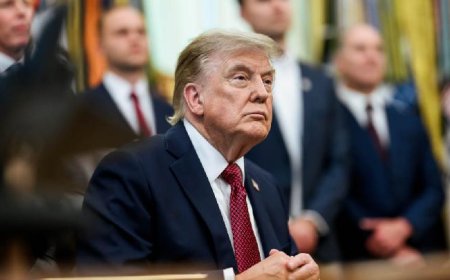
On Thursday, April 30, Admiral Brad Cooper, the top US commander in the Middle East, briefed President Trump on potential military options against Iran should he decide to return to conflict. What some observers are now labelling the Third Gulf War has been on pause since April 7, when Trump agreed to suspend the US bombing campaign for two weeks in order to provide space for a diplomatic process. Sensing that arriving at a comprehensive end-of-war settlement with Tehran would take far longer, the president has since extended the ceasefire indefinitely.
While the shooting has stopped, the war can hardly be declared over. Washington and Tehran are now in a new stage of conflict, with both sides staring one another down in the Strait of Hormuz and waiting for the other to blink.
The Trump administration has put its faith in the US blockade of Iranian ports, which seeks to prevent Tehran from exporting crude oil to world markets and, the theory goes, will force the regime to shut down production once their storage tanks are full. The goal: deprive the Iranians of cash and cause so much pain to the regime’s bottom line that a nuclear deal on Washington’s terms becomes a more realistic prospect. In public, Trump is gung-ho about the strategy. “Well, the blockade is genius, OK,” Trump told reporters this week. “The blockade has been 100 per cent foolproof.”
Iran, however, is just as confident in its own strategy. Although the Iranians are grossly outgunned in terms of conventional military capacity, the regime has demonstrated that it doesn’t need to match the United States gun-for-gun or ship-for-ship to have an impact against the enemy. Iran’s ability to bottle up shipping in the Strait of Hormuz – according to shipping tracker Kpler, oil flows through the choke point declined by 95 per cent in April – and inject economic pain worldwide is a card it has deployed to the fullest extent.
Just as Trump is aiming for Iran’s economic collapse, Iran is aiming for the financial pressure to get so politically toxic in Washington that the president will have to reassess his position and sign a deal to Tehran’s liking.
Militarily, the United States has a lot to brag about. Thousands of Iranian military targets have been destroyed. Iran’s large naval vessels are history. Iran’s antiquated air force has been grounded. Waves of senior Iranian political and military officials, including Supreme Leader Ayatollah Ali Khamenei, have been killed. More than 40 Iranian-linked ships have been turned around by the US blockade. And Iran’s economy is feeling the heat as inflation rises, the Iranian rial depreciates and unemployment begins to hit the population.
But these metrics are less impressive when one considers Carl von Clausewitz’s old adage that war is a continuation of politics by other means. The US military and economic pressure against Iran are means to an end, not an end itself. If US airstrikes and the blockade are not producing a positive change in Tehran’s negotiating position or altering the regime’s strategic calculus, then they can’t be labelled a success. Instead of the frightened, more cooperative Iran the Trump administration is looking for, it’s facing a regime that is as unflappable as ever.
He won’t admit it publicly, but Trump is stuck. He has options, but none of them are ideal and all of them carry risks. In essence, he’s caught between relaunching a military campaign he would prefer to avoid and adopting terms of peace with Iran he evidently considers unacceptable, which include deferring the Iranian nuclear issue to some undefined date in the future and tolerating a new status quo in the Strait of Hormuz.
The ongoing US blockade, and Trump’s declaration that he will continue enforcing it until the Iranians come to their senses, is a middle-ground option meant to buy more time for economic coercion to work. But given the history of how Iran operates, the chances that it will force the regime to bow to America’s wishes are surely slim. The longer the US blockade is in effect, the longer Iran will stick with its own blockade, and the less likely Ayatollah Mojtaba Khamenei and the Islamic Revolutionary Guard Corps generals he surrounds himself with will return to the table with serious, workable proposals.
If Trump does decide to return to war, he better understand what’s likely to ensue. Iran, which since the ceasefire has suspended its own missile and drone strikes against Persian Gulf countries, will resume those attacks, forcing Washington’s regional partners to expend air defence interceptors that are already running in short supply. Infrastructure and energy sites in Saudi Arabia, Qatar, Kuwait and the United Arab Emirates will again be targeted, potentially leading to even more long-term damage to the region’s economies and fuel costs ballooning even higher than they are today.
This doesn’t account for the additional casualties that will result, particularly if Trump goes one giant step further by deploying US troops on Iranian soil to either clear the Strait of Hormuz militarily or capture Kharg Island, through which approximately 90 per cent of Tehran’s crude is exported.
This is not a conventional war with clear winners and losers. There will be no surrender ceremony on a battleship like on September 2, 1945, when Imperial Japan waved the white flag. Trump is as likely to admit a mistake as Iran is to “cry uncle”, and both are still unwilling to meet each other halfway.
Unless Trump is open to pulling the plug on the operation entirely and selling it as a success, a mutually acceptable settlement with Tehran is the only way this war officially terminates. We may have to wait another few weeks, if not months, before that realisation kicks in.
[Source: Daily Telegraph]